

Cyprus
Situation as of June 2025 (2024 ESM Annual Report)
Highlights








Programme overview
Programme Timeline
2012
2013
ESM disburses first loan tranche
Cyprus returns to bond market
Economic growth returns (1.4%)
Capital controls imposed in April 2013 are fully lifted
Conclusion of ESM programme
2014
2015
2016
ESM/EFSF programme outcomes
Economic adjustment and reforms
In the late 2010s, Cyprus witnessed a rapid growth of the financial sector and expansion of bank lending. At the same time, serious macro-economic imbalances built up. They extended to public finances with current account deficits and to trade with dropping exports due to Cyprus’ falling competitiveness. The banking sector was increasingly cut off from international market funding and Cyprus’ largest banks recorded substantial capital shortfalls. The global and the euro area crises exposed these growing financial vulnerabilities coupled with structural weaknesses in the rest of the economy. The Cypriot economy’s strong links to Greece amplified the situation. The excessive budget deficit limited Cyprus’s ability to support banks on the verge of collapse. Cyprus requested financial assistance from the EFSF/ESM and IMF in June 2012.
The financial assistance package was tied to an economic adjustment programme, which included:
- Restoring the soundness of the Cypriot banking sector by restructuring and downsizing financial institutions;
- Fiscal consolidation to correct the excessive general government deficit, in particular through measures to reduce current primary expenditure and to increase the efficiency of public spending; and,
- Structural reforms to support competitiveness and sustainable growth.
Thanks to the implementation of reforms, Cyprus resumed economic growth and regained access to international financial markets. The country reduced its public deficit, and the oversized financial sector was significantly downsized and restructured. Capital controls and the economic adjustment programme helped stabilise deposits and the liquidity of the banking system. Confidence in the financial system was also strengthened thanks to improved financial regulation and supervision, while banks achieved sizeable reductions in the very high levels of non-performing loans that followed from the crisis. Cyprus’s economic recovery continued to progress until 2020, when the pandemic crisis triggered a severe downturn to economies all around the world. Earlier reforms and fiscal consolidation helped improve the resilience of the Cypriot economy in the face of the Covid-19 pandemic.
After the programme
Following the completion of Cyprus’s programme in 2016, post-programme surveillance (PPS) has been carried out by the European Commission in liaison with the European Central Bank. The procedure involves regular review missions in the programme country to assess its economic, fiscal and financial situation. The ESM participates in PPS missions to fulfil the requirements of its Early Warning System, i.e. to assess a country’s capacity to repay its outstanding loans.
Cyprus fully repaid its IMF loan in February 2020.
ESM country team coordinator for Cyprus: Wim Van Aken
Disbursements of ESM financial assistance to Cyprus
| Date of disbursement | Amount disbursed | Type of disbursement | Final maturity | Cumulative amount disbursed |
|---|---|---|---|---|
| 13/05/2013 | €1 billion | Cash | 13/05/2026 | €2 billion |
| 13/05/2013 | €1 billion | Cash | 13/05/2027 | €2 billion |
| 26/06/2013 | €1 billion | Cash | 26/06/2028 | €3 billion |
| 27/09/2013 | €750 million | Cashless | 27/09/2029 | €4.5 billion |
| 27/09/2013 | €750 million | Cashless | 27/09/2030 | €4.5 billion |
| 19/12/2013 | €100 million | Cash | 19/12/2029 | €4.6 billion |
| 04/04/2014 | €150 million | Cash | 04/04/2030 | €4.75 billion |
| 09/07/2014 | €600 million | Cash | 09/07/2031 | €5.35 billion |
| 15/12/2014 | €350 million | Cash | 15/12/2025 | €5.7 billion |
| 15/07/2015 | €100 million | Cash | 15/07/2031 | €5.8 billion |
| 08/10/2015 | €200 million | Cash | 08/10/2029 | €6.3 billion |
| 08/10/2015 | €300 million | Cash | 08/10/2031 | €6.3 billion |
Weighted average maturity of loans: 14.9 years
Details of the ESM floating rate notes provided to Cyprus*
| ISIN | Issuance date | Maturity | Type | Amount |
|---|---|---|---|---|
| EU000A1U98Y4 | 27/09/2013 | 27/03/2015 | 18-month FRN | €1.5 billion |
*Notes provided by the ESM are redeemed at maturity and rolled over into cash loans
Explainer
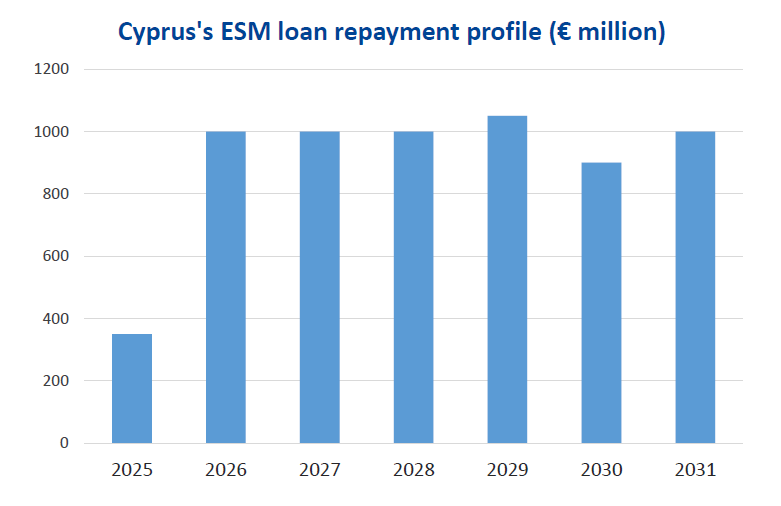
Cyprus will repay the principal on ESM loans from 2025 to 2031.
The key conditions of the programme were:
- to restore the soundness of the Cypriot banking sector and rebuild depositors' and market confidence by thoroughly restructuring and downsizing financial institutions;
- to continue the process of fiscal consolidation to correct the excessive general government deficit, in particular through measures to reduce current primary expenditure and to increase the efficiency of public spending; and
- to implement structural reforms to support competitiveness and sustainable and balanced growth, allowing for the unwinding of macroeconomic imbalances.
The total amount of financial assistance agreed in 2013, in support of Cyprus’s macroeconomic adjustment programme, was up to €10 billion. However, thanks to the rapid economic recovery made by Cyprus, the full amount was not needed. The ESM disbursed €6.3 billion, and the IMF disbursed a further €1 billion.
Cyprus’s accession to the EU in 2004 and its adoption of the euro in 2008 contributed to a rapid growth of the financial sector and expansion of bank lending. At its height in 2009, the Cypriot banking sector was equivalent to nine times the country’s GDP, compared to the current ratio of 3.5 times GDP (close to the EU average). In addition, high current account deficits were recorded, and exports dropped due to Cyprus’s falling competitiveness.
The banking sector was increasingly cut off from international market funding and Cyprus’s largest banks recorded substantial capital shortfalls against the backdrop of the exposure to the Greek economy and deteriorating loan quality. Bank credit policy, poor risk management practices and insufficient supervision contributed to the problems. The excessive budget deficit limited Cyprus’s ability to help when the banks were on the verge of collapse.