Authors

Bulgaria joins the euro and moves towards the ESM: a powerful signal of the euro area’s appeal
On 1 January 2026, Bulgaria adopted the euro and became the 21st member of the euro area, a truly historic step in its European journey. With this step, Bulgaria is also set to join the European Stability Mechanism (ESM) later this year. This will give the country access to the euro area’s common financial safety net.
This is not just a symbolic milestone. At a moment of intensified geopolitical and economic challenges, Bulgaria’s accession strengthens Europe’s united resolve and its capacity to act, respond, and protect its citizens.
With Bulgaria on board, the euro area now represents around 82% of the EU’s gross domestic product (GDP).
Bulgaria’s path to the euro
Bulgaria’s journey to the euro did not happen overnight. It is the result of years of political commitment, steady work, and discipline.
Bulgaria became a full member of the Schengen area in January 2025, after lifting checks at its internal land borders with other Schengen countries. Internal air and sea borders had already been lifted since 31 March 2024.
Well before adopting the euro, Bulgaria had been operating under a currency board, keeping their former currency, the lev, firmly tied to the single currency. This guaranteed stability, avoided exchange‑rate uncertainty, and created confidence long before formal accession.
In 2020, the country joined Europe’s banking union, meaning its banks have operated under common European rules and with access to European protection mechanisms. This increased trust in the banking system and reduced risks for taxpayers.
Bulgaria is already tightly integrated with the European economy. About 65% of its exports go to the European Union (EU), and almost half to euro area partners. Around 83% of imports are invoiced in euros and by the end of 2024, 57% of household deposits were held in euros.
Living standards have also risen significantly. Since 2000, GDP per capita, in purchasing power terms, has moved from less than one‑third to about two‑thirds of the euro area average. And growth is set to continue: the European Commission forecasts 3% growth in 2025 and 2.7% growth in 2026.
Inflation, which rose after the 2022 energy shock, has gradually eased, thus fulfilling the last criterion for joining the euro area. Prices are expected to come down to just under 3% by end‑2026.
What euro membership brings to Bulgaria
Joining the euro strengthens Bulgaria’s stability and gives it a stronger voice in Europe.
The Governor of the Bulgarian National Bank now sits at the table of the European Central Bank’s Governing Council, shaping monetary decisions that affect the entire euro area.
Later this year, Bulgaria will also join the ESM. This gives the country access to euro area's financial safety net, support that has proven essential in moments of crisis for other Members.
Experience from other countries shows that euro adoption leads to lower borrowing costs (Figure 1), stronger confidence, and more investment, increasing financing options for the Bulgarian economy. For millions of Bulgarian citizens and businesses, the euro will bring greater security and more growth.
Figure 1
Euro adoption has been driving down Bulgaria’s borrowing costs
10-year spread versus German Bund
(in basis points)
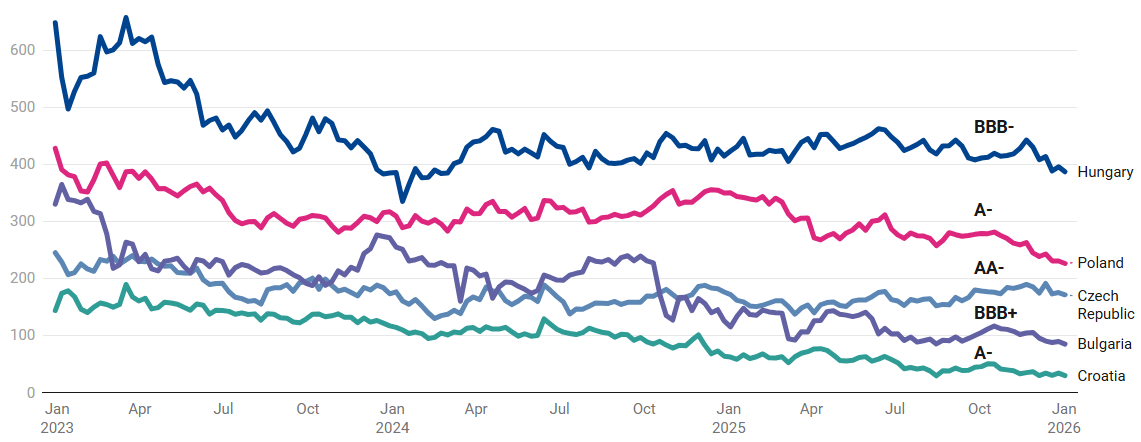
Source: Bloomberg
The country is already seeing the benefits: in July 2025, Fitch and S&P upgraded its sovereign ratings, acknowledging the progress made and the advantages of euro adoption. Continued fiscal discipline and further reforms will allow Bulgaria to build on these gains.
And politically, adopting the euro sends a clear message: Bulgaria chooses deeper European integration.
A gain for Europe as well
Europe is stronger because Bulgaria chose to join its core.
It shows that the euro remains attractive, strengthening the credibility of the monetary union, and demonstrates that European integration continues to deliver concrete results.
A larger euro area also supports a stronger single market. A shared currency makes trade easier, investment more predictable, and daily life simpler for citizens and businesses across borders – all crucial in today’s complicated geopolitical environment.
Bulgaria’s move is also a positive signal to other countries preparing for euro adoption: the path is open, rewarding, and anchored in clear, fair criteria.
Strength in unity
Bulgaria’s adoption of the euro and its upcoming entry into the ESM mark important advances for both the country and the euro area.
These steps strengthen Bulgaria’s economic foundations and resilience. They also reinforce the euro area and improve our collective capacity to respond to crises, demonstrating that integration remains a powerful force for stability and growth.
Bulgaria now contributes to decisions that affect more than 357 million Europeans, including around 6.7 million Bulgarians. It joins a community based on solidarity, responsibility, and shared prosperity that promotes multilateralism and the rule of law.
This move also sends a message across Europe: progress is possible, integration delivers, and unity remains our greatest strength in the face of growing international fragmentation.
The ESM looks forward to welcoming Bulgaria as its 21st Member later this year.
Acknowledgements
The author would like to thank Giovanni Callegari, Lluis Sanchis i Herrero, Ermal Hitaj and Olivier Pujal for their valuable suggestions and contributions to this blog post, as well as Raquel Calero for the editorial review.
Blog manager

About the ESM blog: The blog is a forum for the views of the European Stability Mechanism (ESM) staff and officials on economic, financial and policy issues of the day. The views expressed are those of the author(s) and do not necessarily represent the views of the ESM and its Board of Governors, Board of Directors or the Management Board.