
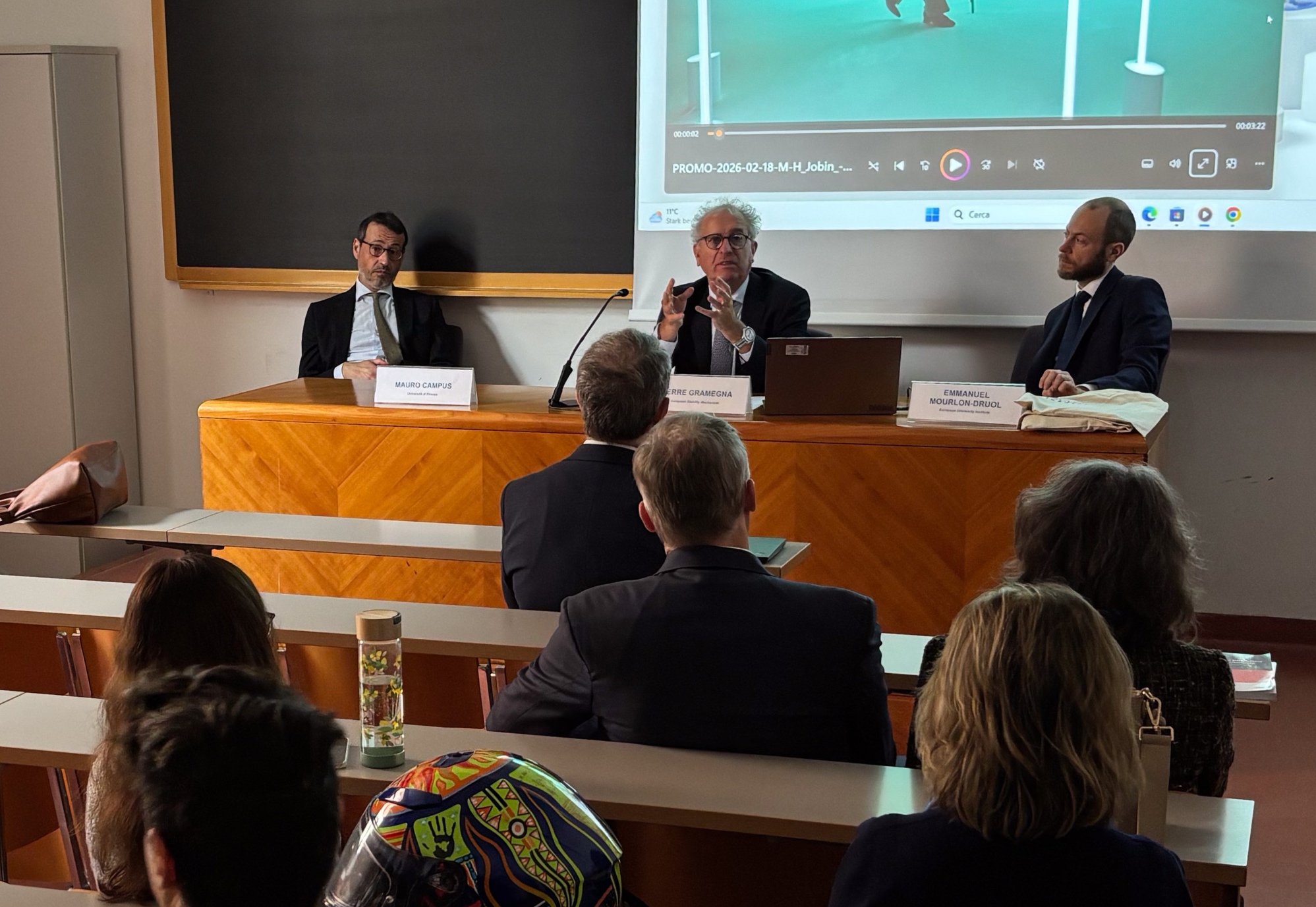

Keynote speech at University of Florence
Tuesday, 24 February, 2026
Introduction
Ladies and Gentlemen, distinguished faculty, dear students of the University of Florence. It is a great honour to be with you today.
I’ve just had the pleasure of opening the exhibition dedicated to Pierre Werner. Luxembourg’s Prime Minister for many years, and earlier as Finance Minister, he was one of the founding fathers of Europe’s Economic and Monetary Union (EMU).
Werner’s vision of a common currency has become such a seamless part of our everyday reality that we now take the euro for granted. We all use it every day without thinking twice, and for many of you, the old national currencies like the lira, franc or deutsche mark have become chapters in history books.
But the euro didn't just happen on its own; it came from years of hard work and political courage by leaders like Werner, and it also took huge efforts to protect it during the euro crisis.
Here in Florence, a city where brilliant artists and thinkers helped shape Europe’s cultural identity it feels especially fitting to reflect on a visionary who helped shape Europe’s monetary identity.
In my speech, I will explain how Pierre Werner's report became the blueprint for the euro. I will also talk about the euro crisis, the creation of the European Stability Mechanism (ESM), and its role in safeguarding financial stability.
In conclusion, I will explain how the European project is in essence a peace project, which needs to be supported in these times of geopolitical turmoil.
The Werner report
Allow me to start by saying a few words about Pierre Werner himself. With a doctorate in law and a deep knowledge of economics, he was a man of exceptional expertise and intellectual authority. He was a skilled and pragmatic leader who excelled at building consensus.
These qualities made him a natural choice for the task he would be entrusted with. The Werner’s report tried to address an important question: How could the European Community achieve economic and monetary stability through deeper integration, including a common currency?
Just to give some historical context: in the late 1960s, the Bretton Woods system was under strain. This was a global monetary order where most currencies were pegged to the US dollar at fixed exchange rates, and the US struggled to maintain the dollar’s value against gold due to its growing trade deficits and inflation.
Exchange rates between European currencies were vulnerable to speculative pressures and dollar instability. This led to persistent currency instability in Europe, which was undermining economic growth and integration efforts.
At the Hague Summit in 1969, the leaders of the European Economic Community (predecessor of the European Union) decided to address this challenge by launching a process of deeper economic and monetary integration, and appointed Pierre Werner to lead the initiative.
His 1970 report, the “Report to the Council and the Commission on the realisation by stages of Economic and Monetary Union in the Community”, known as the Werner Report, provided the first comprehensive roadmap to achieve an Economic and Monetary Union. It was based on three key principles:
- The process should be binding and irreversible;
- Economic union and monetary union were to be implemented in parallel;
- Powers over economic and monetary policy would gradually shift from national governments to Community institutions.
The project’s ultimate goal was the introduction of a single European currency, supported by a “Community system of central banks”, which was the equivalent to the European System of Central Banks created under the Maastricht Treaty.
This goal was to be achieved in a gradual transition lasting 10 years, consisting of three stages. If we look at this architecture today, it is striking how coherent and ambitious it was.
Werner was truly a visionary. He outlined a complete framework for what would become the euro and EMU, two to three decades before they materialised. Many institutional features we now consider fundamental were already present in his 1970 design.
But Werner’s insight went further. He understood that a monetary union would have to cope with country-specific economic difficulties. National economies would sometimes diverge, and economic shocks could affect one country more than others. This is why the report envisaged not only policy coordination, but also mechanisms of financial support and solidarity at Community level.
One such proposal was the creation of a European Monetary Cooperation Fund. The Fund was intended to pool part of the member states’ foreign exchange reserves and to provide short- and medium-term financial assistance. In other words, it would have institutionalised financial transfers and credit mechanisms within the Community.
Just to be clear: the Fund was not conceived as a sovereign crisis resolution fund in the modern sense. It was designed to address balance-of-payments pressures and exchange-rate tensions. But it did represent an early, embryonic form of a collective financial backstop.
Werner recognised something essential: integration requires solidarity. The assumption at the time was that with sufficient policy coordination and convergence, major sovereign crises could be avoided.
History would prove that assumption optimistic. The oil shock of 1973, rising inflation, and insufficient political will halted the project. But the intellectual groundwork had been laid.
From Werner to Maastricht
Two decades later, the project was revived through the report by Jacques Delors, then President of the European Commission, and ultimately enshrined in the Maastricht Treaty, which entered into force in 1993.
The essential architecture outlined in Werner’s plan was carried over into this final design, forming the backbone of how the euro was ultimately implemented.
Where the final design diverged from Werner’s plan was in the economic pillar. Rather than building strong central fiscal capacities or permanent financial solidarity mechanisms, the Maastricht framework relied heavily on rules: deficit limits, debt thresholds, and market discipline. The belief was that discipline would prevent crises from occurring.
What was lacking was a common capacity to manage crises once they emerged. We saw the consequences of this gap during the euro crisis.
The euro crisis
It began in late 2009, amplified by the global financial crisis that started in 2008 with the subprime mortgage crisis and collapse of Lehman Brothers in the United States. The euro crisis exposed the vulnerabilities in the common currency’s design, particularly the lack of a lender of last resort for sovereigns.
Several countries, starting with Greece, faced soaring borrowing costs, massive public debts, and banking sector weaknesses, leading to fears of defaults and even the breakup of the euro area. The integrity of the euro area was under serious threat, with markets questioning whether it could survive without better tools for crisis management and fiscal support.
It took great efforts from European leaders, the European Central Bank (ECB) - with its famous "whatever it takes" pledge by President Mario Draghi in 2012 - and new institutions to stabilise the situation and restore confidence.
Creation of the EFSF and ESM
In response to these challenges, first, the European Financial Stability Facility, or EFSF, was created as a temporary crisis fund in 2010. Two years later, in 2012, the European Stability Mechanism, or ESM, was set up as a permanent crisis resolution mechanism for the euro area.
Established through an intergovernmental treaty, the ESM was designed to provide financial assistance to member states in financial distress, through loans and other support, conditional on economic reforms. This is a model based on how the International Monetary Fund (IMF) provides financial assistance to countries around the world. In fact, the ESM is sometimes called “the European IMF”.
The ESM’s role
The ESM acts as a “lender of last resort” for euro area countries when they are unable to refinance their government debt in financial markets at sustainable rates. In a sense, it represents the concept of a solidarity fund that Werner had envisioned, but that was not included in the Maastricht Treaty.
During the euro crisis, the EFSF and ESM provided a total of nearly €300 billion in loans to five countries: Ireland, Portugal, Greece, Cyprus, and Spain. Today, with an available lending capacity of over €430 billion, the ESM serves as a firewall to protect financial stability in the euro area.
Apart from managing financial crises, the ESM also fulfils a crisis prevention role, which is becoming increasingly important. Like the IMF, we offer to our members precautionary credit lines. These are instruments designed to stabilise economies before major problems arise.
In line with best practice, the ESM reviews its toolkit regularly to make sure it can support its Members in the most effective way, keeping in mind that the nature of crises has evolved over time.
The second major component of the ESM’s preventive capacity is risk monitoring. It allows us to identify potential threats early, develop appropriate policy responses, and boost resilience to crises.
Intergovernmentalism and European integration
Ladies and gentlemen, it is important to recall that the ESM was established as an intergovernmental institution. It is owned by its member states – the euro area countries – and they are its shareholders. This reflects a particular feature of European integration: not everything must be done exclusively through the so-called Community method.
In moments of urgency, member states can also act together through intergovernmental cooperation. The creation of the ESM showed that these two approaches are not in competition; they are complementary. The euro area itself is an example of differentiated integration within the European Union, a concept often described as a "two-speed Europe," where core groups advance more deeply while others proceed at their own pace.
Despite different legal foundations, the ESM works closely with the European Commission, the ECB, and other EU institutions. It forms part of a broader institutional architecture designed to make Europe’s financial system more resilient. It shows that flexibility in institutional design can strengthen, rather than weaken, European integration.
We can see that the intergovernmental approach remains relevant today. The ESM demonstrates that integration can advance pragmatically when there is political will and a shared objective.
The ESM’s robust financial structure
The credibility of the ESM rests not only on political commitment, but also on its financial structure. Unlike the IMF, which gets its financing through central banks and credit lines, the ESM finances its loans to beneficiary countries by borrowing money through the issuance of bonds, sold to institutional investors.
The ESM can borrow money at very low rates because its bonds are backed by €81 billion in paid-in capital from the Member States. This is the highest amount of paid-in capital among all international financial institutions (IFIs).
In addition, the ESM has nearly €630 billion in committed callable capital, a unique feature among IFIs. It means that, in the unlikely event that the ESM’s paid-in capital proves insufficient to meet its financial obligations, a capital call can be made. It would require Member States to contribute their share of the committed capital. This reinforces the ESM’s creditworthiness, and contributes to the highest, triple-A, rating assigned to the ESM by all major credit rating agencies. This exceptionally strong capital base and top-tier credit rating are the very foundation that enables the ESM to offer effective support to its Members.
The euro area today
But the strength of the ESM is ultimately a reflection of something broader: the strength and evolution of the euro area itself. The euro area started out with 11 countries in 1999. Following Bulgaria’s accession on 1 January 2026, it now comprises 21 members, and the euro is used by nearly 360 million people in these countries. This expansion demonstrates the continuing attractiveness of the single currency.
In a world marked by geopolitical tensions and economic fragmentation, membership in a strong monetary union offers resilience. The euro is today the second most important currency in the world. It plays a central role in international trade, global bond markets, and foreign exchange reserves held by central banks. This gives Europe economic weight, and a degree of monetary sovereignty, in the global financial system.
And yet, there are good reasons to strengthen its international role further. A stronger international role for the euro would reduce Europe’s exposure to external shocks transmitted through other regions. And it would enhance Europe’s strategic autonomy when economic or geopolitical tensions arise.
A deeper and more resilient EMU would naturally reinforce that position.
Conclusion
Ladies and gentlemen, let me conclude.
EMU is an additional layer to the European construction, which is of a very special kind and of a very special nature. No other part of the world has peacefully pooled its currencies to make one currency. It has happened in history only through wars. The Roman Empire had a common currency, but, that was not done peacefully. This is a construction that is very unique.
Today marks the fourth anniversary of a dramatic event at our doorstep: the war in Ukraine. The European project, launched with the speech of Robert Schumann in Paris on 9 May 1950, is not finished, because it is a peace project. Can you imagine today a situation where, once the war in Ukraine ends, Russia and Ukraine would reach out and say: “We need to build something together. We need to have a common currency. We need to be friends.” You imagine how difficult this is. But this is what Europe ultimately achieved after World War II.
You may ask, what is the most pressing challenge while the war in Ukraine continues to rage? It is how to become stronger in areas where our cooperation is very limited. And the key area that currently comes to mind is defence and security.
In the context of financing defence needs, the ESM was mentioned by Enrico Letta in his 2024 report, and also in the European Commission’s White Paper last year. Particularly in times of strained international cooperation, in times of geopolitical fragmentation, we have to look at all the options on the table. The ESM is one of them. We are ready to discuss with our Member States if that is the option they wish to pursue.
Thank you very much.
Contact