

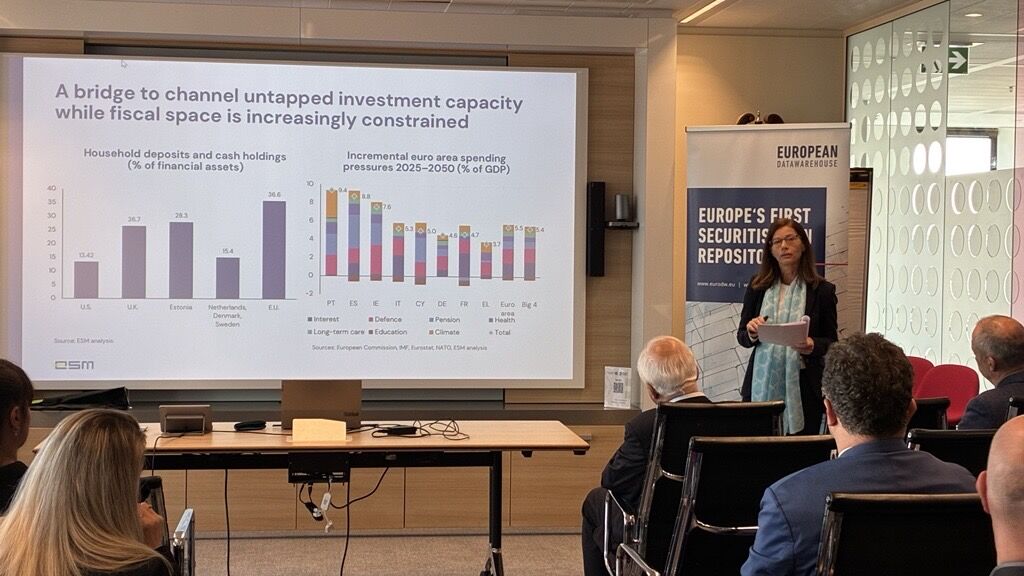
Nicoletta Mascher, Head of Financial Sector and Market Analysis
European Data Warehouse keynote speech
“Securitisation and financial stability: fostering Europe's growth while safeguarding resilience”
Amsterdam, 23 September 2026
The slides referred to in the speech can be accessed here
1. Why is the ESM here?
Since 2012, the European Data Warehouse has played a crucial role in the European securitisation market: collecting, validating and standardising data. This has helped to increase transparency and restore confidence in European asset-backed securities.
And that is where I would like to start, because transparency is not just a matter of market efficiency. It is also a matter of financial stability.
The relationship between securitisation and financial stability is the theme I am going to explore today, and, more specifically, how securitisation can support Europe's growth and competitiveness while preserving and strengthening resilience.
Some of you may be wondering why a representative of Europe's permanent crisis-management mechanism is speaking here in favour of an instrument that many still associate with the global financial crisis.
The European Stability Mechanism (ESM) was created in 2012, as the successor to the European Financial Stability Facility (EFSF), to provide financial assistance to countries in distress and safeguard stability in the euro area.
As you can see from this picture [Slide 3: The ESM within the European financial architecture], the ESM shares the mission of safeguarding financial stability in Europe with several institutions, which all developed after the great financial crisis, each in its field of expertise.
It is fair to say that the ESM emerged in the aftermath of a crisis in which opaque and poorly structured securitisations contributed to the spread of financial stress.
Yet, the lesson from that crisis was never that securitisation itself is destabilising.
The design, incentives, transparency and supervision determine whether risk is distributed safely, or whether it is obscured and amplified.
When properly designed, securitisation helps diversify funding sources, free up lending capacity and reduce concentration in the banking sector.
On top, securitisation can also serve as a genuine crisis-management tool. We have seen this in practice.
In Italy and Greece, schemes such as GACS (Garanzia sulla cartolarizzazione delle sofferenze) and HAPS (Hellenic Asset protection Scheme) [combined state guarantees on senior non-performing loan (NPL) tranches with private investors taking the riskier portions on market terms. At a critical moment, these programmes] helped banks remove legacy bad loans from their balance sheets and restore lending capacity. And, as the data show, they worked remarkably well.
[Slide 4: NPL workout in Italy and Greece in the last decade]
So, we know securitisation can do a lot of work. The question for Europe now is how to move from viewing securitisation as a powerful financial technique to recognising it as a critical component of a financial infrastructure that can make Europe’s economy more competitive and better able to absorb shocks.
This brings me to the role of securitisation within the Savings and Investments Union (SIU).
2. Securitisation within the Savings and Investments Union
Securitisation is the most advanced file in the EU SIU agenda, and rightly so.
Europe’s challenge, in fact, is not a shortage of savings, but an incomplete transmission of those savings into productive investment, across borders and over the economic cycle.
[Slide 5: A bridge to channel untapped investment capacity while fiscal space is increasingly constrained]
At the same time, Europe faces massive investment needs to address long-term challenges; it also needs to respond to immediate and mounting threats, not least armed conflicts at its borders.
The successful execution of the SIU strategy is therefore critical for Europe’s future.
Such a strategy is not about replacing banks with markets. It is about making banks and capital markets work better together.
Securitisation is particularly well suited to this objective: it makes bank-originated credit risk investable by a broader range of investors. This helps banks manage risk and capital and creates capacity for further lending.
In that sense, securitisation is a bridge between banks and capital markets.
That bridge will also strengthen financial stability.
More investors, more funding channels and a wider distribution of risk-bearing capacity can make the financial system more resilient and less dependent on individual national banking sectors.
3. The bridge product — but which type?
So, what determines whether that bridge is solid and large enough?
This is where the current reform of the Securitisation Regulation (2017/2402) comes in. By improving the framework and building on what already works well — a sound banking system and a strong regulatory architecture — the reform can help securitisation fulfil its role more effectively.
Let me underline that the reform can strengthen that bridge, but not through any single lever.
Three elements of the reform are particularly important given their interdependency: supervisory harmonisation, transparency, and proportionality.
First, supervision. The framework needs a clear division of responsibilities between European and national authorities, stronger coordination, and more consistent supervisory practices. This needs to cover both bank and non-bank originators.
Second, proportionality. This is perhaps the most difficult challenge. Getting proportionality right, and avoiding cliff effects, depends on supervisory convergence. There will always be a tension between principles and rules. A principles-based framework provides flexibility and requires confidence in supervisory judgement; a rules-based framework provides certainty but risks rigidity and potentially inconsistencies.
Third, transparency. The ambition of the reform should be to make all securitisations more transparent, while applying reporting and due diligence requirements in a proportionate manner.
Today, regulators still lack systematic, centralised visibility into the private securitisation market. This unfortunately remains a contested issue and the risk of losing visibility over the most important part of the market is becoming increasingly material.
[Slide 6: Is private securitisation becoming market dominant? Issuance volumes in the broader market are not growing; private securitisation is the only growing segment of the market]
[Slide 7: Institutional investor appetite is changing. Transparency increases market appetite: the introduction of the STS framework in 2019 and its expansion in 2021 directly stimulated a significant shift in investor composition].
For those entrusted with a financial stability objective, it is clear that transparency should not be a negotiable feature of any financial architecture. Confidentiality is a different objective and it can be preserved together with greater transparency.
In that context, a restrictive definition of public securitisation would run against the spirit of the reform, which is to lower barriers. At the same time, the framework must remain simple and predictable. Excessive complexity or legal uncertainty would ultimately undermine the objective of attracting a broader investor base.
Finally, let me say a few words on the debate on synthetic securitisation, which seems to attract the greatest attention.
In the United States, the synthetic securitisation market remains relatively limited, yet the broader securitisation market has expanded substantially since the global financial crisis. The key drivers were not new structures, but rather standardisation, predictability, deeper institutional investor demand, liquidity, stronger alignment of incentives and investor confidence.
That is an important lesson for Europe. Market scale comes from a well-functioning ecosystem, not from any single instrument.
Traditional securitisation and synthetic securitisation are both valuable tools, but they serve different purposes.
Whatever the structure, three safeguards remain essential: genuine and durable risk transfer; transparency and standardisation; and resilience throughout the cycle, including confidence that protection providers can perform under stress.
Synthetic securitisation can be useful when the business objective is targeted risk management and capital optimisation. However, where the policy goal is to expand funding for the real economy, particularly for SMEs, traditional securitisation has a distinctive role. It connects loan portfolios to a broader investor base and helps generate additional funding capacity.
Whichever structure is used, market growth will not come from greater complexity. It will come from investors being able to understand, compare and trust the product.
4. Trust is the market infrastructure
This brings me back to EDW and its central role. EU securitisation will not scale from lower capital charges alone. New and returning investors need trust: they need reliable data, common definitions, and the ability to compare structures across countries.
A central repository that provides high-quality data and access for all parties with a legitimate interest (investors, central banks, supervisors and rating agencies alike) is key.
Simplification is warranted where reporting requirements or due diligence are duplicative. Transparency is not the problem to be simplified away; it is the pillar that supports confidence and participation and, ultimately, the market foundation of growth and financial stability.
EDW's own data makes the case for extending the repository infrastructure to private transactions. By December 2025, more than 400 private transactions had already been stored voluntarily, roughly a quarter of the private market, without regulatory requirement.
We support that extension, with appropriate guardrails. Supervisors need the information for oversight, investors need it for due diligence, while commercially sensitive information can remain appropriately protected. Standardised reporting and confidentiality are not in tension; they are compatible.
5. A European SME platform — common standards, not a new monopoly
My last point is about standardisation and creating conditions for scale.
Under the European Competitiveness Lab, nine Member States are now working with market participants and EU institutions on an SME securitisation platform; a design and a pilot are expected in autumn this year.
The problem it is meant to solve is familiar to this room:
- fixed costs are prohibitive for small originators,
- SME loan data are difficult to compare,
- investors face national legal and servicing differences at every border (not specific to SMEs, though).
As a result, national issuance lacks scale, particularly in the SME sector, which is the backbone of the EU economy and where innovation and growth is most needed.
An ESM staff paper published last year, Capital Markets Union Redux, presents a very similar proposal. The authors discuss how banks themselves can nurture the Capital Markets Union by converting SME loans into investible European capital market instruments.
The framework, from our perspective, should build on existing frameworks and templates to avoid duplication.
[Slide 8: A common EU securitisation platform]
The platform's value would come from coordination, aggregation, and standardisation across borders. For instance, it could act as a catalyst for standardising loan documentation and due-diligence practices. These in turn, would reduce costs, improve comparability, price discovery and attract a wider range of investors.
Our proposed approach is a "European layer, national rails," on a voluntary basis. Existing originators, servicers and SPVs would stay in place.
An EU initiative should not duplicate or displace functioning Special Purpose Vehicle platforms or force a single structure on different national markets.
It should instead promote common standards and make national arrangements interoperable. Country compartments could preserve legal distinctions and transparent risk attribution, with a common distribution layer sitting on top.
The structuring could also include a public guarantee from a highly rated EU body for selected tranches.
Concerns around risk mutualisation could be partly mitigated by structuring the platform to pool SME loans by originating country, rather than mixing them across borders. Investors would still access all offerings via a single EU-wide marketplace and retain the option to invest in, say, a Greek SME tranche or an Italian one. That would preserve a clear link between credit risk and national jurisdiction.
GACS and HAPS are relevant here again, not as templates for performing SME loans, since NPL work-out and performing-loan origination are different problems, but as a source of design lessons. Guarantees should be transparent and risk priced. Private capital should absorb meaningful risk. Incentives and servicing should remain aligned. And fiscal exposure and state-aid treatment must be explicit from the start.
The success criterion is straightforward: the platform should lower entry costs and broaden the investor base, without concentrating opaque credit risk on an EU public balance sheet.
A common European layer can solve coordination and scale problems. But its impact ultimately depends on the surrounding regulatory framework, which brings me back to the core of our discussion today. We should aim for a system that is simpler in practice, and safe.
6. Regulatory reform — the final balance and usability will decide
In the current legislative process, some important open questions remain. I have touched upon some of them. I look forward to hearing your views on other important aspects of the reform (e.g. investor sanctions, exemptions from due-diligence and risk-retention requirements, bank-capital treatment under the Capital Requirements Regulation and changes in the Liquidity Coverage Ratio and Solvency II regimes).
One concern I would like to highlight is that negotiations can add conditions that are individually defensible, but collectively, they undo the simplification that everyone agreed they wanted. A sound transaction should become easier to originate, assess and invest in, while supervisors and investors keep the information they need to know where the risk actually sits. The reform will succeed only if it delivers a market that is both more investable and more resilient, not one or the other.
7. Conclusion
Securitisation belongs to the SIU agenda because it is a practical bridge between Europe's banks, capital markets, and real economy. That bridge has to rest on genuine and durable risk transfer, high-quality structures, transparency and standardisation, and resilience through the cycle.
The ESM's interest is the same in crisis and in normal times: a financial system that can absorb shocks while continuing to support credit to viable firms. Properly designed securitisation can help deliver that.
As I explained in my introduction, the ESM was built to overcome crises; in peace times it spends its energy on crisis prevention and preparedness.
This is the same spirit behind a new yearly publication we have just launched, the Euro Area Stability Watch. Unlike most financial stability reviews, it does not try to cover every possible risk. Instead, it follows a small number of plausible adverse scenarios end-to-end and examines them through the lens that matters most to a rescue fund for sovereigns - fiscal sustainability and market access.
If that interests you, I would encourage you to take a look. It is available on our website.
Thank you for your attention.
Contact