

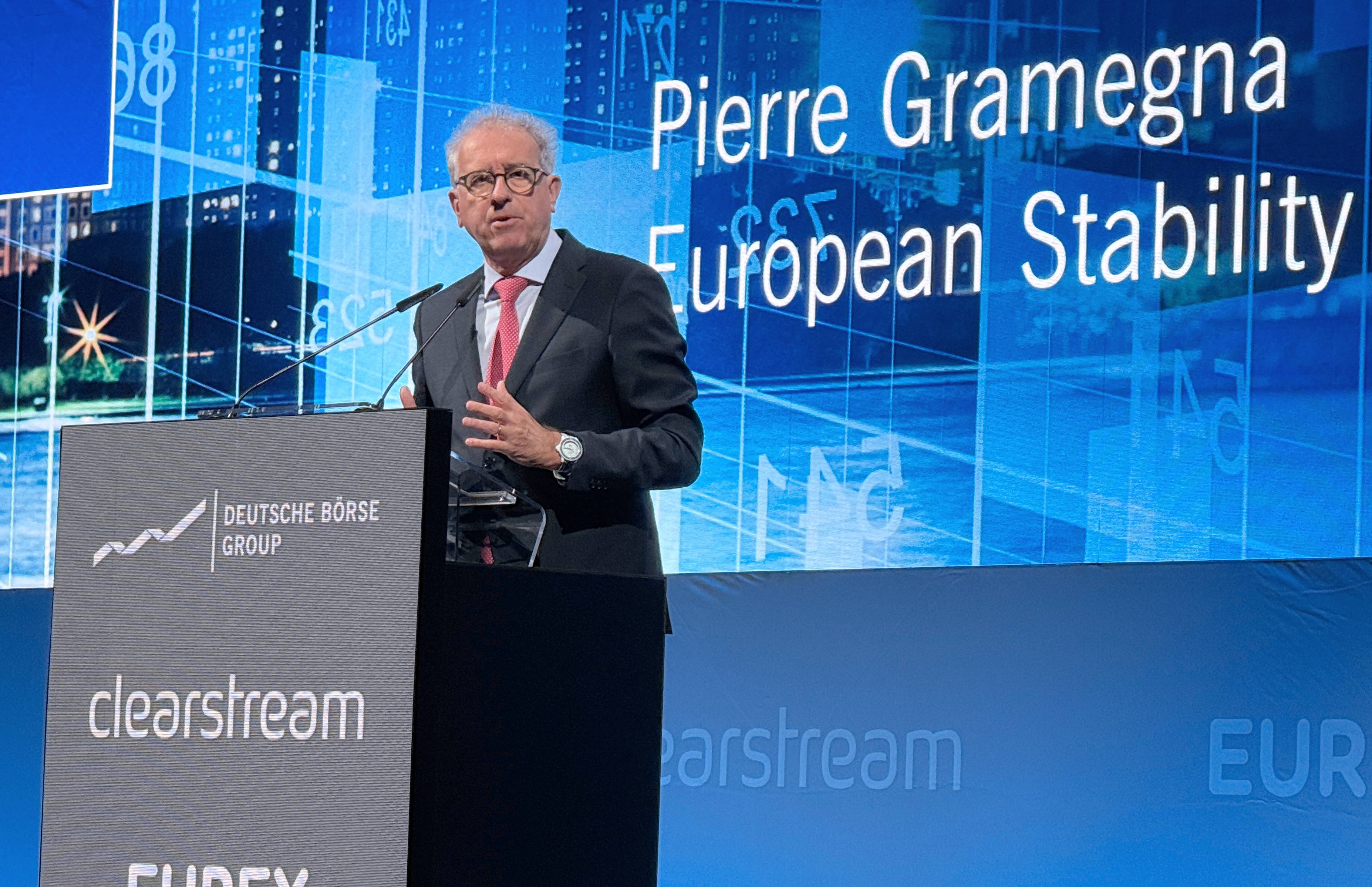
Pierre Gramegna, ESM Managing Director
“Savings and Investments Union: mobilising capital for Europe’s strategic needs”
Keynote speech at Global Funding and Financing Summit (by Clearstream)
Luxembourg, 28 January 2026
Good morning, ladies and gentlemen. Thank you, Stephanie [Eckermann, Managing Director at Deutsche Börse Group] for your warm welcome. I extend my thanks to Clearstream for the opportunity to speak at this event.
Over the past three decades, the Global Funding and Financing Summit has provided a valuable platform for discussions on global finance. I had the pleasure of speaking at the Summit in 2018 as the Minister of Finance of Luxembourg. I delivered a speech on Brexit, shortly after it took place. At that time, Brexit was a major political disruption for the EU, with big implications for the financial sector.
Today, speaking to you as Managing Director of the ESM, Europe is again experiencing a period of turmoil following the recent confrontation with the US over Greenland, which was fortunately de-escalated in Davos last week. I was there as well. And this was just the latest in a series of geopolitical shocks, testing Europe’s economic and financial resilience. I will expand on that later in my speech.
Europe’s resilience to recent turmoil
Ladies and gentlemen, I would like to start with a statement that may come as a surprise. In these times of geopolitical shifts and uncertainty, Europe’s position is more resilient than it might appear at first sight. When we look at financial markets, investors are partly diversifying away from the US and Europe is seen as a stable and reliable alternative underpinned by the rule of law and robust democratic values.
A compelling example of this growing confidence is the strong performance of major European equity markets in 2025. Major indices like the FTSE, DAX, and CAC outperformed their US counterparts (the S&P 500 and Nasdaq). And unlike US regional banks, EU banks remained well-capitalised and stable, and their stocks had a particularly strong year, reflecting renewed confidence in Europe’s financial system, which has been significantly strengthened via reforms following the global financial crisis and euro crisis.
Another bright spot has been the labour market, with unemployment in the EU and the euro area hovering around historic lows. These are positive examples, but they relate to short-term developments. If we look at GDP growth in the euro area – it has been improving but remains lower than in the US and much lower than China.
Structural weaknesses
This is not just a short-term blip; it is a trend caused by structural weaknesses in the euro area economy. Let me quote a figure comparing the euro area and US that is very telling.
In 2008, the US and euro area economies were roughly the same size. In 2025, the US economy was about 70% larger than the euro area.1
The major factor for this widening economic gap is a large discrepancy in productivity and innovation. This topic was presented by Mario Draghi in his 2024 report, where he described EU productivity problems as an “existential challenge”. Europe failed to capture digital revolution gains, lagging the US and China in total factor productivity (TFP) which is the key growth driver amid demographic decline.
The report notes that, out of the largest 50 technology firms in the world, only four are in Europe. Last week in Davos, if you walked on the promenade, it was full of people from American and Chinese tech companies. I could spot few European counterparts. Europe is not lacking in talent or innovation; it has produced dozens of billion-euro startups, world-class research institutes.
Yet innovative companies often chose to list on NASDAQ or move to the US instead of scaling within Europe. Why? Because capital markets in Europe remain segmented and less liquid. The cost of inaction is staggering: a study published last year concluded that Europe’s GDP today could be 25–30% higher (about €7.5–8 trillion) had a US-style capital market integration existed since 1995.2
Another reason behind the divergence in GDP growth is the ageing of Europe’s population. The EU currently has a ratio of three workers for every retiree. By 2050, it is projected to have only two workers per retiree.
This indicates the scale of the demographic shift which will create fiscal pressures through growing pension costs and burdened healthcare systems throughout the EU. It also affects productivity, as older populations are usually less innovative.
Massive investment is needed
These structural weaknesses cannot be fixed without bold action, and that starts with investment. Boosting productivity and innovation, completing the green and digital transition, but also strengthening defence capabilities, are the EU’s strategic priorities.
They will require additional public and private investment – between €800 billion (Draghi report) and €1.2 trillion (ECB) per year over the coming decade. Mobilising these resources starts at home, by completing Europe’s Single Market.
This is the core message of Enrico Letta’s 2024 report, which charts a path to deepen internal market integration. The EU prides itself on having an internal market, but in reality, there are numerous internal barriers to the flow of services and capital.
As Christine Lagarde noted in a speech last November, internal barriers in services – including financial services - are equivalent to a tariff of around 100%. These are barriers include different national regulations, tax rules, professional qualifications.
One way to address this is the creation of a so-called “28th regime” - an EU-wide legal framework that companies could choose replacing or supplementing the 27 national regimes with uniform rules. The European Commission is working on this issue and is scheduled to present a legislative proposal soon[Q1 2026].
The need for deeper financial market integration
The Commission already tabled several major proposals to deepen EU capital markets last year. The proposals aim to reduce market fragmentation, simplify existing rules, and boost cross-border activity. Within the broad goal of deepening financial market integration, advancing the Savings and Investments Union (SIU) project is especially crucial.
The SIU is an initiative by the European Commission to channel Europeans' massive private savings into productive investments for businesses, especially SMEs. What is the scale of these savings? €40 trillion, of which around €10 trillion is held in low-yield deposits. SIU builds on and evolves the Capital Markets Union project, launched in 2015, and also integrates the EU banking union.
The importance of SIU for growth and financial stability
SIU would deliver this by standardising retail investment products, like a pan-European savings account with tax incentives and streamlining cross-border fund distribution through harmonised supervisory rules, enabling seamless capital flows from savers in one member state to innovators in another. And we know that innovation is a key driver of sustained economic growth.
Easier access to capital enables firms - especially start-ups and innovators - to grow, invest in new technologies, and create jobs. Market integration doesn’t just boost growth; it also strengthens financial stability in a virtuous cycle. Well-integrated capital markets enhance private risk-sharing, allowing investment and credit to flow more freely across countries.
This cross-border flow helps absorb economic shocks, distributes losses and profits, and smooths out economic cycles, making the system more resilient. Greater market integration supports financial stability without overburdening public finances and reduces reliance on public safety nets like the ESM.
Bottom-up approach also needed
However, EU-level legislation is just part of the necessary approach. Certain areas are the competence of national governments. This is a topic that we have studied at the ESM; a bottom-up approach is needed alongside top-down measures to reduce financial fragmentation. Our research focused on practical ways to achieve progress in this respect.
In a Discussion Paper published in May 2025, ESM economists found that “savings and investment accounts”, which successfully function in Sweden could significantly increase household participation in capital markets if applied across the EU.
Another example of an effective idea at national level are funded pension schemes, as operated in the Netherlands. Again, if other EU countries applied this idea, this would boost the supply of long-term capital. What we really need is sustained political will and hands-on cooperation between European institutions national authorities, and market players, to make it happen.
Geopolitical disruptions make the task more difficult
Deeper market integration and the Savings and Investments Union can indeed address many of Europe’s structural challenges. Yet current geopolitical disruptions – from the shifts and unpredictability in the actions of the US administration, to heightened tensions with Russia, and China’s industrial dominance - will make this task significantly more difficult.
As Canadian prime minister Mark Carney put it at Davos last week, great powers are now weaponising economic integration: “[They are] turning tariffs into leverage, supply chains into vulnerabilities, and global ties into sources of subordination.”
Investor confidence, key to SIU’s success, risks being shaken by volatile capital flows and policy uncertainty. These shocks heighten the urgency: only by accelerating internal integration now can Europe build the domestic resilience to weather external storms.
Strategic autonomy
And the ultimate goal must be to achieve strategic autonomy - Europe's capacity to act independently in defence, energy security, critical technologies, and raw materials supply. Let me present a few examples of how Europe is building its strategic autonomy.
In the area of defence, last year there was an important initiative called SAFE (Security Action for Europe). It's an EU facility providing up to €150 billion in low-interest, long-term loans to member states for joint defence procurement. Let me mention here that the European Commission, in a White Paper published last year suggested that the ESM could also be called to finance the defence needs of its members if other means prove insufficient.
Another important strategic sector for Europe are semiconductors. In 2023, the European Chips Act was implemented. It is an initiative designed to boost semiconductor production from 10% to 20% of global share by 2030 reducing reliance on Asia amid supply chain risks.
Europe must also extend strategic autonomy to payment systems, where over-reliance on US-dominated networks like Visa and Mastercard exposes Europe to geopolitical risks, data privacy issues, and potential disruptions during tensions.
This vulnerability is now compounded by USD stablecoins – privately issued digital dollars that threaten to entrench US dominance in payments bypassing European regulation and undermining financial sovereignty.
The digital euro
Is there an answer to these threats? Yes, the digital euro emerges as a powerful solution. It would run on European infrastructure, be legal tender, and allow consumers to pay merchants without routing payments through Visa or Mastercard. The digital euro could also mirror the role of stablecoins thanks to being pegged 1:1 to physical euros, and enabling peer-to-peer payments across borders.
If approved by European Parliament and EU Council, the digital euro will come in two forms: a retail digital euro for citizens and businesses and a wholesale digital euro for financial institutions. If legislation passes this year, digital euro pilots and initial transactions could start in mid-2027.
Conclusion
Ladies and gentlemen, let me conclude. Europe’s ability to remain a global economic power will depend on our capacity to act together, not as 27 separate markets but as one cohesive economic community ready to shape its own future.
No single member state, regardless of its size, strength, or history, can navigate today’s geopolitical and financial turbulence on its own in a more effective way than all countries acting together.
Only by deepening our cooperation, completing our integration projects, and aligning our priorities can we safeguard our competitiveness and prosperity. If we choose unity, Europe will not just attempt to withstand the challenges ahead; it will help shape the global economic order. Today we need more Europe, not less. Thank you very much.
1 Measuring nominal GDP, i.e. not adjusted for inflation; European Commission data.
2 Working paper "Capital Market Fragmentation and Economic Value Migration” by Ravi Balakrishnan (IMF, Bruegel) and Mahmood Pradhan (Global Head of Macro at Amundi Investment Institute), June 2025.
Contact