
Rolf Strauch interviewed by Confrontations Europe (English version)

Transcript of interview with Rolf Strauch, ESM Chief Economist
Interview conducted by Olivier Marty, Economic and financial adviser, Confrontations Europe
13 July 2026
Confrontations Europe: Why have you decided to launch the Euro Area Stability Watch (EASW), a thorough assessment of risks to financial stability and potential consequences for euro area countries? Hasn’t the euro area reinforced its resilience in the post-crisis years?
Rolf Strauch: Our main reason for launching the report is the rise in uncertainty driven by significant geopolitical and geoeconomic challenges. As a permanent crisis resolution mechanism, the ESM wants to follow best practices and participate in the discussion on macro-financial risks. Geoeconomic and geopolitical shifts have made the world more complex, uncertain and volatile. The ESM has always been engaged in monitoring risks, which is part of our preventive role. But, so far, we hadn’t published our assessments.
As for the euro area’s resilience, we can point to three strengths: i) the labour market, which is still strong; ii) the banking sector, which is rather robust, largely as a result of the responses that were enacted after the past financial crisis; and iii) the institutional framework, which is more resilient. The role of the ESM is an important element of that framework. So, I think there are important elements of resilience, but that does not mean that we are immune to shocks. In fact, the conclusion of the report is that the euro area’s resilience is “under strain”.
And so, what are the key risks to worry about for the euro area?
We identify two core risks that may affect the euro area. The first one is prolonged tensions and an escalation of conflict in the Middle East. We are currently living through that, and the situation is still very uncertain. We do not know how and when it will end, but we know it will have an impact on energy prices and inflation. The second potential shock is a significant loss of value of US assets, both equities and US Treasuries. If that were to happen, we would face a tightening of financial conditions and European investors would be exposed to losses.
How seriously do you consider this repricing of US assets as a risk? It seems that tech stocks’ valuations are able to deflate regularly and that, on the other hand, US Treasuries have so far remained broadly stable?
I do think that Europe’s exposure to US assets is an important source of possible losses, as 46% of the euro area’s GDP is invested in US equity and debt securities. Therefore, a potential repricing is an important risk that deserves to be highlighted. True, in the survey of market participants that we have conducted, the repricing of US assets is seen as less important than geopolitical risks or inflation prospects. However, we still believe that valuations in the US equity markets are stretched, because they largely rely on expected earnings in artificial intelligence (AI) and related sectors.
We may experience strong valuation revisions if, for example, a much cheaper competing model of AI technology, from China or elsewhere, comes to the market. Earnings expectations may then seem overstretched and that could lead to a stronger repricing. Since AI is a continuous technological process, we do not know where we will be moving in the medium term and we need to be conscious of the risks.
On US treasuries, we have observed some shifts in the market related to the policies of the US administration. Going forward, we think that the related uncertainty will remain. In my view, the key issue is how markets assess the US risk considering policy uncertainty and the path of the public deficit. The question is whether this would lead them to reprice or not. And if such repricing is combined with higher interest rates due to higher inflation expectations, then the shift could be drastic.
How precisely is the euro area vulnerable to the risks you outline? Are fiscal buffers in individual countries too low? Is the region too much exposed to energy supply disruptions? How about the exposure of sovereign markets?
The impact of the shocks that we describe would differ from what we experienced in 2010, during the euro crisis. From an economic point of view, it was the initial fiscal positions of the countries that determined the vulnerability and the extent of crisis propagation at the time. Today, the crisis would be different: trade openness and energy dependency would determine the vulnerability of the countries. This means that small and open economies are more exposed than the bigger economies that are less energy dependent or less open to trade. From a financial point of view, as we have said before, there is indeed a higher exposure of Europe to US repricing because almost half of euro area equity funds' holdings have been invested in the US. In 2009, the exposure was 19%. In addition, we note a change in the sovereign debt market: some market actors, like hedge funds, play a more important role. They are very price-sensitive, which possibly implies more volatility.
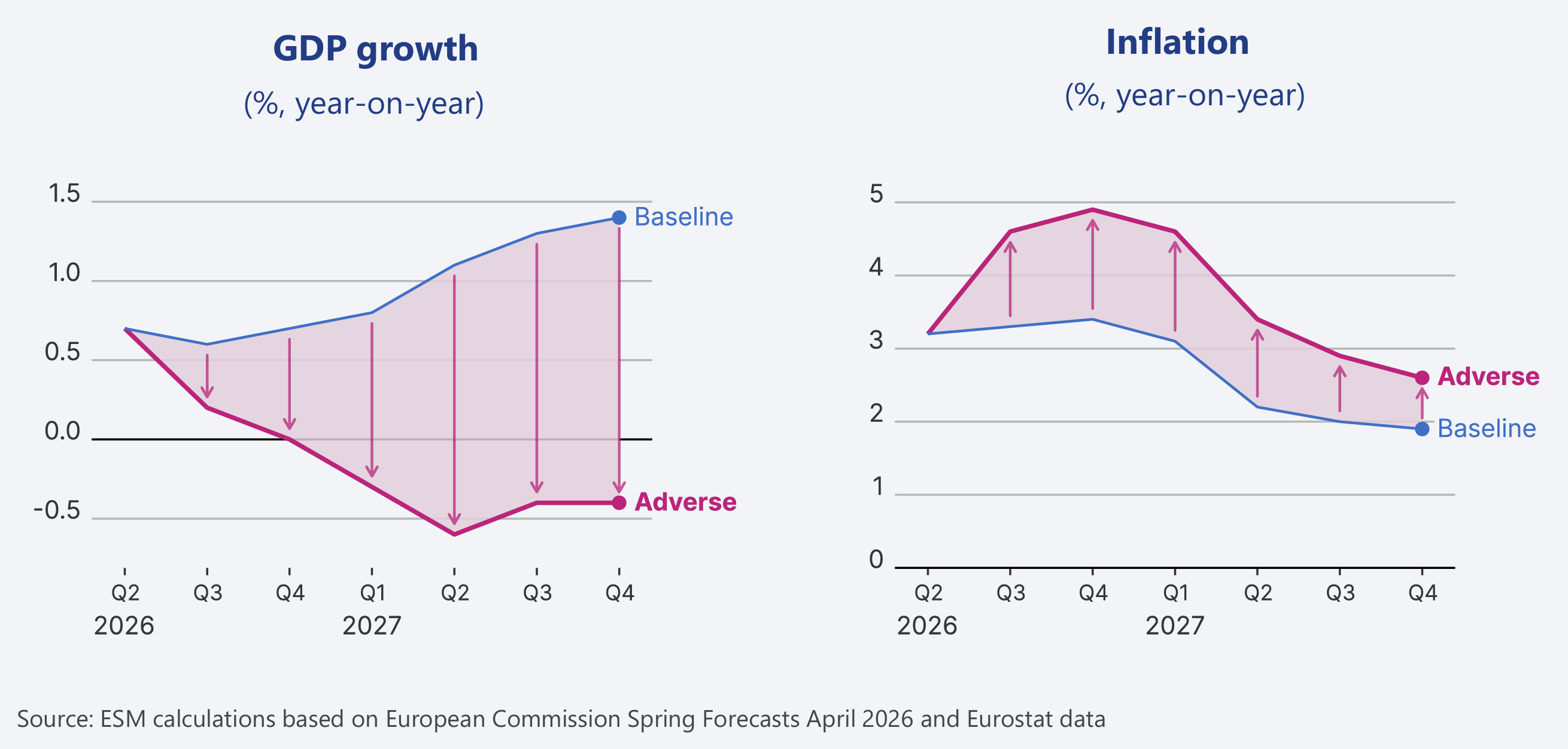
In an adverse scenario, you estimate that the combination of the two major risks that you outlined would likely push the euro area into a recession, with inflation rising to as much as 5% in 2026–2027. Can you elaborate on the reasons why there would be no policy change at that stage?
In our exercise we ask the question of “what happens if things go wrong” and not the question “what will actually happen?”. This is the difference between a scenario analysis and a forecast. In that context, it is very common to have a “no policy change assumption” because you do not know precisely how governments will react and you do not want to predict how the monetary authority and government will react. You rather want to assess the potential economic impact of shocks materialising. This is why major institutions (e.g. IMF, ECB, Commission) have developed “scenario analyses” in a world of heightened uncertainty: they calibrate and study potential economic impacts and then derive what can be done at the policy level. So, we follow best practice in that area.
Figure 1: Euro area growth and inflation under the adverse scenario
I understand, but in the event that your adverse scenario materialises, it would be quite likely that the ECB would raise interest rates, wouldn’t it?
The ECB reaffirmed its credibility by responding forcefully to the inflationary shock triggered by Russia’s war against Ukraine and the subsequent energy shock. I have no doubt that it would act adequately to defend price stability again if this scenario were to materialise.
When it comes to the reaction to potential crises, you recall that the quality of policy choices is essential. Yet, in adverse circumstances, many countries are tempted to make inappropriate decisions amidst vivid popular expectations and political fragmentation. What do you recommend? And how could the ESM possibly help?
For governments, there will be strong fiscal adjustment needs and they need to be prepared for that. They also need to follow the European fiscal framework and get growth going. The growth element cannot be emphasised enough. Creating fiscal buffers and spending efficiently would allow them to create fiscal space. But pursuing structural reforms would help support growth, which would also contribute to strengthening fiscal positions. We do not make recommendations for individual countries as this is the role of the European Commission. Broadly, however, I can say that the priorities fall within those areas. Fiscal space is essential in light of growing spending needs, especially in defence.
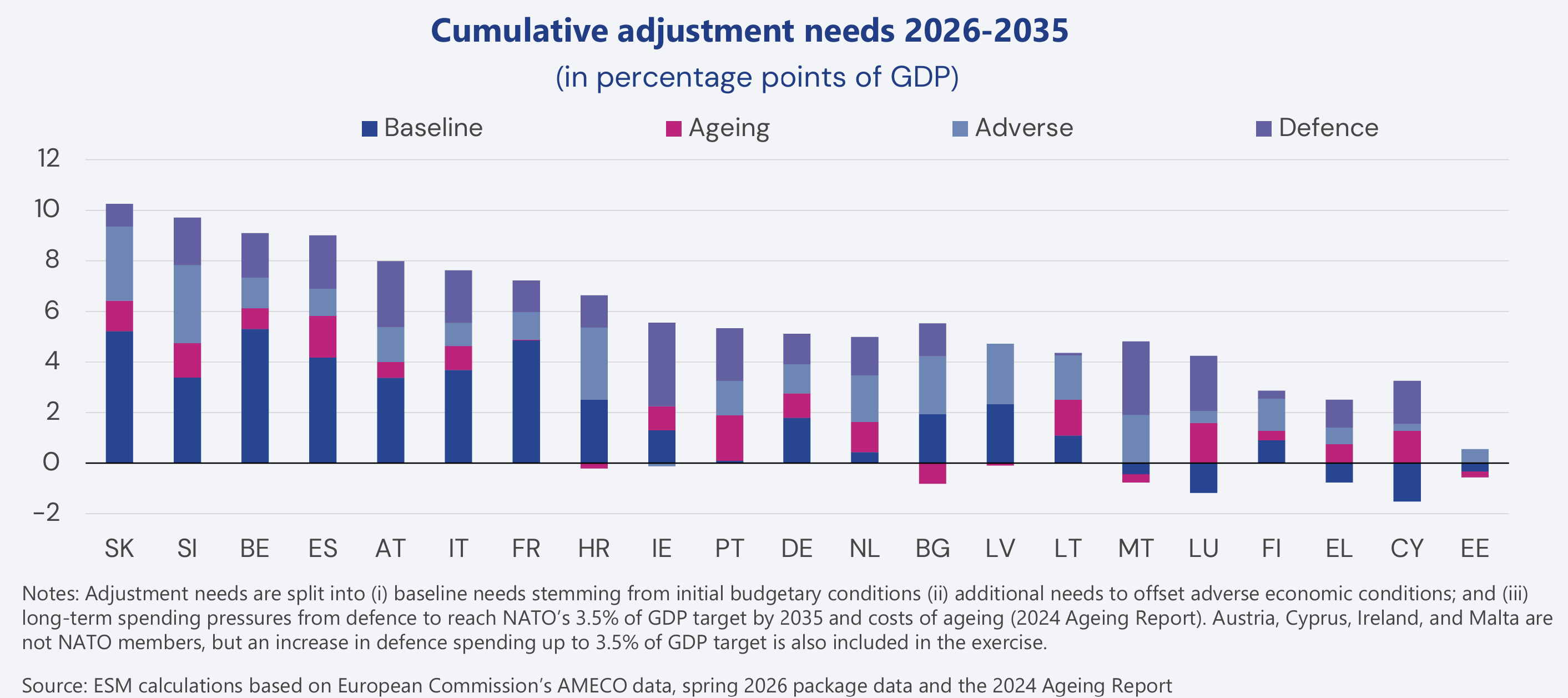
Figure 2: Large fiscal adjustment requires difficult policy choices
As for the ESM, we are there to safeguard financial stability, we have worked over the past years on the review of our toolbox and had discussions with our Members, the euro area member states, to make sure our varied instruments are adapted to the circumstances we are living in. In that context, we have looked at our precautionary credit lines and whether they would be suited to address those risks. We think they can be useful tools in the case of a major financial risk. Our precautionary instruments could also be useful in the event of an external security threat.
Given all the above, an essential aspect of crisis prevention lies in the ability of countries to reconstitute fiscal buffers. In your analysis, crisis scenario-related adjustments are coupled with other long-term spending needs and reveal a diverse pattern of national fiscal efforts from 2026 to 2035. How would you describe it? Are you worried countries would not adjust as much, prompting negative market reactions?
In the report, we identify short-term shocks and long-term challenges as sources of long-term spending drivers. We then combine these with the current pattern of national public finances. As a starting point, governments which should adjust the most are those with the highest levels of debt and deficits and those with a high interest burden relative to their growth. If that is then matched with the impact of adverse economic developments, small countries are more exposed. Finally, we also look at the needs of higher defence spending as well as ageing costs to provide an overall picture of the adjustment needs. For some countries, assessing these needs from today’s perspective points to significant adjustment requirements.
Looking back, we have observed that around half of the countries managed to make fiscal adjustments of that magnitude in the past. This is not a prediction of what would happen, but a reason why we say “resilience is under strain”. It is a challenge for all governments to cope with these fiscal adjustment needs. Not addressing these challenges and failing to think about future needs affects the credibility of public finances. Market confidence depends on whether investors believe a government has control over the future path of its public finances. If not, markets define the fiscal space and borrowing costs could rise, reducing a government’s ability to spend and support economic growth.
The second chapter of the Euro Area Stability Watch (EASW) delves into the issue of defence spending. You point out that defence spending can eventually become substantially self-sustaining fiscally, to the tune of 53%, because of additional labour taxes and expenditure revenues, provided that there are significant productivity spillovers. Can you elaborate on this very important result?
This part of the report is topical. It contributes to the debate on sovereign resilience and the fiscal situation of Member States. Indeed, defence can make an important difference for public finance as defence spending, if well done, can be partly self-financing. We find that member states can recover up to 53 cents for each additional euro spent on defence with high productivity spillovers of defence spending into the civilian economy. Without productivity spillovers, we get 25 cents for each additional euro spent. How do the spillovers happen? The design of the spending is critical. If spending goes to technology and innovation, it can help civilian counterparts improve their productivity. When you promote research and development, the effect may take a long time to materialise fully. If instead governments use defence spending to support maintenance, personnel or buy military material abroad, the spillover effects are more limited.
What are the key conditions for defence spending to be self-sustaining fiscally?
From our perspective, there are four important payback factors that determine the degree to which defence spending can partly “pay for itself”. First, it needs to be well designed, i.e. directed towards R&D and technology. Second, the source of financing matters: we believe the reprioritisation of spending within a given budget envelope is better than an increase in taxation. How you spend is as important as the amount spent. Third, the European dimension matters, especially for procurement. It is essential to leverage the strength of the single market to the benefit of the defence market. A larger market allows for broader supplies and more competition, which then leads to more product diversity and cost efficiency. Within the EU, there should be enough flexibility to allow Member States to choose suppliers from other EU countries. The final point is the credibility of the fiscal framework. Defence spending can be done at a lower cost if it is part of a well-designed national fiscal plan and if it falls within the European fiscal framework. This provides credibility, and credibility means lower borrowing costs. This then implies that a country can spend more and achieve a higher growth effect.
Coming back to this European coordination in defence (e.g. procurement design, integration of supply chains, joint financing or R&D programmes…), which is essential to amplify the benefits of the defence build-up and its fiscal self-sustainability: what is your assessment of the current state of play in this respect?
The report stresses the importance of the European dimension. Deepening the single market and organising joint procurement is one element. Another is to view defence and security as a European “public good”. If spending is efficient and raises productivity, joint European financing of defence would make sense. There is still progress to be made in this area. Beyond the SAFE (Security Action for Europe) programme, other avenues are available. Overall, a strong European dimension would indeed be very helpful.
Do you have some particular expectations or wishes on the financing of defence?
The Commission’s proposal to finance defence through the upcoming multiannual financial framework is an important step. The EIB has also increased its defence-related financing. The ESM could become involved only if financial stability were at stake and if all its Members agreed. This could include a precautionary dimension in the event of an external security threat. Proposals have been made, including in the Letta report, on using the ESM to finance defence. In any case, the ESM’s possible involvement is for the Member States to decide.
Contact