

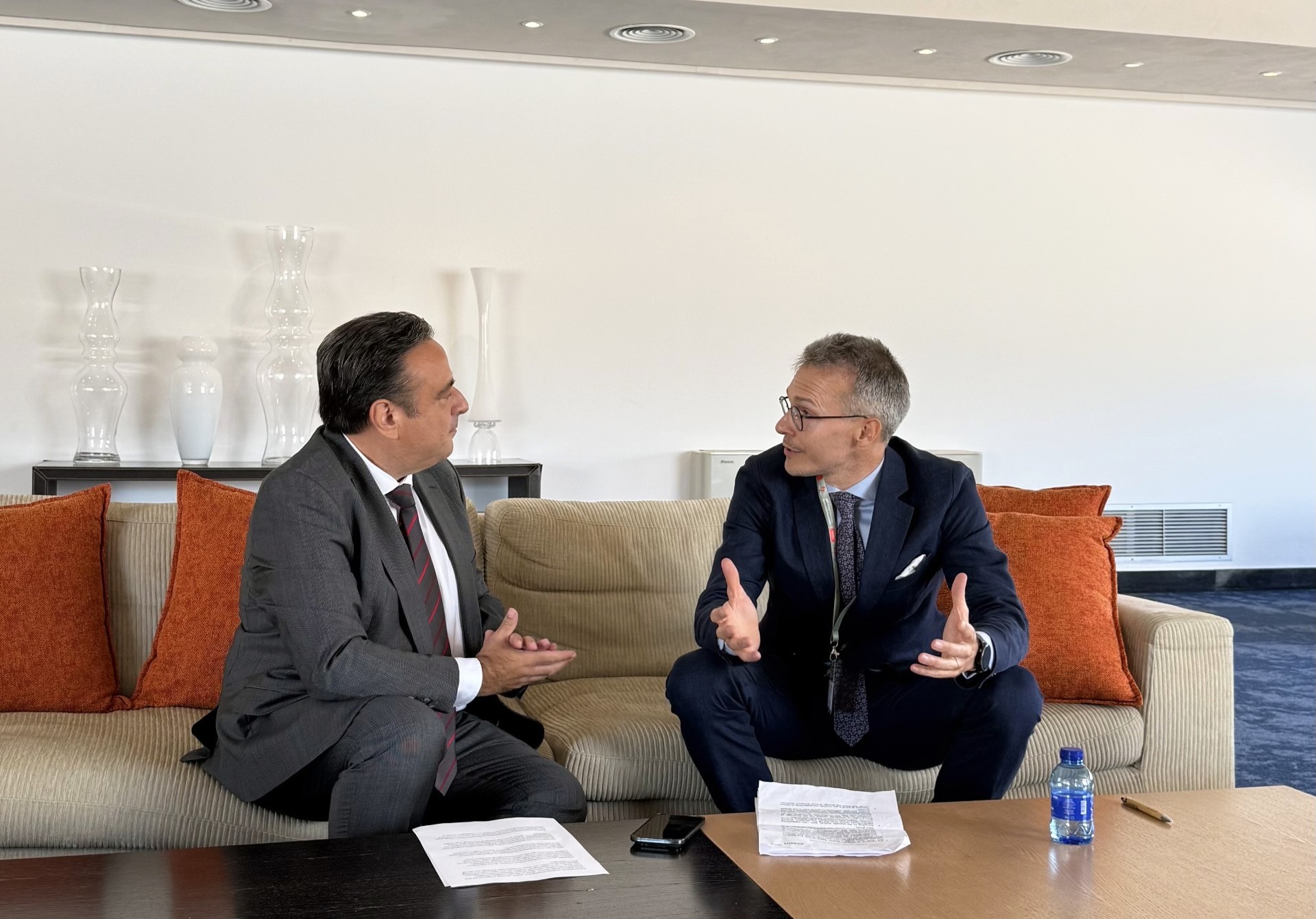
Interview with Robert Blotevogel, ESM Country Team Coordinator for Greece
Athens Radio (translated from Greek) and Athens Digest (original language – English)
16 July 2026
Interviewer: John Papageorgiou
Athens Radio: The European Stability Mechanism (ESM) recently published its first ‘Euro Area Stability Watch’. What is the key baseline scenario outlined in the report, and what should policymakers and markets take away from it regarding the outlook for the euro area? Focusing specifically on Greece, are there any particular findings you would like to highlight?
Robert Blotevogel: The European Stability Mechanism is the crisis resolution institution for the euro area. We are the firefighters. And we are convinced that the best way to prevent fires is to be prepared and to be aware. Exactly with this spirit in mind, we have published the first edition of the Euro Area Stability Watch. The report has one central theme: Europe has been surprisingly resilient over a number of crises and shocks in recent years, but this resilience can come under strain and it cannot be taken for granted. What we do is conducting a scenario analysis. We identify two highly relevant risks that the euro area is facing today. One is an escalation of the conflict in the Middle East, and the other one is a sharp correction in asset prices in the United States.
According to this scenario analysis, if both events were to materialise at the same time, the euro area would enter a recession, inflation would go as high as 5%, and debt sustainability concerns would come to the fore in many euro area countries. Difficult policy choices would become unavoidable. Looking at Greece specifically, the country has the advantage of having already taken very difficult decisions in the past. And we all remember the pain that the citizens went through during the sovereign debt crisis. Today, the picture is different. Greece has recently gone from strength to strength economically. The number of people that hold jobs is close to a record high. Greece has been growing almost twice as fast as the euro area on average over the past couple of years. And fiscal deficits and debt have declined precipitously.
In the adverse scenario, thanks to the progress that the country has achieved: it remains relatively resilient. Greece, together with Cyprus, are the only countries in this scenario where debt still declines over a 10-year horizon. That said, the real challenge for Greece is to address the big gaps that still exist today when it comes to productivity, to wages, and to income. These are the measures that really matter for the Greek citizens, and all focus should be on finding ways to narrow, if not close, these gaps relative to the rest of Europe.
The ESM remains Greece's largest creditor. At the same time, Greece appears to be improving its debt profile faster than previously expected through early repayments. In practical terms, what changes could these repayments bring? How might they support economic growth and investment in the short term?
You are right that the ESM and its temporary predecessor, the EFSF, remain Greece's largest sovereign creditor. In total, out of all the Greek sovereign debt, the ESM and EFSF hold more than half. What that means is that our interests overlap. We support all efforts that will help the economy grow faster, that make the economy more resilient. I already mentioned that the Greek government over recent years has really displayed quite remarkable fiscal discipline. That has helped generate fiscal surpluses and bring down debt, including repaying some debts early that were accumulated during the crisis times. And as a matter of fact, according to the European Commission, Greece will no longer be the most indebted European economy from next year.
We believe that the strategy of repaying early legacy debt accumulated or that the government contracted during the crisis is a very prudent strategy. Because what that means is a euro that you use to repay debt today, is a euro that is freed up to invest in housing and education and in infrastructure tomorrow. That way, you are really building the basis for a more sustainable and more prosperous future. Finally, by reducing debt, Greece insulates itself a little bit more against volatility in financial markets. Because lower debt means that Greece pays lower interest costs. And if interest rates change, which can affect some countries at times quite substantially, this feedback effect is dampened. Therefore, we think that repaying legacy debt from the crisis early helps to make the economy more resilient for the future.
One of the most important challenges for the Greek economy remains the need to increase productivity. Which policy measures do you believe could have the greatest impact, both in the short term and over the medium term?
I already mentioned that indeed Greece continues to have a large gap when it comes to average productivity to the rest of Europe. And unfortunately, this gap has existed for many years. It would be unrealistic to assume that this gap could be closed overnight. This will really require a dedicated and multi-pronged strategy to address. What is important in Greece is to stimulate and to enhance the dynamism of the economy. When we look at indicators like the rate at which new firms are being created and the rate at which less profitable firms exit operations, these indicators are low. This means that the economy is not re-allocating labour and capital from less efficient to more efficient firms, and that is holding back productivity.
So, what can we do? What can we do to really stimulate more entrepreneurship? It is a complicated puzzle. I'm only going to emphasise one piece of that larger puzzle. And it has to do with specific fiscal measures. For example, making investments in research and development tax refundable. That would mean that it pays more quickly for younger firms to try out new untested ideas. Another example is accelerated depreciation for investments in capital and equipment. With more capital, especially in smaller and in younger firms, you're going to make the entire company more productive, and you also create the basis for companies to scale their operations. And that is what can enhance Greece’s aggregate productivity in the future.
The Recovery and Resilience Facility (RRF) has helped address part of Greece's long-standing investment gap. How do you expect the expiry of the RRF to affect the Greek economy, and what policy priorities should follow once this source of financing is no longer available?
The Recovery and Resilience Facility provided significant support to the Greek economy at a very critical time. In 2021, the Greek economy started to rebound from the pandemic, but this recovery was initially heavily concentrated on tourism. With the help of the Recovery and Resilience Facility, recovery became more broad-based. And it increasingly developed an investment component, which is exactly what we would like to see in order to generate more growth in the future. Despite the important role that the RRF played, we believe the expiry of the programme does not need to become a major headache for Greece. And there are two reasons for that.
The first one is, under the RRF, the country implemented significant reforms and long-term investment projects. And both reforms and investments are going to pay dividends that extend well beyond the expiry of the disbursements of the programme. So, the Greek economy moved onto a higher growth trajectory thanks to the programme.
And the second point is that the RRF also created synergies with other forms of European support. Greece is entitled to substantial financial support from Europe in the context of the multi-annual financial framework, the MFF. And in the past, Greece was not always able to make use of all the money that was earmarked. But because of the RRF, administrative capacity in Greece has risen, the administration is now better able to identify projects, to design projects, and to implement them, and to then request financial support from the outside.
So, one hope is that thanks to the RRF, administrative capacity to also make use of other European support has increased, and that is going to also pay dividends over the longer term. That said, maintaining higher public investment is essential, but the goal is to crowd in more private investment, and for that you need overall a more conducive business environment, and that is what and that is going to be the focus of policy in the future.
Greece is expected to hold elections in the near future. While every EU Member State has its own electoral cycle, are you concerned about the potential economic impact of a prolonged period of political uncertainty in the country? More broadly, how do you currently assess Greece's political risk profile?
Let me start with a seemingly simple but fundamental point. Elections are an inherent part of the democratic process. So, there's nothing particularly surprising or uncertain about them. What can create uncertainty is if people do not know which type of policies and which type of priorities will prevail after the elections. And if this is unknown, then people can switch into a wait-and-see mode, and this can really dampen economic activity.
Now let's look at the risks for Greece specifically. In the short term, we believe that risks in Greece remain low, and this is primarily because of the economic achievements that Greece has realised in recent years. I already mentioned that employment has risen substantially. Many more people have jobs. The economy has been growing robustly, and fiscal performance has been remarkable, the government continues to hold large cash balances, and that is also insulating the country against uncertainties in the future. At the same time, Greece continues to have high levels of public debt, and I already mentioned the gaps that prevail when it comes to productivity, income, and wages.
Against this background, the ESM believes that it's important to be prepared, especially when things go wrong. And this suggests that two priorities will be important. One is to continue prudent fiscal policies and to keep public finances healthy. And the second one is to press ahead with the economic reform agenda that is already underway. These reforms will then lay the foundation to increase growth and to make the economy overall more prosperous and create even more jobs for the Greek people.
Contact