
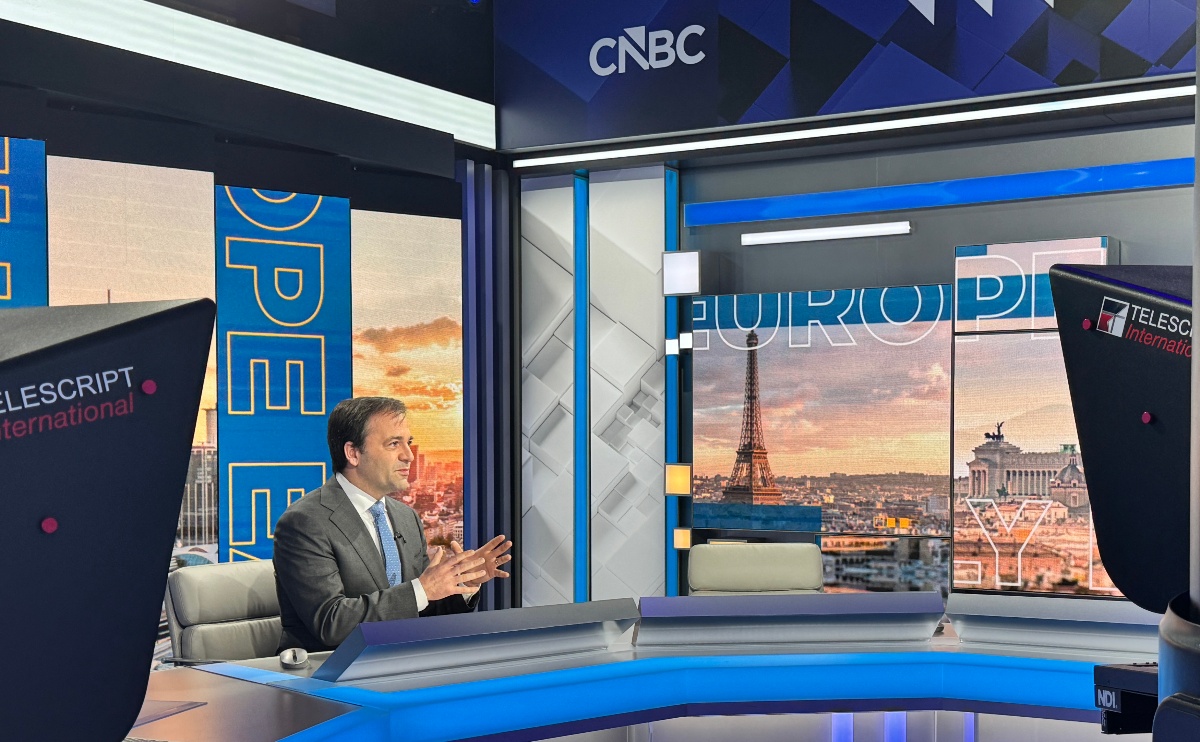
Transcript of interview with Kalin Anev Janse, ESM Chief Financial Officer
CNBC Europe Early Edition
5 February 2026
Interviewer: Carolin Roth
CNBC: When it comes to the attractiveness of the euro, what is it down to? Is it a pure safe haven play with the uncertainty and geopolitical uncertainty in the world, or is it actually a growth story?
Kalin Anev Janse: Good morning. If you look at last year, I think Europe went through a tremendous process of becoming very popular. First, the equities. I think one of my stories that I was telling last year is if you look at European equities, so whether that's the CAC 40, the Stoxx Europe 600, or if you look at the DAX, they all outperformed the Nasdaq and [other] top US exchanges. Europe is really becoming popular. Then if you add what the top-performing economies are, they are now based in Europe. The Economist has this very good publication where at the end of the year, they said that seven out of the ten economies that globally are outperforming are European. And that is, I think, a remarkable story.
It is a remarkable story, but you want that capital, you want that to be sticky, and you don't want that to leave the European Union once again, once the growth numbers do disappoint. How do we make sure that we do actually implement all the reforms that we set out?
What is really nice to see that the capital is really coming in. You mentioned one of my stories I've been telling last year is that we've seen in bond investments - and we as ESM are a large bond issuer - is that investors from around the globe, whether it's from Asia or from Latin America or from the Middle East, are getting more and more into the euro. And that is, I think, very attractive. On top of that, we also have seen countries like Saudi Arabia, like China, like Indonesia, like Chile, starting to use the euro as their currency of choice in issuing outside their local currency. So I think there's really a European momentum that started in 2025, and I think it will continue in 2026 because it is probably the safest place to invest your money these days.
So it's safe, but it's also banking on reforms, specifically coming out of Germany when it comes to the fiscal spending package. And we're seeing some of the fruits of labour coming through. But you always got to wonder, is there a big bang coming or is it really just a trickle-down effect of certain reforms that filters through to the economy? When I talk to international investors, they're hoping for this big bang. Maybe they're too naive here. Should we temper expectations here on what the Eurozone economy, what the German economy can achieve?
I'm with you that I think this great momentum of last year, where equity is great, the economy doing well, we should now take it in 2026 in order to do the big reform. For me, there are some reforms we in Europe have to do in the long view. One of them is the Savings and Investments Union. I think we really need to deepen capital markets. So that's one. I think the other one is that we need to boost our competitiveness. What gives me hope is that if you see equity prices go up, if you see debt markets go up in Europe, that at least investors, global investors, are with us. And now I think on the policy side, we need to make sure that these reforms are really happening.
Mario Draghi made a big splash with the Draghi report. We’ve also got the Letta report. We’ve got all kinds of reports. He also criticised that it hasn't really been implemented just yet. Now, recently he's saying that we really need to step up our game given the geopolitical challenges we're all facing, we need a federated Europe. Is Europe ready for more federation?
If you look at where Europe is really coming together is in debt markets. When I started my career in the EFSF 15 years ago, we had only around €400 million of European safe assets, and they were coming out of the European Investment Bank. If you fast forward to today, we have €1.4 trillion, so more than three times in the market, which is the EIB, the European Stability Mechanism, the EFSF, and the EU. So that is already coming as a kind of European safe asset bond that is in the market, all trading on EU ISIN codes. So I think we are already consolidating in terms of finance and economics. I think Mario Draghi is trying to push us in that direction. It is happening, but I think more can happen in the future.
You say it is happening, but when it comes to a safe European asset, Europe has a couple of options here, but in terms of liquidity, in terms of volume, they're nowhere close to, obviously, US treasuries, and that that won't be the case for a while. Is there hope here? Is that a plan? Is that a strategy to develop a profound safe European asset?
It's not only a hope, I think it is really reality these days. With the €1.4 trillion of European safe assets now in the market, we're very close in terms of liquidity as Spain, because Spain has €1.5 trillion. And we represent now the fifth largest country in Europe after France, Germany, Italy, and then Spain. We will soon surpass Spain as a safe asset in the market. So, it's not as big as the US, but also our debt levels in Europe are lower than in the US. But for investors, that deep safe asset of European issuers is really helping. And what gives me additional hope is we have seen over the course of the last 12 months real price tightening. At the ESM, we issued a bond earlier this week, and we were pricing just 19 basis points over Germany. We are triple-A rated, and it means that the market appreciates these European safe assets almost at the same price as Germany, which I think is an incredible story. The safe assets are there, and I think they'll be growing in the future.
And that is remarkable. Obviously, at the ESM, you have a very important job also in terms of giving funding, and there's always the hope that the private sector does 80% of the heavy lifting, and then institutions like the ESM or others, they do the rest. The EIB has been a very important player, but you have more firepower. The European institutions, you could do more, right?
If you look at my own institution, the ESM, we have a lending capacity of €500 billion, of which now around €70 billion is used. So €420-430 billion is still available for the future. And when I'm at roadshows, and I was in India last November, in one of the Indian conversations they said, “You know, the ESM is Europe's hidden treasure”. There's so much available as a capacity. If something hits Europe, whether this is another financial crisis or another Covid crisis or if it's defence-related, the ESM is there to help and protect the euro area. We have this hidden pocket of financial stability and financial firepower, which we can unleash if there is an external shock to the euro area.
Contact