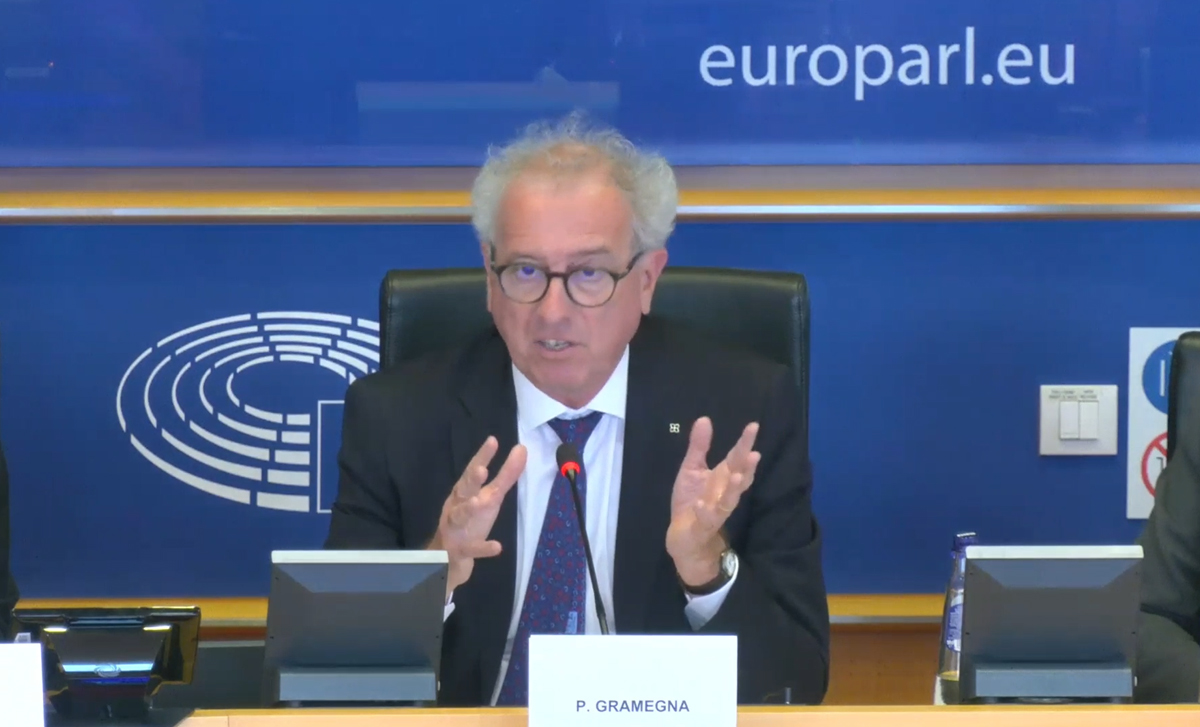
Transcript of statement by Managing Director Pierre Gramegna
ECON Committee of European Parliament
Brussels, 22 June 2026
Madam Chair, honourable members, dear Aurore, it's a pleasure to be here with you today to present to you the Annual Report, which also contains the accounts and financial position of the ESM, to share that with you and exchange views with you.
This is my first appearance before the ECON Committee since the Memorandum of Cooperation between the European Parliament and the ESM was signed in 2024, and I had the privilege to sign that with you. I'm glad that today we have this opportunity today.
We will also have the opportunity to have a mission of the ECON to Luxembourg in September at the headquarters of the ESM, and I think this is also a very efficient way to exchange views and to learn more about each other. The Memorandum of Cooperation established a more structured framework for cooperation and exchanging of views. The ESM is an intergovernmental institution, but it is part of a broader European institutional and democratic framework. Regular engagement with this Committee helps ensure transparency, accountability, and a shared understanding of how the ESM contributes to safeguarding the stability of the euro area.
Just 11 days ago, at our Annual Meeting in Luxembourg, the ESM Board of Governors approved the Annual Report, which has since been officially transmitted to the European Parliament. The Board of Governors, which comprises the ministers of finance of the euro area member countries, also reviewed the institution's recent work and discussed the challenges that Europe faces in a more uncertain and shock-prone world. The Annual Report shows that in 2025, the ESM operated in an environment marked by heightened geopolitical tensions, renewed market volatility, and increasing pressure on the rules-based multilateral order.
In that context, one message stands out clearly: the euro area and the ESM have remained resilient. The ESM delivered a record net profit of €1.97 million in 2025, the highest result since its inception. This result was supported both by higher interest rates and by the performance of the ESM's [investment] managers, who outperformed the benchmarks while remaining prudent. This growth in the ESM's reserves strengthens our capacity to respond in times of market stress and uncertainty. With €81 billion in paid-in capital and a reserve fund of around €7.2 billion, the ESM is the most capitalised international financial institution in the world. That capital is not used directly for lending.
It underpins our AAA rating and allows us to raise funds at very low cost. Our maximum lending capacity of €500 billion, of which €433 billion is available, is a form of insurance against financial instability. And like good insurance, its value lies in the fact that it is there when and if needed.
But beyond the figures, the Annual Report reflects something more fundamental: the continued relevance of a common institution built on resilience, solidarity and credibility. This is why the ESM matters. Because there are not abstract principles, but practical requirements for safeguarding financial stability.
Let me start by focusing on resilience. That means having the institutional and financial strength to respond when conditions deteriorate. This is reflected in the ESM's balance sheet, its lending capacity, and its ability to act in support of euro area stability, which contribute to keeping sovereign spreads contained.
Solidarity, the second feature, remains central. The ESM continues to serve as an anchor of stability for its Members, underpinned by shared responsibility and mutual trust.
And third, credibility. This credibility is built through strong financial results, prudent risk management, and close cooperation with our European and international partners. The ESM and the EFSF, which is under ESM management, are an integral part of Europe's economic and institutional architecture.
The credibility of the euro area and of the ESM as its safety net continues to attract new members. When the ESM was inaugurated in 2012, 17 countries were sitting around the table. Today, the euro area counts 21 countries. Following Bulgaria's ratification of the ESM Treaty, its accession as the 21st member of the ESM will become effective next Monday, on 29 June. This is an important and positive development for both Bulgaria and the euro area as a whole.
In this year's Annual Meeting, we had the privilege of welcoming, alongside the ECB representative and European Commissioner Valdis Dombrovskis, also the IMF Managing Director Kristalina Georgieva for an exchange of views on global challenges. She stressed the importance of strong cooperation between the IMF and regional financing arrangements such as the ESM as a cornerstone of the global financial safety net. In a more shock-prone world, that cooperation matters for crisis preparedness and for safeguarding financial stability. That discussion was particularly timely. The environment we face today is different from the one in which the ESM was created. Europe is exposed to new sources of risk, and financial stability can be affected by shocks that are geopolitical, economic, financial, or of strategic nature.
This is why the debate on the adequacy of crisis prevention and crisis response tools is so important. At the Annual Meeting, I recalled the progress made in the follow-up to the ESM toolkit review, including work on precautionary instruments and on the indirect recapitalisation instrument. At the same time, important questions remain open on how Europe can best equip itself for more volatile world situations. In that debate, the ESM stands ready to contribute constructively and pragmatically.
Let me conclude with a simple point. The 2025 Annual Report is not only a record of a successful financial year for the ESM. It is also a reminder that Europe needs strong, credible and agile common institutions. In a world of growing uncertainty, the ESM remains resilient, anchored in solidarity and ready to act in support of euro area stability. I am looking forward to your comments and questions.
Contact