
10th Joint RFA Research Seminar Calls for Stronger Cooperation on Digital Finance in a Geo-Fragmented World
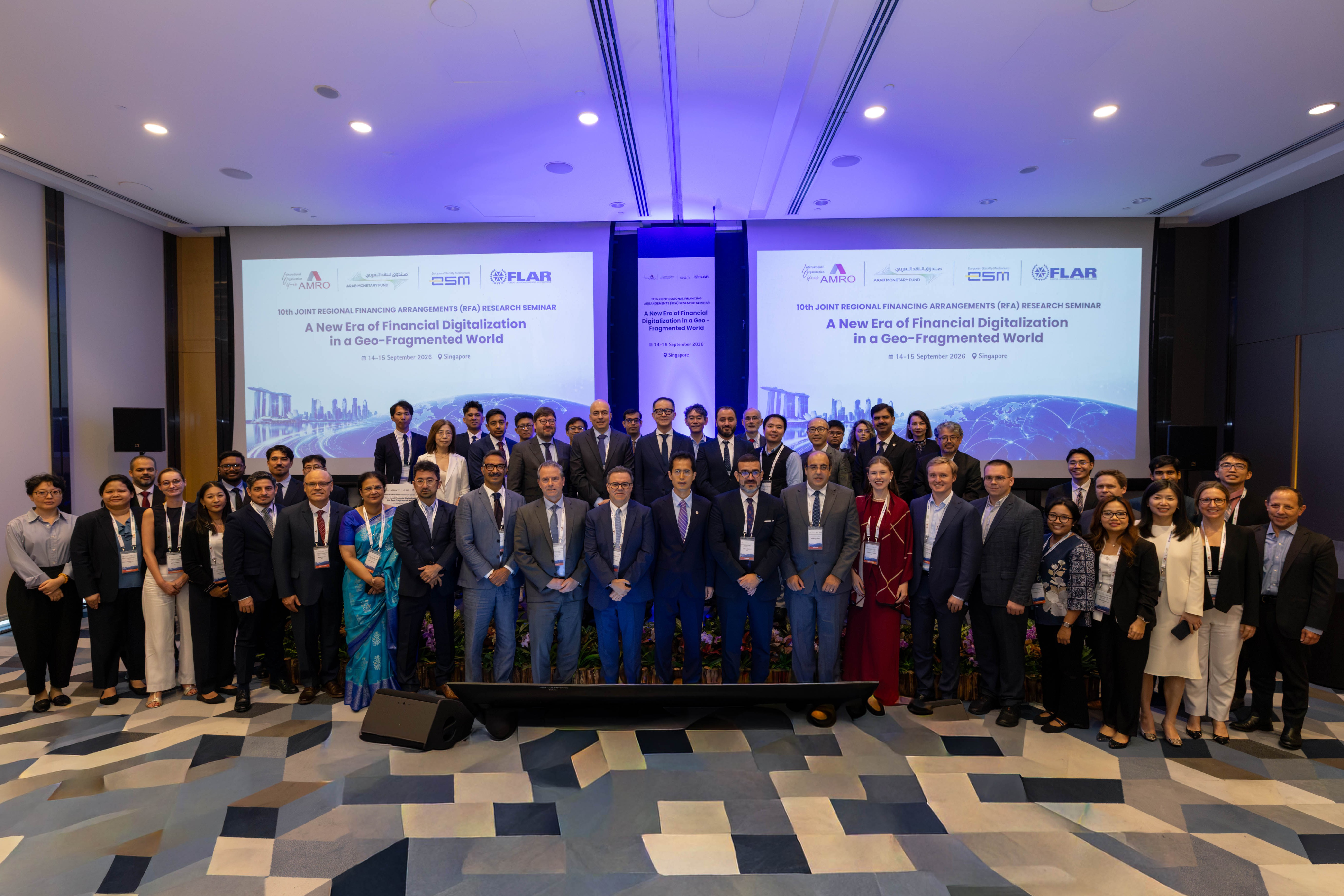
SINGAPORE, SEPTEMBER 15, 2026 – The 10th Joint Regional Financing Arrangements (RFAs) Research Seminar concluded today in Singapore, bringing together more than 150 participants from across the globe, including heads of institutions, policymakers, academics, and experts. The seminar examined how rapid financial digitalization is reshaping money, payments, and global financial system; the implications for financial stability and policy formulation; and the evolving role of regional and global financial safety nets.
Held on September 14-15 in a hybrid format, the seminar was jointly organized by AMRO, the Arab Monetary Fund (AMF), the European Stability Mechanism (ESM), and the Latin American Reserve Fund (FLAR). Discussions focused on the opportunities and risks arising from stablecoins, tokenized deposits, central bank digital currencies (CBDCs), and emerging cross-border payment systems against a backdrop of growing geoeconomic fragmentation.
AMRO Director/CEO Yasuto Watanabe opened the seminar, emphasizing the shared commitment to exchanging experiences and enriching dialogue to strengthen cooperation among RFA institutions and deepen understanding of the opportunities and challenges arising from financial digitalization. Will Cong, President’s Chair Professor of Finance, Computing and Data Science and Associate Dean of Nanyang Business School, delivered the keynote address on innovation, competition, and stability in an increasingly tokenized financial system.
The first session, chaired by AMRO Chief Economist Dong He, examined the transformation of money and payments, including fast payment systems in Latin America, cross-border payment connectivity in ASEAN+3, the tokenization of real-world assets in the Arab region, and the evolution of digital finance in Europe. Participants noted that greater interoperability could make cross-border transactions faster, more affordable, and more accessible, while fragmented technical and regulatory standards could introduce new operational and financial integrity risks.
The second session, chaired by FLAR Chief Economist Carlos Giraldo, explored the implications of CBDCs and stablecoins for monetary policy and central bank balance sheets. Participants discussed how different forms of digital money could coexist while preserving central bank money as an anchor of trust. They also considered how CBDC design and stablecoin regulation could affect competition, privacy, monetary sovereignty, and the transmission of monetary policy.
The third session, chaired by AMF Executive Director for Capacity Development and Innovation Department, Dr. Sofiene Gaaloul, focused on financial stability in a digital monetary system. Participants examined how the speed and ease of digital transactions could intensify runs during periods of stress and create new channels of contagion between the traditional financial system and the digital asset ecosystem. Authorities will therefore need to strengthen monitoring, clarify regulatory responsibilities, and ensure that crisis-management and liquidity frameworks keep pace with innovation.
The seminar concluded with a policy roundtable on digital finance, trade, and growth in a geoeconomically fragmented world, chaired by ESM Secretary General Nicola Giammarioli. The discussion highlighted digital finance as a key driver of growth, trade integration, and financial inclusion, particularly through more efficient cross-border payments. Panelists also stressed that geopolitical fragmentation could lead to competing payment systems and standards, which could undermine global financial connectivity. They underlined that interoperability, resilience, and international cooperation will be essential to harness innovation while safeguarding an open and integrated financial system.
For RFAs, these developments have direct implications for economic surveillance, crisis prevention, and financial assistance. A deeper understanding of emerging digital channels and vulnerabilities will enable RFAs to better assess risks and contribute to a more responsive and well-coordinated Global Financial Safety Net.
Held annually since 2017, the Joint RFA Research Seminar provides a platform for RFAs, central banks, finance ministries, international financial institutions, and academics to exchange research and policy perspectives on global and regional financial stability.
The RFAs will next convene at the 11th High-Level RFA Dialogue, to be held alongside the IMF–World Bank Annual Meetings in Bangkok, Thailand in October 2026.
Contact