
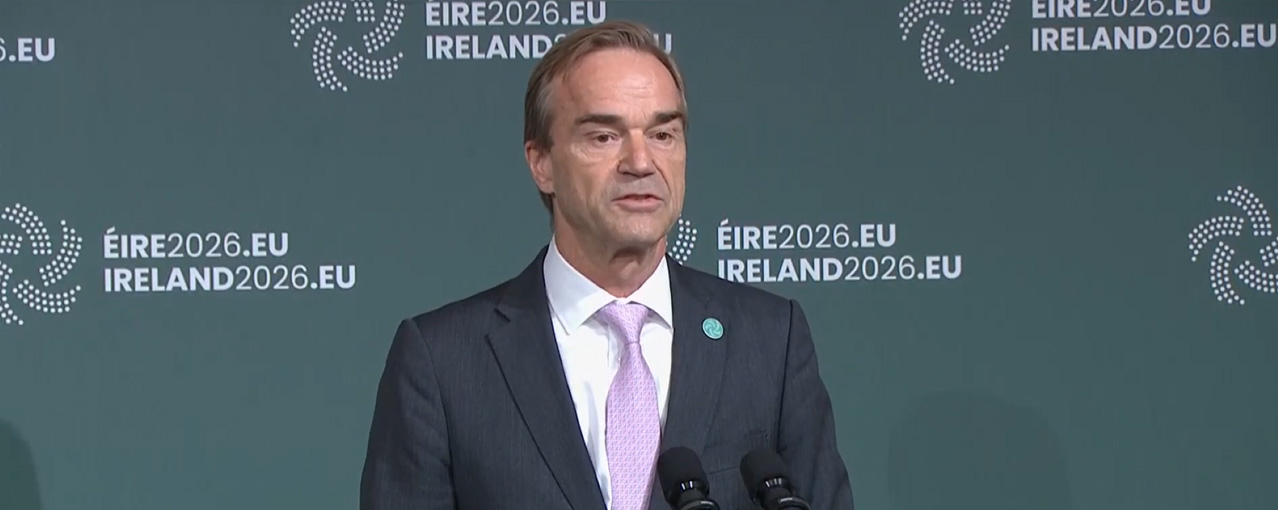
Remarks by Chief Economist Rolf Strauch
Press conference following Eurogroup meeting
Dublin, 18 September 2026
I will focus on the risks that put Europe's resilience under strain. And here let me say that the conclusions of the Euro Area Stability Watch, the ESM's financial stability report that we published in July, still hold.
It is true that the euro area economy has held up better than expected: strong exports, resilient labour markets, and stable household demand. But some of those factors may be temporary. Particularly, export outperformance may be driven by one-off factors, and it does not change the fact that, in terms of growth and competitiveness, Europe is still outperformed by the US and China.
So, recent data clearly give reason and encourage confidence, but they do not justify complacency. Inflationary pressures from high energy costs are driving higher expectations for central bank rates, as central banks have to act, have to react, not only in Europe, but globally. And so, rising long-term rates are working their way into borrowing costs for sovereigns, for companies, and for households alike. That reinforces the message that was also made before: fiscal space is limited and governments need to be careful.
The most indebted and those with the biggest refinancing needs are the most exposed. And in this case, rates matter more as debt is climbing. Euro area debt-to-GDP is set to reach 90% this year and interest payments are set to exceed 2% of GDP. Higher long-term yields will translate into heftier interest rate bills and debt refinancing at higher rates. And there are other international developments that warrant continued monitoring, like Japanese investors selling overseas and US hyperscalers issuing on bond markets.
In this environment, maintaining credible fiscal policies and rebuilding buffers where possible remains the best possible protection against future market stress.
Turning to productivity and competitiveness, we had the great chance to hear the Secretary-General of the OECD, Mathias Cormann, today. I would like to thank him for the thought-provoking presentation.
The business model that supported European export growth for many years is coming under increased pressure. China has caught up rapidly and high energy costs are adding to the pressure. Electricity prices in Europe are double as high as they are in the US for energy-intensive sectors, and they are 50% higher than in China. From that perspective, we know that we need to act and improve on innovation. Europe's challenge in this regard is not the lack of startups, but the lack of scale-up. A stronger savings and investments union can close the gap, mobilising private savings.
The discussion today highlighted both Europe's strengths and its vulnerabilities. The challenge is now - as was also said by the President of the Eurogroup - to turn diagnosis into action.
Thank you.
Contact