
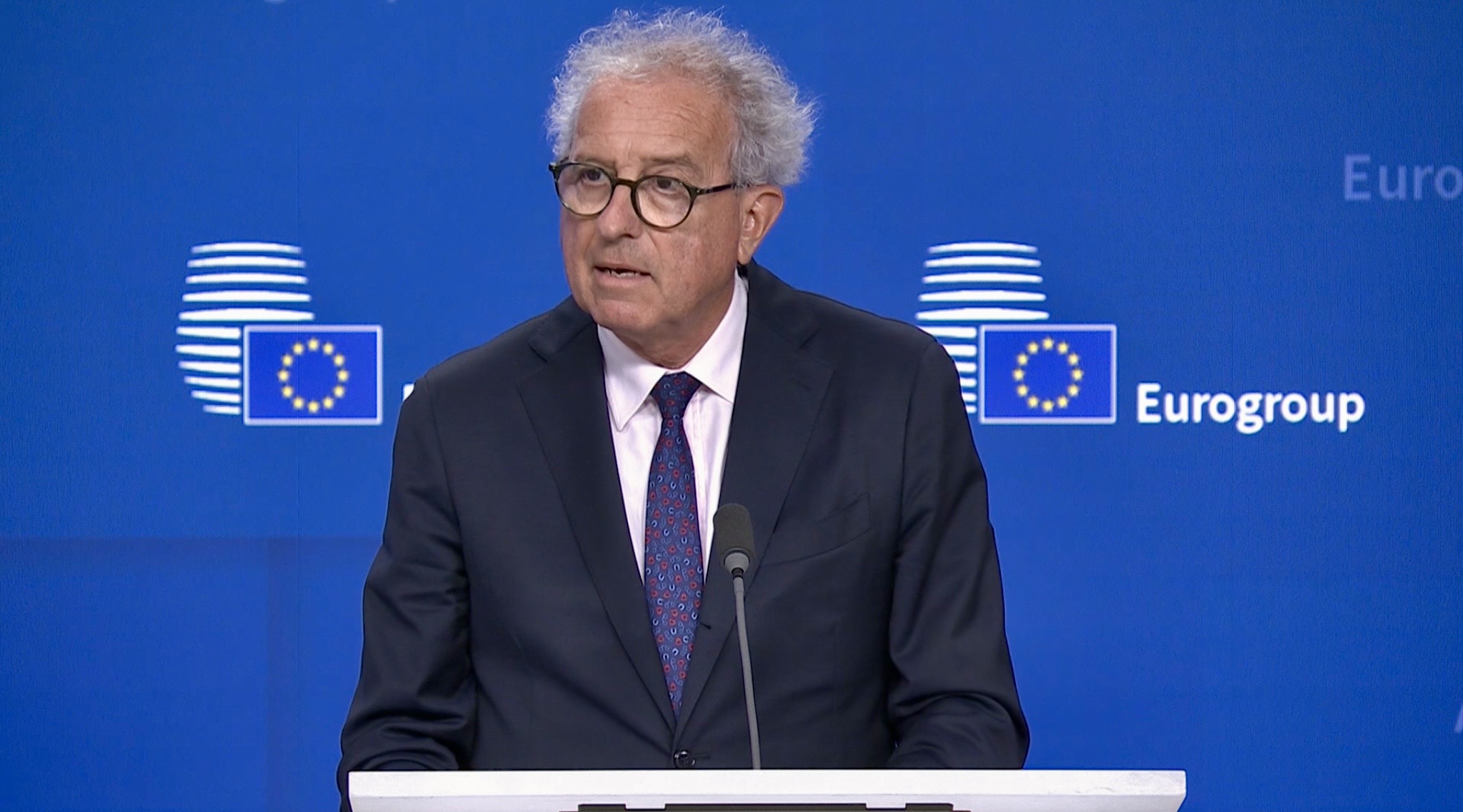
Remarks by Managing Director Pierre Gramegna
Press conference following Eurogroup meeting
Brussels, 9 July 2026
Good evening, everyone. I will just focus on two topics: the fiscal outlook and the international role of the euro.
First, I would like to thank the European Commission and the European Fiscal Board for their thorough assessments. Risks remain tangible and the uncertainty around geopolitical tensions in the Middle East remains high.
The ESM broadly concurs with the European Commission's fiscal stance for 2026, which looks appropriate given the prevailing outlook. In this volatile and uncertain global environment, the ESM has published the first edition of its Euro Area Stability Watch, which focuses on two external risks: a re-escalation in the Middle East and a potential sharp repricing of US assets. If both these risks were to materialise, the euro area would see weaker growth and higher inflation.
In the ESM's Euro Area Stability Watch, staff simulations show that, in such a severe scenario, where these shocks would both materialise at the same time, euro area growth could move into slightly negative territory while inflation could rise to close to 5% by the end of the year. This would weigh on budgets, while higher inflation would push up interest rates and borrowing costs. It forces difficult budget trade-offs.
That is why governments need to continue doing their homework: rebuilding buffers, protecting investment, and focusing on growth-enhancing priorities. We concur here with the analysis of the European Fiscal Board. In this respect, I would also like to mention the EU fiscal rules, to which we must always refer and with which we need to comply. Broadening national escape clauses to include energy support measures may be a pragmatic solution but will lead to underlying debt pressures. Every exception carved out today will require more fiscal adjustments tomorrow.
This also matters for the international standing of the euro. The ECB's report on the international role of the euro confirms the strong euro-denominated issuance in 2025, with signs that the euro could act as a safe-haven currency in times of market stress. This highlights that the euro is gaining importance as a safe haven and alternative reserve currency, supported by strong issuance, robust foreign demand, institutional strength, and signs of diversification away from the US dollar.
But the safe-haven status is not just earned through trust alone. The fundamentals must be right. It needs a sound economic structure to ensure Europe's strong role in the global economy and its competitiveness. And we need accessible, deep, and integrated markets. The international role of the euro rests on our efforts to mobilise growth drivers and strengthening our strategic autonomy.
The Draghi and Letta reports have given us the blueprint both for directions of national reforms and European action. Promoting the single market is key. Many initiatives have been launched in this matter. They need to be complemented and implemented. The Savings and Investments Union is a cornerstone of where this becomes concrete.
It can help turn Europe's large savings pool, over €10 trillion, into productive investments. We also need to set the basis for Europe's future in a digitalised financial system. We very much welcome the progress made on the digital euro project. Digital central bank money will be the backbone of our financial system and the comparative advantage promoting the international role of our currency.
The ESM is part of this landscape: financial stability is our mandate, and the stable euro is what gives international investors confidence to hold euro assets in the first place.
Finally, I would like to congratulate Kyriakos on the priorities for next year's discussions, which is a very ambitious plan. Thank you very much.
Contact