
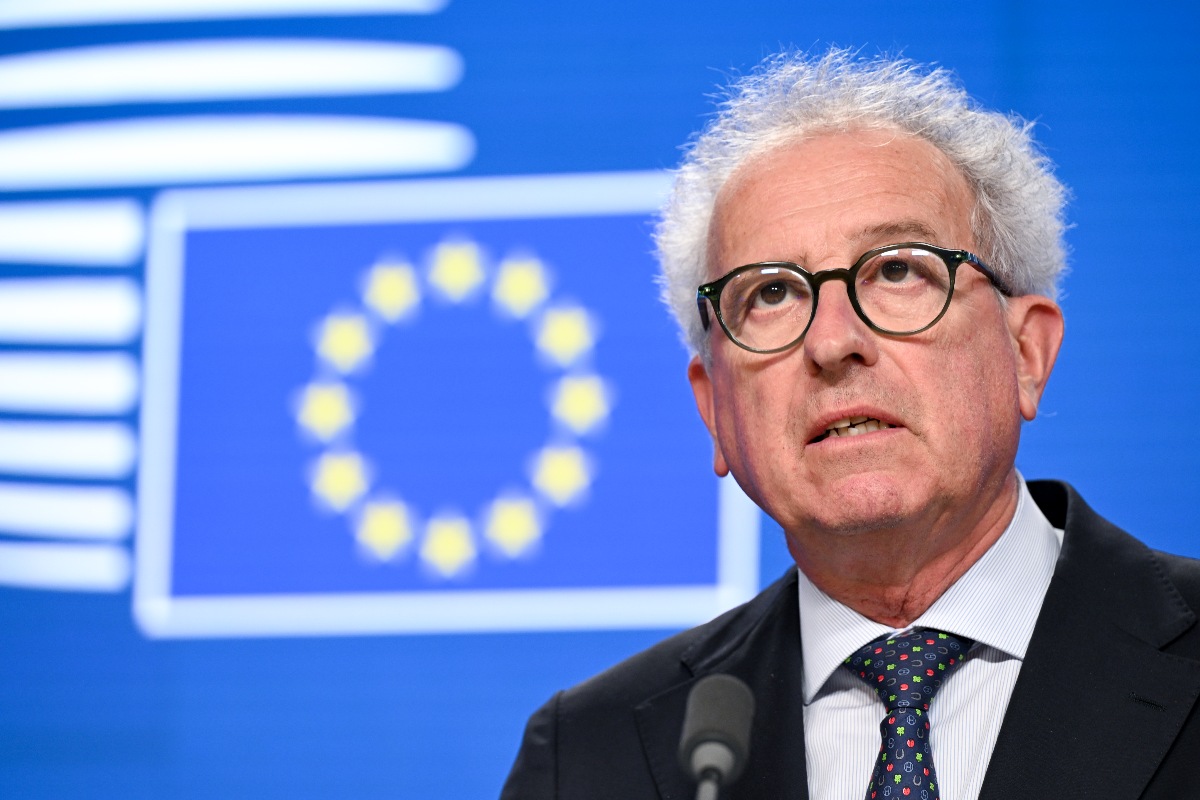
Remarks by Managing Director Pierre Gramegna
Press conference following Eurogroup meeting
4 May 2026 in Brussels
Good evening, everyone. Let me first start by congratulating President Pierrakakis for putting on the agenda today the important issue of digital finance. These discussions are extremely useful in building a shared understanding of how digitalisation will fundamentally transform our financial system. We are fully engaged as ESM in this work, including also in our role as an issuer on financial markets. Digital finance is becoming an essential element to ensure Europe's strategic autonomy and financial stability over the long term. So, this work is key and the discussion today paved the way for the statement that is being prepared for July.
On banking union, we had the pleasure to have the chairs of the Single Supervisory Mechanism and of the Single Resolution Board with us, Claudia Buch and Dominique Laboureix. They underlined that it is important to ensure that banks are sound and can be resolved effectively in a crisis. This is particularly critical for Europe's resilience in today's volatile environment and times of geopolitical turmoil.
In parallel, Europe faces very large investment needs, and the public sector can meet only part of it. In fact, an essential role is played by financial investments from the private sector. In this context, cross-border consolidation in the banking sector is about Europe's ability to finance its own priorities and strengthen its strategic autonomy. Large cross-border banking groups can help channel savings towards productive investment. They can offer pan-European investment products, help develop securitisation through more diversified assets, and better support companies operating across borders. At the same time, we should keep in mind the lessons from the great financial crisis.
It is important to remember that larger and more complex banking groups can become too big to fail and create risks across borders. This is why we need to make sure that our safety net is complete. This includes the ESM backstop to the Single Resolution Fund, a credible arrangement for liquidity in resolution, and European Deposit Insurance Scheme, EDIS.
Last but certainly not least, the conflict in the Middle East. Let me conclude with those remarks. In recent weeks, the reaction of markets appeared overly optimistic, but as the progress in reopening the Strait of Hormuz has stalled, oil prices have moved up again. And sovereign spreads in the euro area are also widening, although less than in March. We know that even if the conflict were resolved in the near term, its economic aftereffects would last longer than the conflict itself. If markets reprice more abruptly, financial conditions will weigh further on growth and stretch already limited policy space for governments. This is why countries need to remain disciplined and keep measures temporary, targeted, and tailored, as discussed today in the Eurogroup.
Response to question on whether financial markets are still overly optimistic about the impact of the war in the Middle East, and whether Mr Gramegna was concerned about a ‘double whammy’ where market volatility coincides with another crisis, e.g. in private credit.
As you know, the markets are always right – that’s what they say themselves. I cannot read the future better than the markets, but what I can say is that in Washington at the IMF Spring Meetings, it was striking that the markets’ analysis was much more positive than the one of institutions, be it the IMF itself, be it the European Commission, be it lots of other participants. And that was for me a striking feature. That's why I mentioned it here in my speech. And it goes along with this tendency with the markets to give more importance or maybe overvalue the good news and play down the bad news. Now, unfortunately, with the continuation of the conflict, the most recent evolution and the stall in the Strait of Hormuz, the markets themselves have revised their position.
As European Stability Mechanism, we try to strike the right balance to have a sound judgment of the risks in terms of financial stability. That's why we follow this very closely and we are ourselves an actor in the markets as we issue bonds. So, we try to be very attentive to what is said in the market and what is really happening, and we continue to analyse this on a regular basis.
Contact