
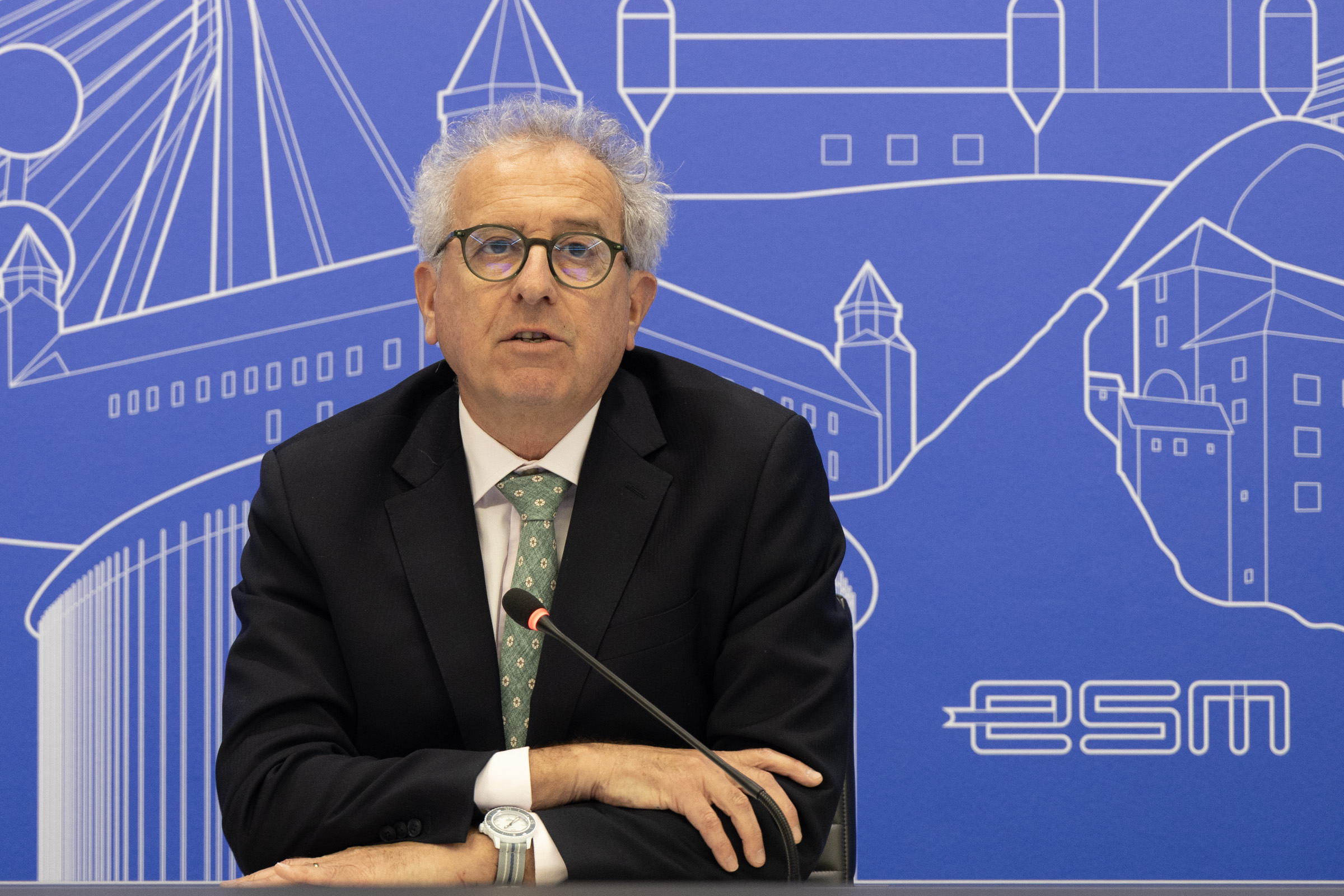
Remarks by Managing Director Pierre Gramegna
Press conference following Eurogroup meeting
27 March 2026 (online)
Good morning, everyone. Let me start by thanking President Kyriakos Pierrakakis for organising this meeting in a teleconference format and thus anticipating rightly that this meeting would be useful, as it proved to be.
Also, many thanks to the Executive Director of the International Energy Agency, Dr. Fatih Birol, who provided a very valuable contribution to our discussions. It is very timely that we have this meeting because the disruption in the energy markets that we have seen since the beginning of the [Middle East] conflict has increased.
I'm going to focus on in my remarks on three items. First, developments in energy markets. Second, the economic consequences as they are perceived by the market. And third, the policy responses.
Even if the conflict ended tomorrow, the consequences of this war - that has spread all over the Middle East - would stay with us for a longer time. Gas and oil prices are expected to stay high throughout the year and this is influencing how markets are seeing inflation and the broader outlook. Concerning the outlook on inflation, markets see that we will have higher inflation ahead during the whole year, but are still expecting a return to the 2% level during next year. In terms of growth, markets also consider that growth will be less than 1% in the euro area due to this ongoing war. And last but not least, markets are expecting that interest rates will be higher for government bonds, which in turn means higher borrowing costs for governments.
Fortunately, compared to the energy shock that we had in 2022, renewable energy is more in the forefront in many countries. And it was rightly mentioned that countries like Spain and Portugal have increased the share of renewable energy, and are now less hit by the energy shock than they were last time. But markets could shift rapidly if the consequences of energy disruption become more severe and governments loosen fiscal policy too much. That is why the ESM supports the Commission’s call for support measures that are temporary and targeted.
Helping vulnerable households can be helpful, but public finances need to remain healthy. The General Escape Clause has provided important flexibility in the past, but using more exemptions to deal with today's pressures could make it harder to return to normal fiscal rules later. It is important to keep the longer-term picture in mind because the credibility of the fiscal framework helps maintain market confidence. In that context, I would like to add that avoiding measures that increase fossil fuel consumption is essential. It is also important not to reverse the progress towards renewable energy that has been made so far.
In conclusion, today's discussions were very important and highlighted both the short-term challenges and the long-term choices that Europe faces. The period calls for careful, coordinated and forward-looking action. In Europe, we are well-equipped to address these challenges ahead, which includes ESM financial instruments available under the current ESM Treaty.
Contact