
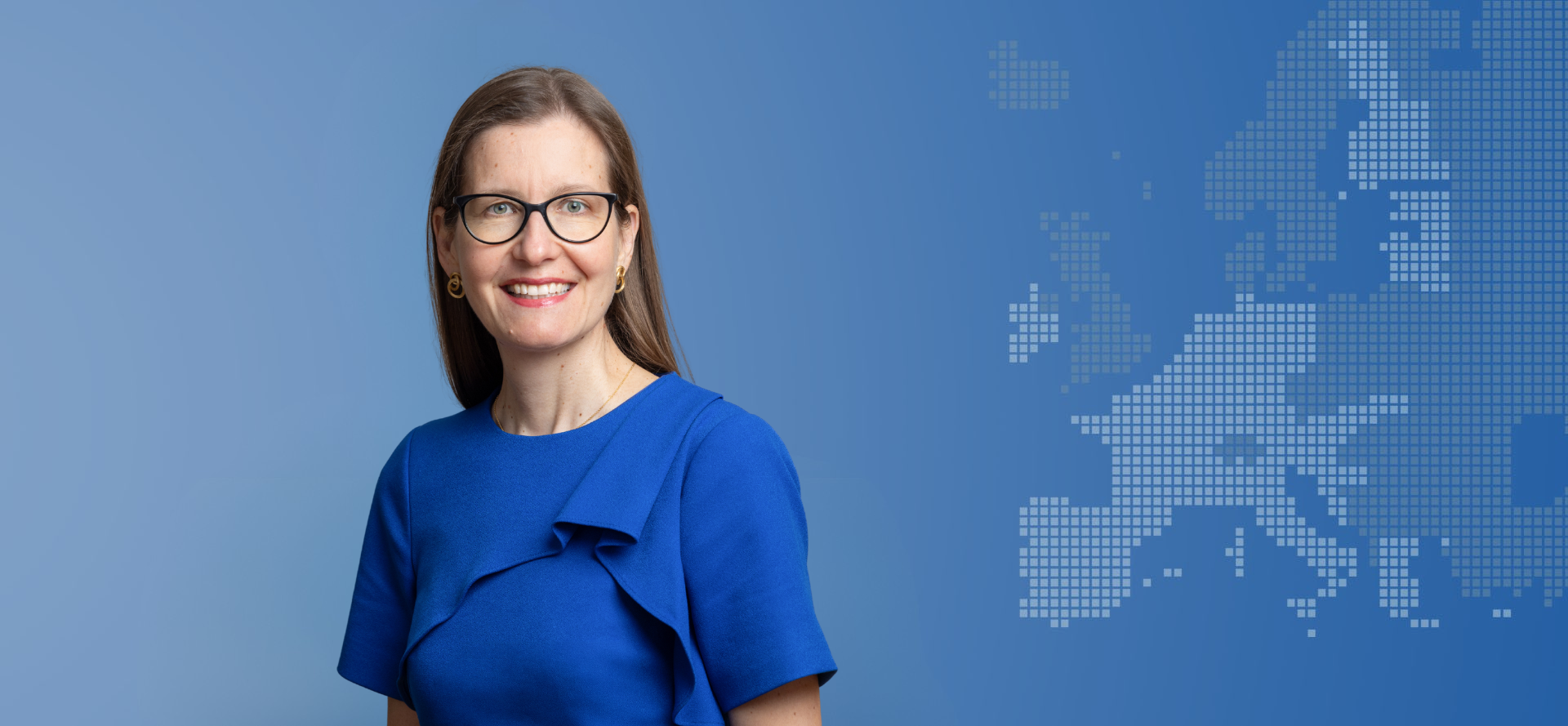
Interview with Yana Djoneva, ESM Chief Operating Officer
Published in Capital (Bulgaria)
12 May 2026
Interviewer: Nickolay Stoyanov
Capital: The ESM is a safety mechanism created after the last major financial crisis. How likely is it that EU countries might need to tap it in 2026 or the coming years considering all the global conflicts?
Yana Djoneva: The euro area is today in a much stronger position than in the past. We have built more robust institutions, sounder public finances in many countries, and a financial system that is better prepared to deal with shocks. This resilience is clearly an asset in the current geopolitical environment.
At the same time, we are living through a period of heightened uncertainty, with ongoing conflicts, energy risks, and a more fragmented global landscape. In such times, it is important to have strong and credible common instruments in place.
This is precisely the role of the ESM. It is not there because we expect a crisis, but because we want to be prepared. It is part of Europe’s financial safety net, and its full potential can be used to support its Members, if needed, and to preserve financial stability across the euro area.
Currently, the ESM members are the other 20 countries of the euro area. We hope that Bulgaria will become its 21st Member soon.
Over the last few years, our efforts have turned to crisis prevention and reinforcing the resilience of the euro area by developing advanced analytical tools and actively contributing to relevant policy discussions. At the same time, we continued to maintain our preparedness to deliver on all aspects of our mandate if needed.
The ESM’s maximum lending capacity is €500 billion, of which more than €430 billion is currently available. This large firepower matters, especially in moments of high volatility and uncertainty that we observe now. Our institutional presence and preparedness to safeguard the euro area is reassuring to financial markets.
So, the focus should not be on whether the ESM will be used or when, but on ensuring that it remains effective, credible, and ready in a more uncertain world. It’s like a fire brigade. You hope you won’t need it, but you want it to be ready to act in case of need.
For countries like Bulgaria, which have just joined the euro area, this is also an important perspective: over time, deeper integration into the euro area’s financial architecture, including the ESM, will further strengthen the country’s resilience and the market and investors’ confidence in it.
How is the oil shock affecting the euro area and its stability? What can be done to mitigate the risks stemming from it?
The euro area is exposed to energy shocks because it still relies significantly on imported energy. Around 60% of the euro area’s energy needs are imported, with oil, petroleum products, and gas representing more than 90% of these imports. The slowdown in the progress towards reopening the Strait of Hormuz has led to a new rise in oil prices, and some widening of sovereign spreads. This points to increasing pressure on growth and financing conditions across the euro area.
As Eurogroup President and Chairman of the ESM Board of Governors, Kyriakos Pierrakakis, noted last week, the situation in the euro area is moving in a direction of low economic growth and rising inflation that requires careful and targeted decisions. In other words, we are not in a crisis scenario, but the risks are clearly rising.
This is also reflected in the ESM’s own monitoring. As our Managing Director Pierre Gramegna has also underlined, even in the case of a relatively quick resolution of the war in the Middle East, “the economic consequences will be longer lasting.” Due to the damage sustained by regional energy infrastructure, restoring capacity and completing repairs will require some time, resulting in extended effects.
This is an important point: the effects of an oil shock do not disappear immediately, and they can continue to affect economies through higher costs and weaker sentiment.
So, what can be done? The key challenge for policymakers is to strike the right balance. On the one hand, there is a need to protect the economy and households from the impact of higher energy prices and increased uncertainty. On the other hand, it is essential to maintain fiscal discipline and avoid undermining financial stability.
This is why the Eurogroup - which gathers the finance ministers of the 21 euro area countries - has been clear that any support measures should be temporary, targeted and tailored. This helps ensure that support reaches those who need it most, without creating lasting pressures on public finances, or incentivising the consumption of oil and gas.
A further buffer against energy vulnerability lies in the EU's expanding renewable capacity. Following Russia's invasion of Ukraine in 2022, renewables' share of EU electricity consumption climbed from about 41% to roughly 48%. Spain and Portugal have led the way, and their progress has made them notably more resilient to external energy shocks.
At the same time, maintaining trust in countries’ fiscal policy and in the broader euro area framework, remains essential. In a more volatile environment, markets can reassess risks quickly, so credibility and predictability are key to preserving stability.
Is it affecting the interest rates at which the ESM is getting funding?
The ESM is designed to raise funding in all market conditions, including periods of volatility such as what we are experiencing with the energy shock. We benefit from a very strong capital base, with €81 billion in paid-in capital from euro area countries, underpinning our triple A credit rating. This allows us to borrow at very favourable conditions, even when markets are more volatile.
We also rely on a large and well-diversified investor base. The ESM has around 1800 investors globally, and a flexible funding strategy. This means we can issue across different maturities, currencies and instruments, which ensures continued access to funding.
So, while market conditions can become more challenging, our ability to fund ourselves at favourable rates remains solid. This is essential, because it allows us to pass on low funding costs to the member states we support and to fulfil our role as part of the euro area’s financial safety net.
What is Bulgaria's place as a newcomer in the ESM? How much is the country paying up and how can it possibly benefit?
Bulgaria is in the final steps of joining the ESM, following its accession to the euro area. After the approval of Bulgaria’s accession to the ESM by the ESM Board of Governors in December 2025, the ratification by the National Assembly is the last step. Once this is completed, Bulgaria will be able to fully benefit from the ESM as the euro area’s financial safety net.
As a member, Bulgaria will have the same voice as every other euro area country. The most important decisions in the ESM are taken by unanimity, so membership is not only about access to support, but also about participating in shaping that collective safety net.
The formula by which Bulgaria's contribution to the capital of the ESM is calculated using the same formula that is used for the contribution to the capital of the European Central Bank. It depends on the size of the population on the one hand, and on the other hand on the country’s gross domestic product. It represents the size of the country. Bulgaria will contribute €992 million to the ESM’s paid-in capital. This represents 1.2% of the total paid-in capital.
The key benefit is protection. The ESM acts as a financial safety net for its members, helping safeguard stability in times of stress. It is an investment in Bulgaria’s financial resilience.
The contribution will be paid within 12 years, that is, the payments will be staggered. Not all at once. In the first five years, Bulgaria will pay €120 million per year, and in 2038, when the 12-year temporary correction period ends, it will pay the remaining amount, and the total paid-in capital will reach €992 million. Despite this extended payment schedule, Bulgaria will have all benefits from its membership in the ESM from day one.
Your portfolio also includes AI, so I have to ask you how it is changing the way you operate at the ESM? What use cases do you already have and what are to be implemented?
Over the past two years, all our staff has had access to an AI‑powered assistant, which is now widely used across the organisation to support daily tasks.
We are now moving to the next phase, where the focus is on applying AI more systematically to optimise and enhance our operational processes, in line with the principles of the EU AI Act.
We already see very tangible benefits. For example, AI coding assistants are helping us accelerate the internal development of advanced tools, in areas like financial operations, risk management, and economic analysis.
In parallel, we have launched a joint research initiative with the University of Luxembourg to push the boundaries of how AI can support our core activities. By combining our first-hand market experience with the university’s research capabilities, we are looking at automating parts of the bond issuance process, generating faster and more insightful market intelligence, and developing new quantitative approaches that combined with AI will enable us to better understand what drives market movements.
This is a three‑year project, and an important aspect for us is that the results will not remain internal. The research will be published, so it can benefit not only the ESM, but also other public institutions and the broader community.
At the same time, everything we do remains anchored in our financial stability mandate. AI is a tool that helps us do our work better, but it is not expected to fundamentally change our business model, as may be the case for some private sector organisations.
On a more strategic note, globally, do you see AI more as a tool or as a threat?
I would say it’s clearly both. The balance depends on how we manage it. On the one hand, AI is a general-purpose technology that has the potential to boost productivity and support innovation in Europe. It is further augmenting the skills of experts and making them even more productive.
At the same time AI is changing the risk landscape. Risks can move faster and scale more quickly, and there can be greater reliance on a small number of players outside Europe. That raises strategic questions about access, control, and dependency on AI in a volatile and uncertain geopolitical environment. For example, European supervisors and banks still seek to obtain access and assess first-hand the Mythos model containing very advanced capabilities to identify and exploit previously unknown cyber-security weaknesses.
As Kyriakos Pierrakakis pointed out at the latest Eurogroup meeting, technologies like AI require international governance frameworks, but this comes at a time when multilateral cooperation is challenged. There is a growing need for coordination, just when it is becoming harder to achieve.
So rather than seeing AI as either a tool or a threat, I see it as a transformation that would affect the European economies, organisations, and citizens. The challenge is to capture the benefits while managing the risks, and that comes down to creating the physical and capital infrastructure to develop and grow European AI companies, while pursuing international governance and cooperation in this area.
Contact