
Rolf Strauch interviewed by CNBC

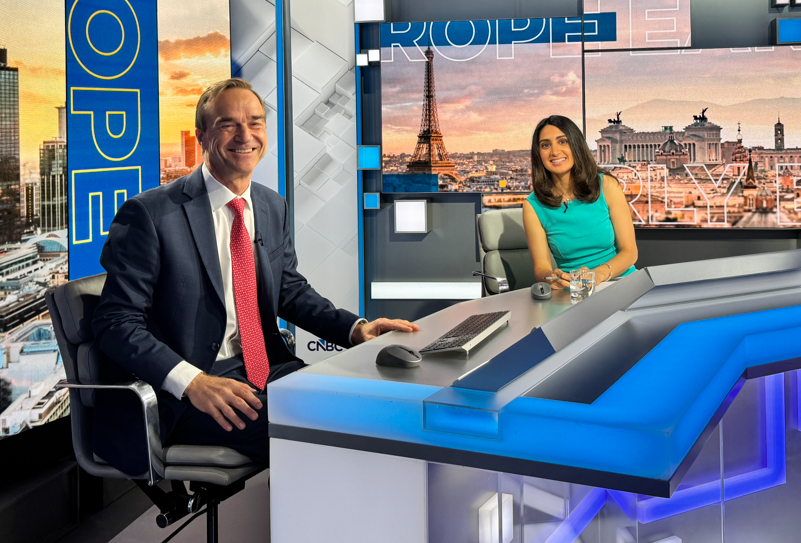
Transcript of interview with Rolf Strauch, ESM Chief Economist
CNBC Europe Early Edition, 16 July 2026
Interviewer: Ritika Gupta
First of all, talk to me about this idea of a more volatile era now where multiple shocks can kind of reinforce each other.
As a European crisis resolution mechanism, we see euro area resilience coming under strain. On the one hand, you have increased risks, geopolitical and geoeconomic. And here we have energy supply disruption, we have trade fragmentation, financial market volatility. And on the other hand, that leads to higher demand on government support, while at the same time, the room for manoeuvre that governments have is shrinking. And that is what we mean when we say that resilience is coming under strain. And we think that governments need to keep a check on budgets and they need to support growth.
Speaking of budgets, your report [the Euro Area Stability Watch] suggests that euro area debt ratios could rise by about 20 percentage points over the long run under what is your adverse scenario. How alarming is that? What would it take to get us to that adverse scenario?
As a crisis resolution mechanism, we want to be prepared and we have a view on what the predominant shocks may be. We have, as you pointed out, two shocks that we focus on. One is prolonged tensions and re-escalation in the Middle East. And that is what we are also currently experiencing - it leads to higher energy prices and inflation. The other shock is loss of value in US assets. That implies financial tightening and it also implies that there is a loss for European investors. Currently, the European Commission and the ECB are predicting growth somewhat below 1% this year and slightly higher next year. If those two shocks materialise simultaneously, we think that we could face a recession next year and inflation could go up to 3.7% and even peak at 5%. That is the risk that we see.
Talk to me about one of your biggest concerns, an abrupt correction in US markets. Why is Europe so vulnerable to the events that are originating in the US, and US markets? You just mentioned, of course, the exposure that European investors have to the US.
The exposure of European investors to the US has increased tremendously over the last decade. Now about half of the European assets abroad are in the US. That means that a correction of US asset prices is felt much more. And we see that equity prices are still stretched in the sense that they rely on future earnings, which are not certain.
And also when it comes to the markets, they've remained relatively resilient in spite of these two risks that you've mentioned, that being geopolitics, the Middle East war, what we're seeing in the US, and also rising debt levels. Do you think that there is a risk that the market is underpricing risk in those two areas?
We face a long-term process here, both for technological change - and we know how it will unfold - and also on the political side, it's very difficult to predict what will happen. There were hopes that the crisis will actually be resolved pretty quickly in the Strait of Hormuz, and that has not materialised. So, that risk remains.
So, when it comes to the tailwinds for Europe, what are you seeing? Is that defence spending, infrastructure spending? Of course, you mentioned the risks. On the other side of that is the higher debt levels. But how much of a tailwind could that provide?
We look in depth into defence spending, and here governments can indeed create a win-win situation. Defence increasing productivity in the civilian economy can actually lead to recovery of cost. For every additional euro spent in defence, governments can recover up to 53 cents from future growth and taxation.
I want to just go back to the point of the Middle East war, what we're seeing with oil prices, how Europe is much more vulnerable than, say, the US, for instance, given its exposure to energy shocks. But what we've seen again is markets being relatively resilient in the face of that news. Do you see more of a delinking now between oil and European equities?
What we can say is that the vulnerability of the euro area has declined, and that is also the consequence of policy measures that were taken in order to diversify the energy sources. And the second point is energy dependency has been lowered. So, in that regard, it pays off to venture into areas of renewable energies and make yourself more independent.
Is Europe losing out in the race with the US and China? Can it keep up competitively? Of course, AI is one of the big topics at the moment, which has got all the investor buzz right now, and Europe seems to be the laggard.
The point is that Europe faces a competitiveness challenge and that needs to be addressed. And we have the political recipe for that. That was published in big reports that are well known - the Draghi Report and the Letta Report - that spelled out an entire agenda. And now Europeans are putting this into place. And I think significant progress has been made. If you think about the Savings and Investments Union, it has indeed been pushed very much and there are concrete proposals on the table.
How much room does the ECB have to support the economy in the face of these shocks?
The ECB has reassured people about its credibility in the past, and I think they will do everything that is necessary forward-looking to cover any price shock that may emerge. So, I think in that regard, the ECB is well-prepared.
Contact