

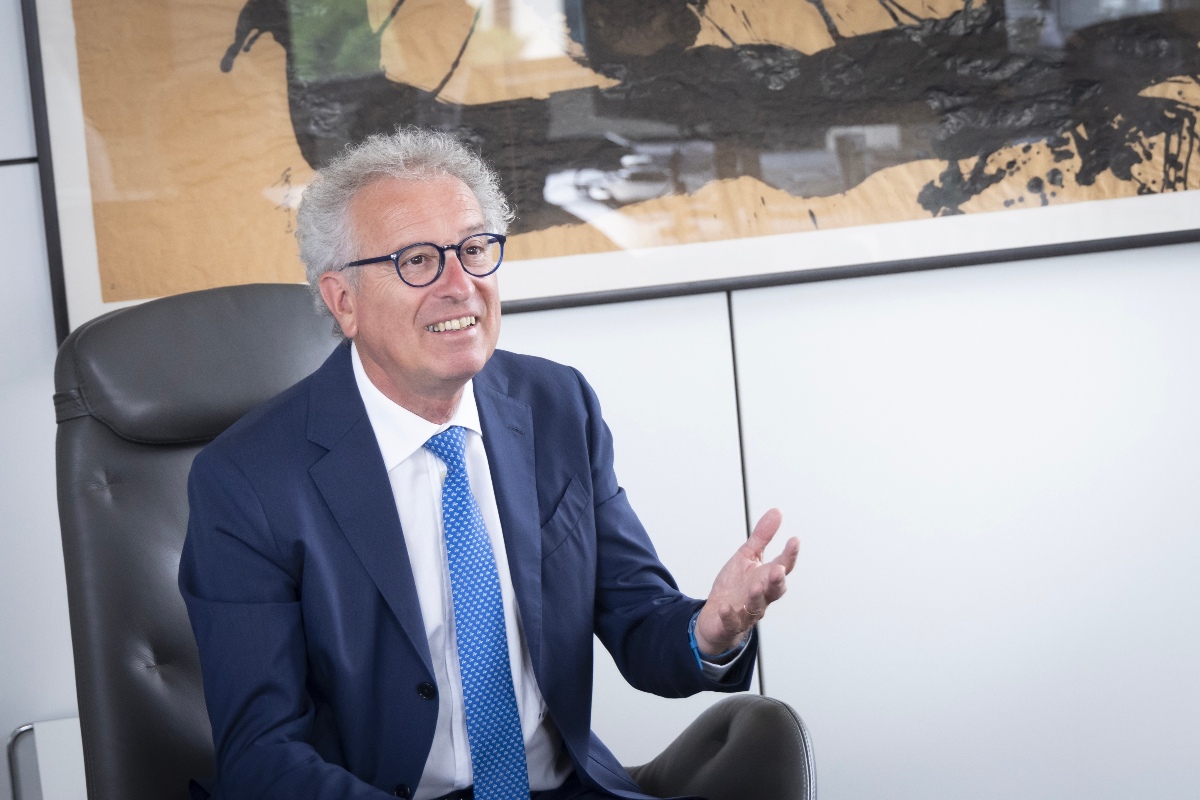
Interview with Pierre Gramegna, ESM Managing Director
Published in Parapolitika (Greece)
25 April 2026
Interviewer: Costas Papachlimintzos
Original language: English
Parapolitika: How well equipped are the economies of the EU Member States to face the energy and financial burden caused by the wars in the Middle East and in Ukraine? Should new tools and mechanisms come into play?
Pierre Gramegna: Europe is facing a succession of geopolitical shocks that risk becoming almost the norm rather than exceptional. Compared with 2022, when Russia’s aggressive war against Ukraine sent energy prices and inflation soaring, Europe is better prepared. Since then, it has significantly reduced its dependence on Russian energy, with gas and oil supplies now more diversified. Production is less energy-intensive and renewables play a much stronger role, already generating more electricity than gas.
This shows that Europe has improved resilience.
But Europe is not shielded from shocks, and not all countries have diversified enough. Europe still imports close to 60% of its energy needs, of which 90% are oil and gas, explaining why global energy shocks continue to matter.
If the Middle East conflict lasts very long, with continued disruption to shipping routes or damage to energy infrastructure, this could keep prices high for longer and weigh on growth, making policy choices more difficult. The duration of the shock matters as much as its size, while short disruptions tend to be more manageable, prolonged ones carry much higher economic costs.
Additionally, not all countries have the same room to act as they did in the past. This means that any public support needs to be temporary and well targeted.
Greece has done well in this regard. It has continued to consolidate its public finances, even amid uncertainty in the last years, which today gives it more room to absorb shocks than some other countries and allows it to help those most in need, even in these difficult times.
Europe cannot bet on the likelihood that shocks will not occur again, and therefore must learn from the lessons of the past and strengthen its strategic autonomy. This cannot be done repeatedly through emergency measures, but by reducing external dependencies and continuing the transition to renewables.
In what ways does the early repayment of loans given during the bailout help the Greek economy in the short term and in the long term?
Before answering your question, let me briefly explain why these early repayments have been possible. In recent years, Greece has regained market trust and markedly strengthened its public finances. Public debt has declined to 146.1% of GDP in 2025 from its peak of more than 200% in 2020. The government had a surplus of 1.7% of GDP last year, compared to a deficit of 10% of GDP in 2020. This progress reflects not only strong fiscal management but also the significant reforms implemented by the Greek authorities.
Throughout this process, the European Stability Mechanism has stood alongside Greece as a long‑term partner and remains fully committed to supporting its stability.
In the short term, early repayments send a signal of confidence in leaving the past behind. This strengthens credibility with markets and supports investor confidence, marking a turning point after more than a decade in which confidence had to be rebuilt step by step.
In the long term, they should help Greece spread out its debt payments more evenly over the years, meaning the country will have fewer large repayments to make at once in the future.
This helps Greece's government finances to become stronger and more resilient. It means the country will be better prepared to manage any problems or surprises that come up in the future, unpredictability and volatility persisting.
Summing up, Greece’s early repayments have been a sign of economic progress and improved fiscal situation. They reinforce confidence today and strengthen the country’s position to deliver sustainable growth tomorrow and better livelihoods for all Greeks over time.
There is a concern that after the conclusion of the RRF programme in four months' time, the Greek economy may face a financing gap for much needed investments. What is your view on this?
The Recovery and Resilience Fund has played a positive role in supporting growth and investment in Greece. It has allowed the country to further progress with its reform agenda. That know-how should also help Greece to effectively absorb funds available under the current EU budget.
But let me be clear: long‑term investment cannot rely on European funds alone. They should be just a part of national growth strategies.
In 2025, the contribution of investments to the Greek economy reached its highest level in 15 years, while the country also recorded strong foreign direct investment inflows. This is a necessary and welcome development.
Greece needs to continue strengthening its ability to attract private investment, including from abroad. Public funds can help create the right conditions, but they cannot replace private capital.
Initiatives such as the Hellenic Infrastructure and Investment Fund are helpful in this respect. By signalling a clear policy commitment in strategic sectors, they can help crowd in private investment and accelerate project development.
Greece also benefits from a much stronger banking sector than in the past. Banks are now profitable again, and non‑performing loans have fallen sharply from the very high levels reached during the crisis. This strengthens the system’s capacity to support investment.
That said, finance alone is not enough. For investment projects to start, expand and endure, a stable, predictable, and business‑friendly economic and regulatory environment is essential. Providing that certainty is one of the most effective ways to sustain investment and growth over the longer term.
How deep are the financial repercussions of the war in the Middle East for the European economies and especially for Greece?
The main macroeconomic risk is inflation, which would complicate monetary policy and weigh indirectly on growth.
Higher prices are already affecting households and raising costs for businesses, especially in sectors that depend heavily on fuel and electricity. You see the impact every day at the gas station. Also, keep in mind that industrial electricity prices in Europe are up to two times higher than in the United States or China, which makes prolonged price shocks particularly damaging for growth and jobs.
The economic impact of the crisis depends on its duration. Prolonged instability affects shipping, supply chains and investor confidence, and risks turning a temporary shock into lasting economic damage.
For Greece, key challenges are the exposure to energy prices and relatively high reliance on tourism, rather than immediate financial stress. Higher energy costs are felt rapidly by households and by sectors such as tourism, transport, and small businesses.
All this is happening at a time when governments, in Greece as in other countries in Europe, have little room to provide support by taking on more debt.
This highlights a broader European challenge.
The continent faces a structural competitiveness problem, with weak productivity growth. With the growing demographic constraint, future growth must come from innovation, investment, and higher productivity.
In Greece, especially, success will depend on companies becoming larger, joining forces, and moving beyond the current landscape of many very small firms and investment projects.
Overall, Europe must act with speed and unity to reinforce its energy security, safeguard its economic foundations, and strengthen its ability to withstand external shocks. When uncertainty is elevated, time itself becomes a decisive factor.
Can you explain how the ESM could assist European countries in improving their defence capabilities and how Greece could benefit from such a mechanism?
The ESM’s role is to safeguard financial stability, and that is the lens through which its work can be discussed.
European countries are increasing defence spending, after decades of underinvestment, in some cases, although Greece has been spending on average, a little over 2% of GDP over the last decade.
The ESM can be part of the solution, using its existing tools to help Member States manage the fiscal impact of these exceptional circumstances.
Some proposals have suggested adapting current ESM instruments, inspired by what was done during the pandemic, to support defence‑related spending where there is a potential risk to financial stability. This could be envisaged within the ESM’s mandate.
These are strategic questions that belong to Member States, but the debate itself reflects a new reality Europe cannot ignore. Any role for the ESM would require full agreement by all Member States and a clear justification based on financial stability considerations.
Contact