

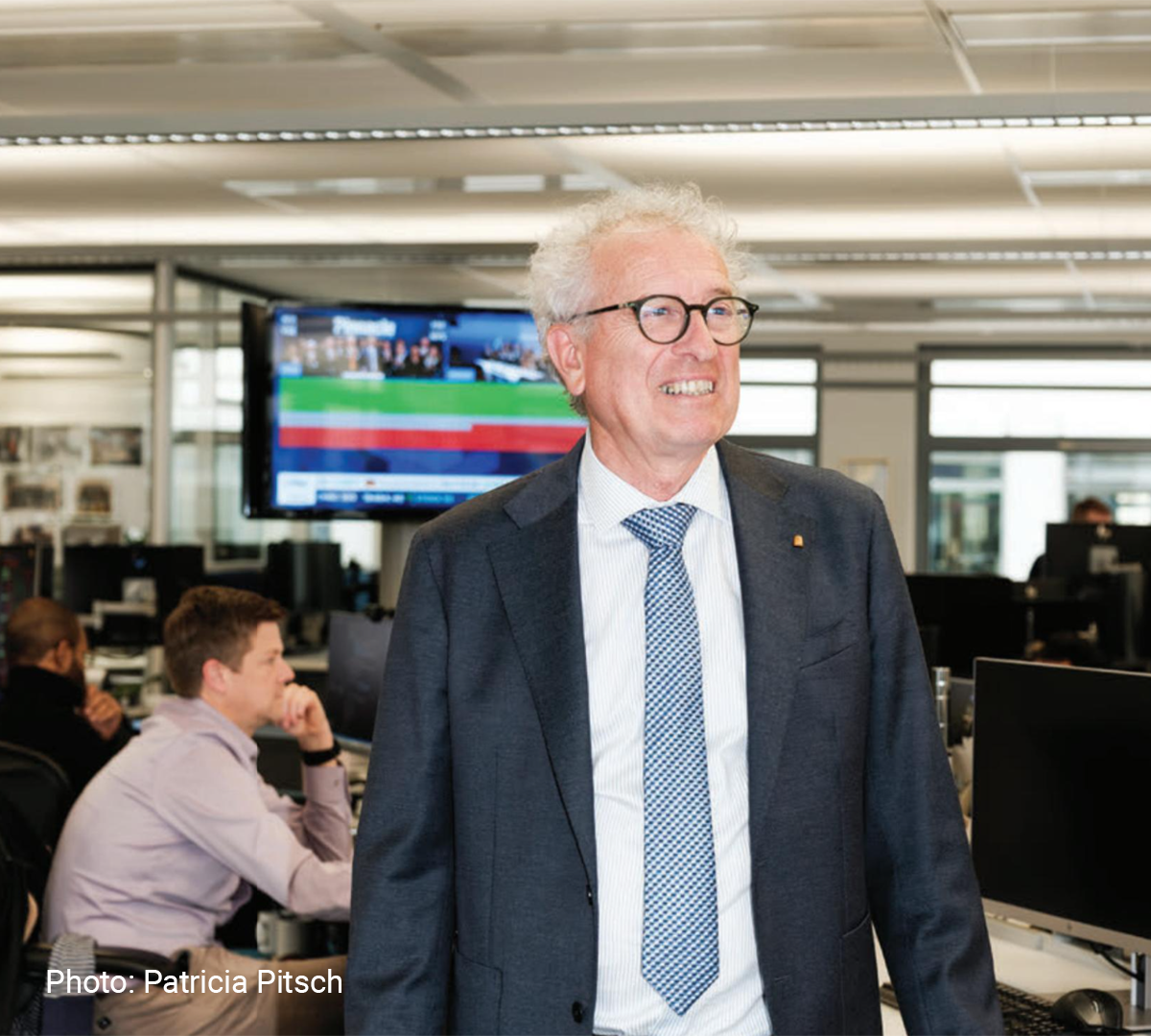
Interview with Pierre Gramegna, ESM Managing Director
Published in Paperjam (Luxembourg)
Conducted on 12 December 2025, published on 28 January 2026
Interviewers: Marc Fassone and Kangkan Halder
Paperjam: The ESM, created in 2012, is the youngest of the European institutions. Why such a late birth?
Pierre Gramegna: First of all, it should be said that the ESM is not a European institution established by the Treaties, but a classic international organisation operating on the basis of consensus. The ESM and its predecessor, the European Financial Stability Facility, which was a temporary solution, were born out of a realisation during the 2008–2009 financial crisis: the euro area did not have an institution capable of acting as lender of last resort for its member states. This need stemmed from the widening divergence in economic performance between euro area countries and from the increase in the risk premium demanded from countries issuing debt in euros.
With the introduction of the euro, it was assumed that country risk would disappear in favour of a single euro risk, and that there would be a euro interest rate in the same way there was a dollar interest rate. Markets decided otherwise. When the economic and financial situation deteriorated, they adjusted interest rates accordingly, leading to enormous spreads. The increase in these spreads put countries such as Greece in a situation where, with interest rates of 20% or more, they could no longer refinance their debt. As the magnitude of the financial support needed far exceeded what the International Monetary Fund (IMF) could have provided, a new institution had to be invented. When you have a common currency, it is only natural to have a common protection. We are the insurers of the euro area.
The ESM is a child of debt. Is debt still a risk in Europe today?
We are seeing an increase in public debt all over the world. But if you look more closely, it is in the euro area that there is the greatest awareness of the importance of limiting this increase. Why? Because we have the Stability and Growth Pact and the famous Maastricht criteria, which are reference values that are unique in the world. Some see this as a disadvantage; I see it as an advantage. The next crisis in Europe will not be a debt crisis.
That said, it is normal to finance part of investment through debt, since investment is intended to make an economy productive. Few countries, such as Luxembourg, finance a large share of their investment through budgetary resources.
If it is not debt, where will the next economic and/or financial crisis come from? What are the main risks in your view?
For Europe, as for the rest of the world, the greatest risk factor for a crisis is geopolitics. Since Russia’s aggression against Ukraine, it has by far been the most unpredictable, the most uncertain, and the most crisis-prone factor -- crises not necessarily financial in nature, but which could trigger financial ones. Two other medium- to long-term challenges are also weighing on public finances, not only in Europe: population ageing and climate change.
Population ageing is a phenomenal constraint on social security and pension systems and therefore on state budgets. In Europe today, there are three people in work for every person in retirement. By 2050, there will be two for one.
What can the ESM do in the face of these risks?
It is our role to raise awareness among member states and the public about these risks and about the considerable impact they will have on national budgets. We spend a great deal of time measuring these risks, which is not always easy.
What can be done? There are two aspects to consider. The first is that we are there to help the 21 members of the euro area, following Bulgaria’s accession, if they experience difficulties in financing or refinancing their debt. In response to the economic crisis caused by the Covid-19 pandemic, the ESM, like the European Investment Bank (EIB) and the European Commission, reacted by proposing measures tailored to the resulting financial needs. For our part, we had a specific financial instrument to support countries, known as Pandemic Crisis Support. The objective eligibility criterion was that borrowing under this instrument had to be used for healthcare expenditure. This is an example that illustrates the need to be innovative in order to adapt our toolbox to emerging needs.
Does the financing of security and defence expenditure fall within your remit?
If military spending were to destabilise the budgets of member states, they could turn to the ESM. At present, we do not have specific instruments dedicated to defence needs. We currently have three main types of instruments at our disposal: direct financial assistance to states (Greece, Portugal, Spain, Cyprus and Ireland have benefited from this), indirect assistance to banks via states (Spain has benefited from this) and precautionary credit lines. We are in fact working on these credit lines to refine them and make them easier to use depending on the type of crisis that may arise.
To refinance our loans, we issue debt from our trading room. We currently have an outstanding loan portfolio of around €240 billion, and we issue between €25 billion and €30 billion each year to refinance the debt. Alongside the EIB and the European Commission, we are one of three institutions issuing bonds with a European underpinning. We do not call them Eurobonds, but “European Safe Assets”. All our bonds are listed on the Luxembourg Stock Exchange.
BOX 1
The risk of stablecoins according to the ESM
Mindful of risks that could potentially affect the financial stability of the euro area, the ESM has analysed stablecoins.
In simple terms, a stablecoin is an electronic currency designed to facilitate payments and issued by private companies, mainly American, as the United States is actively promoting their development, whereas the euro area has chosen the digital euro. Currently, 99% of stablecoins are denominated in dollars, and the total value of the stablecoin market is around €300 billion. A volume that may appear limited, but which some experts believe is set for spectacular growth.
Pierre Gramegna highlights the risks, while stressing that the ESM does not recommend banning the issuance of euro-denominated stablecoins: “It is essential that Europe is not closed to innovation.” What are the risks? An increasing dollarisation of the global economy via a currency not backed by a central bank, raising questions about the quality of the underlying guarantees. Another risk is mass distribution, which could result in a loss of control by the ECB over the money supply and therefore a loss of effectiveness in the transmission of monetary policy decisions.
Contact