
Transcript of interview with Pierre Gramegna, ESM Managing Director
Broadcast by KRON4 (San Francisco Bay Area TV station)
12 March 2026
Interviewer: Noelle Bellow
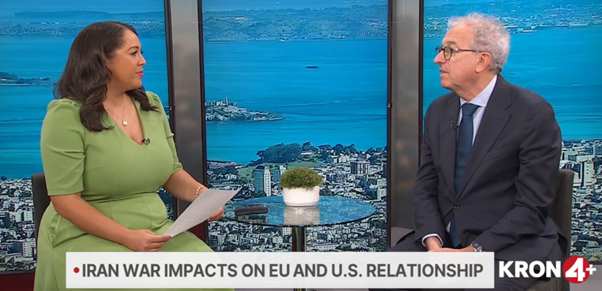
KRON4: As the war in the Middle East continues to raise concerns here at home, it's also caused ripple effects all around the world. The European Union is navigating direct impacts from the conflict, both in safety concerns and economically. Here to give us a closer look at these impacts is Pierre Gramegna, Managing Director of the European Stability Mechanism.
Pierre, thank you so much for joining me to give a different perspective on what's going on globally. I think something that is not lost on us here in the Bay Area, specifically, is our relationship with European nations. We are a global region, the Bay Area. So many people come here and stay and live here. I'm curious what the feeling is in Europe, just generally, as this conflict enters almost its second week.
Pierre Gramegna: Good morning, thank you for having me. It's always a privilege and pleasure to be in San Francisco, in this beautiful part of the world. Talking about things that are less nice, obviously, the conflict in Iran, which is less than two weeks old, is leaving a lot of consequences everywhere in the world, and also, obviously, in Europe. The ripple effects are mostly felt far away in Europe or in the United States because the price of oil and gas is going up. At the same time, I think it was also a surprise that the conflict spread so widely through so many countries in the Middle East - something we haven't seen now for years.
So obviously, the economic consequences that we, as the European Stability Mechanism, have to follow, are significant. The ESM is a kind of European IMF, the lender of last resort. Our task is to advise countries to prevent crises, or if they are in a crisis, to support them. The best way to prevent problems in budgets, for example, is to see the risks that are coming around the corner.
This war obviously takes predictability out of the situation. I was watching a video where you were speaking just about how there was a lot of confidence in the economic stability of European nations previously, and now that confidence has been shaken.
Yes, you're right. Europe has done much better than expected economically during the year 2025 and in the beginning of 2026, with growth at 1.5%, which was three times more than expected in the forecast despite the tariff hikes, despite the war in Ukraine. And now we have a new situation which has obviously, in a provisional manner, hurt a little bit the optimism that was around. Very few know that, for example, last year, the stock exchange and the equities in Europe performed better than in the United States. You get the image seen from here that the United States is faring better every year and all the time. It's not the case.
We've had very low unemployment, historically speaking, for two decades, and also employment at its highest, and inflation on target at 2%. So, a very good position to be in. And obviously now the expectations of growth, of inflation are less favourable. But let's also not overdo it. Let's not forget that this conflict is nearly two weeks old. It has had a direct impact on energy prices, and Europe is more dependent on energy prices and energy from outside than the United States, which is a net exporter. We are a net importer.
So, we are watching the situation very carefully, very seriously. You can see that governments are now taking decisions to alleviate the price situation through releasing oil reserves. I think this is good news. And since then, the price increase has levelled out both on gas and on oil. But if the conflict were to continue, the consequences are going to be more significant.
Both economically and just also the relationship between the United States and Europe - do you see that shaken, the confidence that European nations have in America's ability to make sound choices and different things when it comes to geopolitical issues?
Geopolitics and the turmoil around geopolitics in the last couple of years have been huge, not only because of decisions of the United States, also because of the decisions of Russia to start an aggression on Ukraine. The ESM is an international financial institution. It is not our role to comment geopolitical decisions, but it is our task to see what the consequences of these decisions are. I think for the time being, they are limited.
But obviously, if the conflict goes on - I'm now talking about the Iran war - and the supply chain of oil and gas is disrupted, this will have a huge impact on inflation worldwide. If inflation goes up, then interest rates normally have to follow, and then you have the economy that's growing less. Everybody is watching it very carefully. I can tell you that the markets are, for the time being, anticipating that the conflict will be short - a matter of weeks, maximum two months. If we stay in that ballpark of figures, the consequences will be controllable.
You were [Luxembourg’s] Consul-General in San Francisco back in the 1990s, so it’s good to have you back here in the States, here in San Francisco. We appreciate you visiting. I know you’re going to be visiting different AI companies – it’s a large market here, for sure.
Let me congratulate the Bay Area and San Franciso for always being top-notch in terms of IT. This is the AI capital of the world, and we are thrilled to be here to learn more. And what I wish for is that there would be more investment of Europe in the Silicon Valley and more investment of the Silicon Valley in Europe. And I think that would be for the benefit of California and Europe.
Contact