
Pierre Gramegna interviewed by CNBC Squawk Box Europe

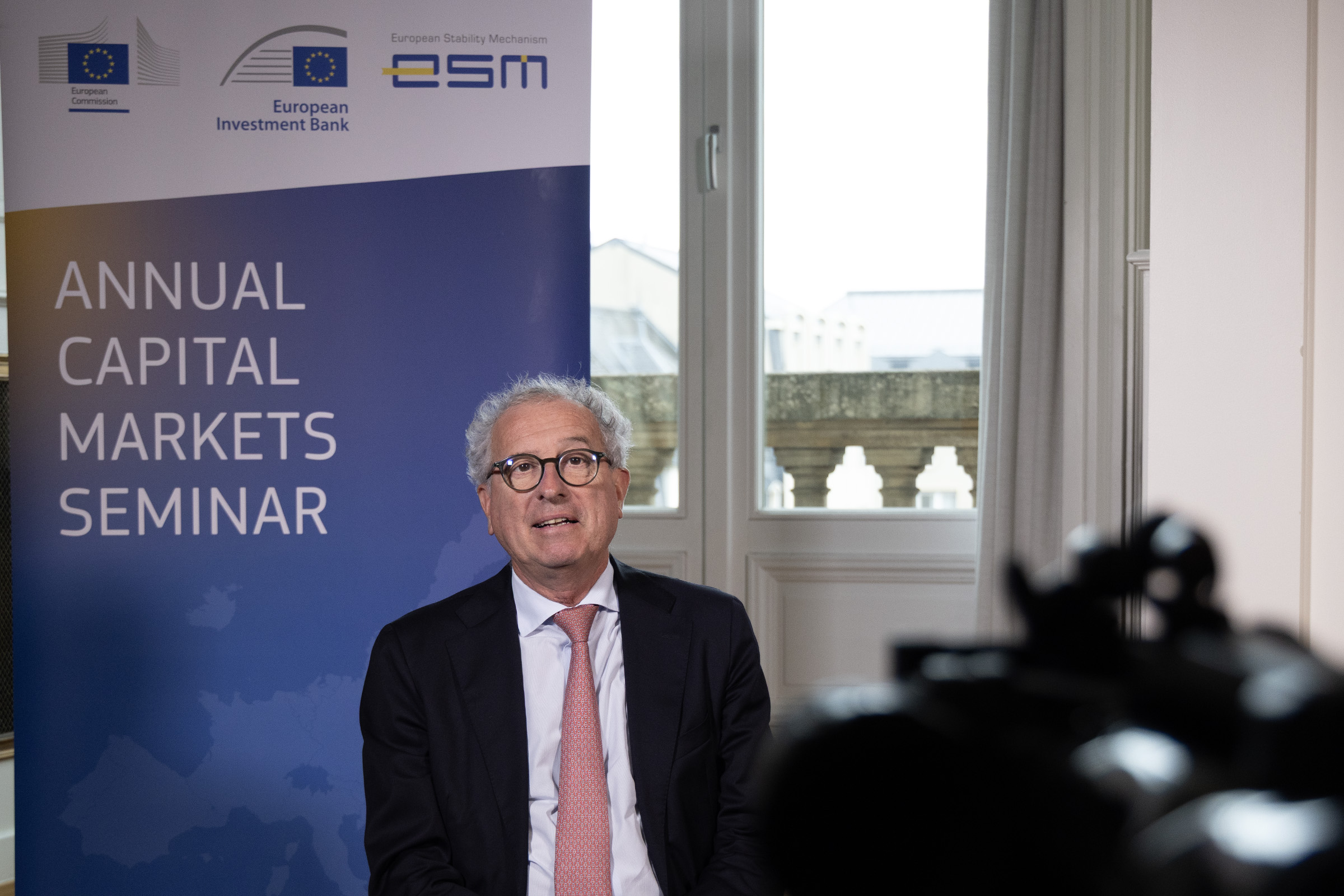
Transcript of interview with Pierre Gramegna, ESM Managing Director
CNBC Squawk Box Europe
1 October 2026
Interviewers: Karen Tso, Ben Boulos, and Steve Sedgwick
CNBC: Pierre, in terms of what we're seeing in sovereign debt markets, do you have concerns that this could have an impact on capital markets as well?
Pierre Gramegna: It is obvious that geopolitical tensions and high energy prices are having a lot of impact on inflation for all the countries. And so obviously this has also an impact on the bond market. This trend has been going on for a couple of months now, and we see that the yield on the 10-year US Treasury bond is above 5% for the first time in many years. Obviously, this is an evolution that's in a way inevitable with the geopolitical situation that we have now.
Given the size that we now see of sovereign debt piles in total, is the ESM in a position to step in and help, or are these debt piles now so big that actually, if we saw the sort of crisis we saw in years gone by, there's not really much difference that the ESM can make?
First of all, the ESM is very useful outside times of high crisis because it's very reassuring for markets. And, as a matter of fact, although the spreads have gone up a bit lately, they are very much contained, compared to what they were during the great financial crisis. In addition, we have a lending capacity of €500 billion, out of which €430 billion is available. So, this is a huge amount of money, and there is for the time being no request by any country. In that sense, we are relatively fine. And the last point, it is foreseen in the statutes that in case of necessity, we have callable capital that would increase the capacity of the ESM even further. So, I think that's very reassuring to markets, on top of the role that the European Central Bank can play.
Pierre, sorry for being blunt, but we are in a crisis, but no one's actually talking about it properly at the moment. The debt-to-GDP levels around the world, whether it be the US, France, or other countries, are at crisis levels. You know better than I will ever know, Pierre, that the debt-to-GDP is supposed to be 60%, and that is supposed to be the absolute limit in the EU-27. We blew through that years ago, led by, dare I say, the likes of France as well. We are in a crisis, aren't we, Pierre? But people just don't want to admit it.
We have had an evolution. You know that the average debt-to-GDP inside the euro area is around 90%. We're 30% above. That is true. Some countries are even higher. But some countries have reduced their debt-to-GDP. I think of Greece, Spain, Portugal, who have done so in a spectacular manner. In fact, the countries that the European Stability Mechanism has supported in the last decade have done the reforms, the reforms have paid off, and they're reducing their debt. Other countries have difficulties to do the necessary reforms and, as a result, they are suffering. Obviously, geopolitical fragmentation and the energy crisis don’t make it easy, but it's unavoidable for countries. And this is the message the ESM gives on a permanent basis. You have to do structural reforms. They pay off, but you have to do them.
Yes, you know that, I know that, Mario Draghi knew that when he was pleading, when he provided the put in the middle of the last decade. The countries that went through the greatest crisis in the GFC, the likes of the peripheral sovereign nations, they did their work. But France never did its work, and that is why it now has this catastrophically high debt-to-GDP and is at the centre of Europe, not on the periphery. We have a major problem here, and yet Rome is fiddling while it burns.
Let's be realistic here. The situation of France is the following: it's true that the debt-to-GDP is increasing. In parallel, up to now, France has complied with the path that is designed in the Stability and Growth Pact to reduce its budget deficit. It's becoming challenging this year, and they are addressing it. They're addressing it because the prime minister has announced a plan of €54 billion of expenditure reductions, which I think is a very ambitious one, because obviously the French government is aware of the situation. And let's not forget that France has very good access to markets, has a deep and liquid market, and doesn't face any problem to refinance its debts. But I agree with you that it is the time to act.
I want to ask you about growth through the lens of the banks, because we know that one of the big initiatives across Europe is to create more European champions, and some of those in the banking sector. We're all closely watching the consolidation attempts from UniCredit with Commerzbank. But why do we not end up in a situation down the line, if we do create bigger banks, that we then end up in a situation like Switzerland where Switzerland created a gigantic bank? And now we have these pressures at bay to create more capital rules to ensure that there's financial stability for that said bank and the likes of UBS wondering whether it should pick up and leave its jurisdiction because of even tighter regulation. Why do we not end up in a situation like that across the rest of Europe if we create bigger banks that then we get nervous about the capital requirements and we end up regulating again for financial stability?
I find your example very interesting, the example of UBS that you're mentioning, which you then compare to the size of Switzerland. That's all the advantage of being in the European Union, or here more precisely also in the euro area - banking union is for the whole of the EU - because the strength and the weight of the whole economy of the EU is huge. Now, let's face it, we have until a couple of months ago advocated, all of us, that Europe needs, in terms of banks, big champions, and our legislation, our political fights or resistance have prevented that we have more mergers. Now it is happening. You mentioned one example, and this is welcome. We have a fragmentation of our banking world. This is being taken care of slowly, maybe too slowly. So for me, the priority and for us at the ESM, is about having bigger banks because that's what the economy needs.
Let me ask you about bigger membership too for Europe, because just in the last 24 hours there's been news flow from the UK, the prime minister, Andy Burnham, talking about the fact that he was open to reversing Brexit and how that would take place if he's truly talking about a plan for the next 10 years. This is extraordinary because the ESM, back when Brexit was happening, was looking at the shock that the event could have on the euro area members. If the UK were to reverse the decision at any point - and obviously there's a long way off from that potential happening - would it be a positive all round for Europe?
I was for 8 years Luxembourg's finance minister, so I followed the whole situation around Brexit very closely. And I've continuously said before the referendum that if Brexit were to happen, it would be bad news for Europe and very bad news for the UK. And it was proven right in many senses. And I'm sad about the fact that the UK left. But then, you have to respect the sovereignty of every country.
On the other hand, I welcome the recognition now by the new prime minister that this discussion needs to be revived to see how to best build bridges with Europe. I think he mentioned eventually membership, but also having stronger links again with Europe for me is an obvious thing, as well as having better access to the single market. Looking into that, and eventually landing later, maybe in the medium term, again at membership, is what is envisaged. To me, it's just common sense. I know that the topic is politically very, very sensitive in the United Kingdom and nobody had wanted to take that hot potato. I must say, I always appreciate when politicians are courageous.
I think it's the right discussion to have and let's see how this will evolve. And if the United Kingdom would be closer to Europe in the future than it is now, it would be good news for the United Kingdom and for the European Union.
Contact