

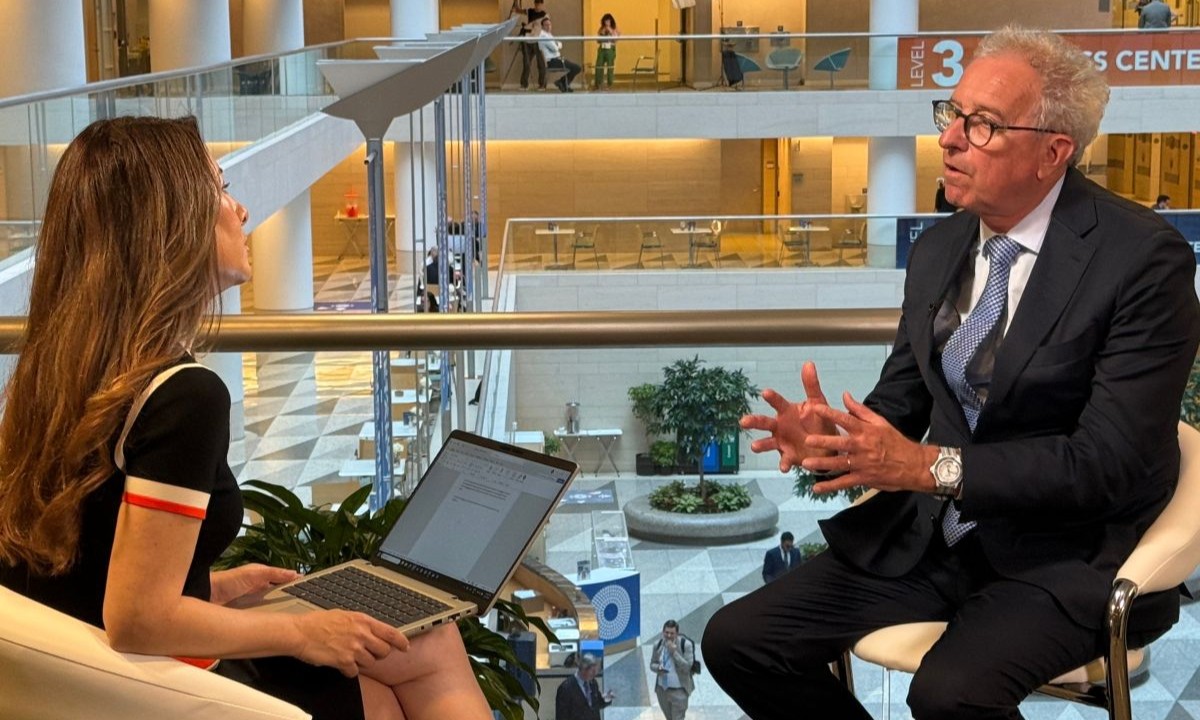
Transcript of interview with Pierre Gramegna, ESM Managing Director
CNBC Squawk Box Europe
16 February 2026 (conducted on 15 April)
Interviewer: Karen Tso
How is geopolitics changing the world order? What are, in your opinion, the most worrisome economic consequences of the war in the Middle East?
Geopolitics has been in turmoil since quite a few years, and it seems like we're not going to get rid of it. And it's a factor that's difficult to incorporate in statistics and is difficult to forecast. I am being asked all the time: “Is this war in Iran and in Lebanon going to have a lot of impact?” The first answer is that it has already had an impact. Look at inflation rates in the last months. Look at what's going on in our gas stations all over the world. So, the impact is obvious.
Is it going to last? I would like to quote Gabriel García Márquez, who said that it is easier to start a war than to end a war. And it's obvious: to start a war, you don't need to ask anybody. You're on your own. But to end it, you need to agree bilaterally, multilaterally. This uncertainty is weighing, obviously, on how we look at the future. And the different scenarios show us that if this war would end quickly, then the impact is limited both on inflation and growth, for most countries.
If it is longer, the impact on inflation is what would worry me most.
If it lasts a couple of months more, if the Strait of Hormuz is blocked or half blocked, then we're going to have inflation that goes up more than 1%, maybe 1.5% this year. And if it's even worse - it lasts longer - then inflation would go up 2.5%. That would trigger probably stagflation. And that's bad news for the world. And so, we can only hope that a diplomatic solution can be found.
Is there any saving grace for Europe in that inflation was much lower as a starting point this time as we faced a fresh energy shock?
Yes, I think that this crisis, this war, comes at a time when Europe is better, has a better setup, than in 2022 when Russia attacked Ukraine, for a couple of reasons.
We have done lots of efforts to diversify our supply of energy. We have reduced the use of fossil fuel and [are using] more renewable energy. And the Stability and Growth Pact is now a little bit more flexible and smarter than it used to be. And I would dare say we are often told as Europeans: “Your deficit is coming down to 3% per year, but your debt is 90%,” which it is now. But look at the United States and look at China. They have far larger annual deficits and larger public debt. So, I think we are in a better spot than we were.
And let's face it, last year we had 1.5% growth despite all the disruptions that we had on tariffs and the conflicts that are going on, on our doorstep, in Europe. And the stock exchange in Europe performed better than the one in the U.S. last year. So we were really in the sweet spot, to use a tennis expression.
This [crisis] is obviously going to slow us down. But I think we have more resilience than we had.
That said, the impact on Europe is going to be much more significant than on the United States. Is there a role for greater energy security in Europe? Is there a way to plan for that?
You are right to highlight the fact that the impact of energy supply is less on the United States because they are an energy exporter and we are a net energy importer, and by a large extent.
But the impact on prices is the same for the United States as it is for Europe because energy prices are worldwide. It's not that the United States is immune to it. Which is, by the way, also a factor that makes me a little bit optimistic that it's hitting the whole planet, in a common manner.
The other thing that one needs to realize is that some, if not a lot, of gas plants and refineries, have been hit during this conflict. And it will take months for sure to repair that. So, there will be supply shortages for a little bit longer, even after the war ends, and even if the Strait of Hormuz opens.
Prior to the conflict, there was a huge discussion playing out about European competitiveness. That said, there is a huge fear now, from the IMF to the World Bank conversations this week, that further geopolitics after what we've seen in recent weeks is going to trigger further global imbalances, again putting pressure on European competitiveness. How do we need to think about the future in Europe to provide that resiliency?
Competitiveness has really become a number one topic in all our Eurogroup and Ecofin [meetings], which is good news. Contrary to what you often hear: “You haven't taken the decisions that are warranted and called for by the Letta report and by the Draghi report.” I think this is wrong. I think most of the proposals are now on the table. For example, for the integration of capital markets, a major one - to have deeper market, more liquid markets in the euro [area] - there's a deadline in the Ecofin to find a compromise by June. So, it is in the making.
You could always argue that Europe is too slow or slower. It is obvious: we need to agree. But I really see a change of pace. And one must acknowledge that as geopolitics is becoming so difficult and with President Trump putting pressure in many ways on Europe, this is obliging us to hurry up.
There are so many different crises as we roll from one to the next. AI is around the corner as well. There's been issues in private credit markets. Is there something we're not focusing on enough?
I think that Europe is recognizing that we have to do a huge catch-up in terms of defence expenditures, not only because our American allies ask us to do so, but because we don't have the necessary capabilities, the necessary equipment. And there, as European Stability Mechanism, a lender of last resort, I can only call on all European countries to cooperate, because otherwise we will have duplication and waste of money.
Contact