Pierre Gramegna interviewed by Bulgarian National TV

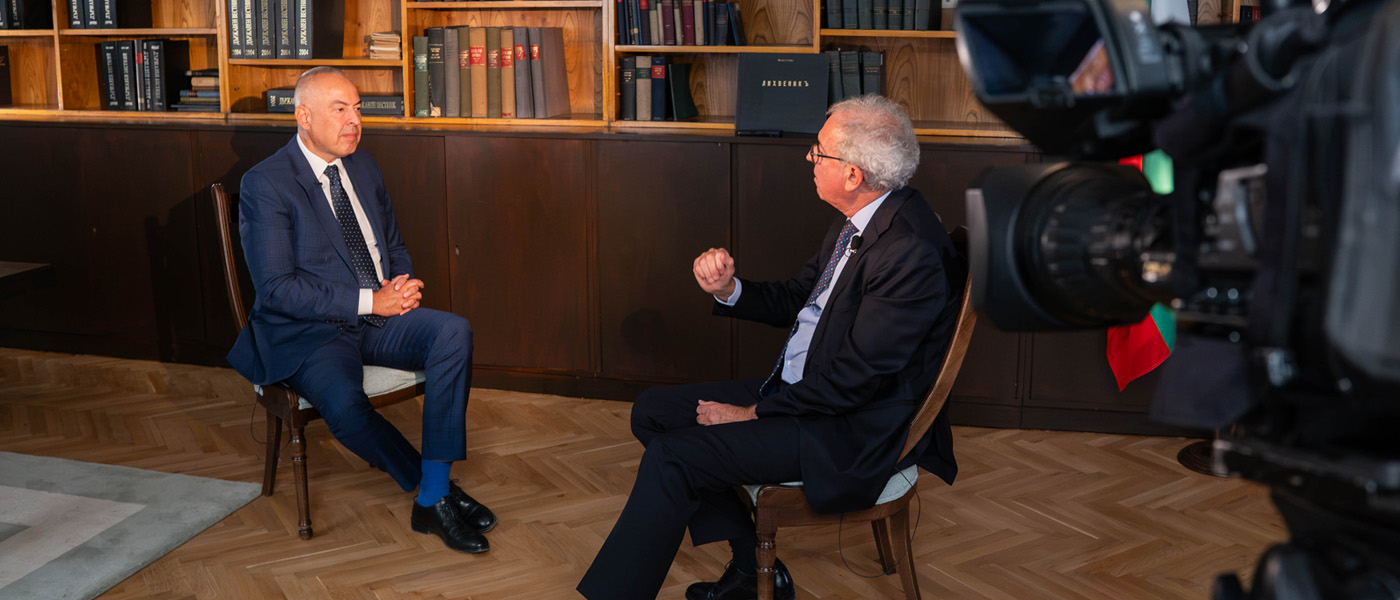
Interview with Pierre Gramegna, ESM Managing Director
Broadcast by Bulgarian National TV on 26 September 2026
Interviewer: Boyko Vassilev
How did Bulgaria implement the euro? Was it a failure or a success story, or something in between?
Pierre Gramegna: To start with, it's a pleasure to be back in Bulgaria. I was here last year also when this was about to happen. You make my life easy.
Why?
Because the way you ask the question, it is so easy to answer "yes, it is a total success". Let me give two or three arguments.
First of all, Bulgaria benefited from accession to the euro area already before it joined in 2026, because the rate you were paying on your bonds, what is called the spread, went down from 2024 - from above 2% - to below 1% in 2025.
Already before accession, you had an advantage. Today, Bulgaria pays less than any other European Union country that is outside the euro. So, the benefits just in money are already there.
Second, the stability of the currency and the advantage of being in the euro area is becoming more evident every day. You have foreign investment coming in because of this stability, because you're more attractive to investors.
Last but not least, you became a Member of the European Stability Mechanism and its safety net.
But 9 months ago, you predicted that there will be a short period of price increase and then long-term stability. We have seen the first part. When will we see the second part? And how would you respond to Bulgarians who say that the euro made them poorer?
I just now said that you had already advantages before you even entered. So, the first part is that …
They're not very obvious.
Yes, they are very obvious. Ask the Treasury of Bulgaria how much money they saved even before joining and how much money they save every time they issue a bond [now].
Let's leave that aside now. Inflation is an important thing to look at, but inflation started to rise last year, before Bulgaria joined the euro, everywhere in Europe. That's why now the European Central Bank needs to take measures and increase interest rates.
There has also been the phenomenon which we had observed in all the countries joining the euro area. In the beginning, you have adjustment of prices. You had double labelling in your country, which was very precious. That did not prevent some excessive [price] hikes. That is something which is unfortunate. But compared to the other factors that are increasing inflation, it is not the major part. So, telling the story that you have inflation in Bulgaria because of joining the euro is only a partial view. And this factor will remain while high prices of energy are here to stay for quite some time. And obviously that impact on inflation is much higher.
But with the ESM, what does Bulgaria get for its money? Is it not a fund which benefits somebody else?
I don't know any insurance that's a better deal than this one. I will make a comparison with fire insurance for your house. You want to get fire insurance for your house, you pay a premium from the first day and you pay every year. At the end of 10 or 15 years, you will have spent money for insurance premiums, and you will have coverage.
Here, it's the other way around. You’re supposed to pay and are paying step by step to get the insurance, which is the safety net. This is very precious because the safety net is the coverage by all [ESM] countries. And the safety net is much bigger than the economy of Bulgaria.
You get it from day one, and you pay from now to 2038. So, you haven't even paid the full amount and you get full coverage. Additionally, what you pay in is not an insurance premium. You pay into the capital of the European Stability Mechanism, become a full shareholder of the ESM, and you have a say. You sit at the table of the Board of Governors from day one. And, at the end of the period of paying this, while you have enjoyed the coverage, you haven't spent the money, you have invested into something.
Yes, but we did have a fire, to use your example, in Europe, and this was the pandemic. And in the pandemic, ESM money was offered to everyone but accepted by no-one, because countries didn't want the stigma. So, if it's politically fatal to accept that loan, what is your aim actually?
I do not deny that there is a stigma and we need to go back in time to understand why that happened. The European Stability Mechanism was created in the middle of a crisis in the last decade. And we had to help five countries. I will come back to it. These five countries got a lot of support. And thanks to that support, they could remain in the euro area. And they got that by implementing reforms with conditionality. Because obviously, if you have big problems and the whole solidarity comes into play, you need to reform your economy, take tough measures, which are not popular.
The result - for the five countries that did that, because they did the reforms – is that today they are performing better than all the other countries in the European Union. So, reforms pay off.
But to your point, why didn’t countries access the ESM [during the pandemic]? Because you could access the NGEU, the Next Generation EU programme, where you had €800 billion, of which €400 billion was available in the form of grants, not loans. And some countries are still struggling to use the full amount of grants. So why would you come to the ESM and have a loan with conditionality, which, by the way, would have been minimal because it was a precautionary loan?
So, you’re jumping to conclusions. There was a stigma, yes. When you go to the ESM and you already have huge problems, there is stigma. But we have also a preventive role, precautionary loans that you can access, if your house is in order. Which is the case in terms of budget for Bulgaria, then you can benefit from it. The stigma discussion is a fair discussion. I even think that the ESM lacked empathy at the time. But you cannot come to a final conclusion only by judging the period of the Covid pandemic.
Let us take a look not only at the ESM but at the eurozone itself. There is one currency for 21 countries with 21 different budgets. Can a monetary union survive without a fiscal union? And can we discuss this with the voters?
Good question. Look back at the 1990s when we were negotiating. I was a young diplomat at the time. I was also posted in Brussels when the Maastricht Treaty was negotiated. You had a school of thought that said: “we need to fix first the economic and financial policies of all the countries, and when they are harmonised, we can move to a common currency”. They said: “what you’re doing now is putting the cart in front of the horse”. If we had done that, we would not have had the euro today. And I bet we would have had in Europe a risk of fragmentation. The crises that we had only led to solidarity because we had the euro. The ESM was created when financial crises were there. If we had had no common currency, everybody would have been on their own during a crisis.
Take [for example] Spain, Portugal, and Greece. They had major problems with debt. They would have eventually fallen out completely of the euro. What have we done in the meantime? We modernised the Stability and Growth Pact a couple of years ago, so that it takes the specificities of every country more into account, what readjustments are needed, in terms of excessive deficits. The period to do that is longer, and very importantly, we are now more focusing on investment. We had a kind of blind view on expenditures before. If you spent a euro on investment or a euro on current expenditures, it was treated the same. That's why we had underinvestment in Europe prior to Covid.
We have improved the system, and the rules as they are now give sufficient flexibility, so that countries have time to adjust. In the end, we are even happier when countries do not need the ESM. It's like insurance. Again, coming back to that image, your house is burning, you're happy to have insurance. Your house is not burning, you're very happy to have insurance.
Yet can you, as a dove, survive in a world when hawks are at large everywhere?
This is the most important question for all of us in Europe. Do we want to remain countries that abide by the rule of law? Countries that are governed by international rules? Countries that comply with treaties and respect other countries? Countries that put diplomacy first? I dare say, as a European, having worked all my life in diplomacy and internationally, the answer is “yes”.
Should we be naïve? The answer is “no”. What is very clear to me – in the context of geopolitics and more than 100 wars being waged across the planet – is that we need to invest much more in defence. But not only in NATO. We need to develop common projects. We need to do common procurement because defence expenditure is high. If you buy American or foreign material, it's a double cost. It doesn't benefit your economy. And in fact, we are in infant shoes in a way, in terms of defence, because we rely completely on NATO. We should keep NATO. That's one thing that we need to have - this important ally - including the United States. But we need to develop our own defence.
We still have so many inefficiencies. And our biggest challenge is productivity. The EU’s productivity in the last 30 years has grown by roughly 35%. In the United States, it surged by close to 90% over the same period – meaning the EU achieved only one-third of the productivity growth recorded in the US. We cannot continue like that because it is productivity that makes our countries richer, and allows us to develop and maintain our social model.
And it is productivity that will help us find the resources to spend more on defence and other urgent needs. We have a blueprint. We need to spend more on defence and work on increasing productivity. The Draghi Report and the Savings and Investments Union provide a clear path for achieving both goals.
Contact