

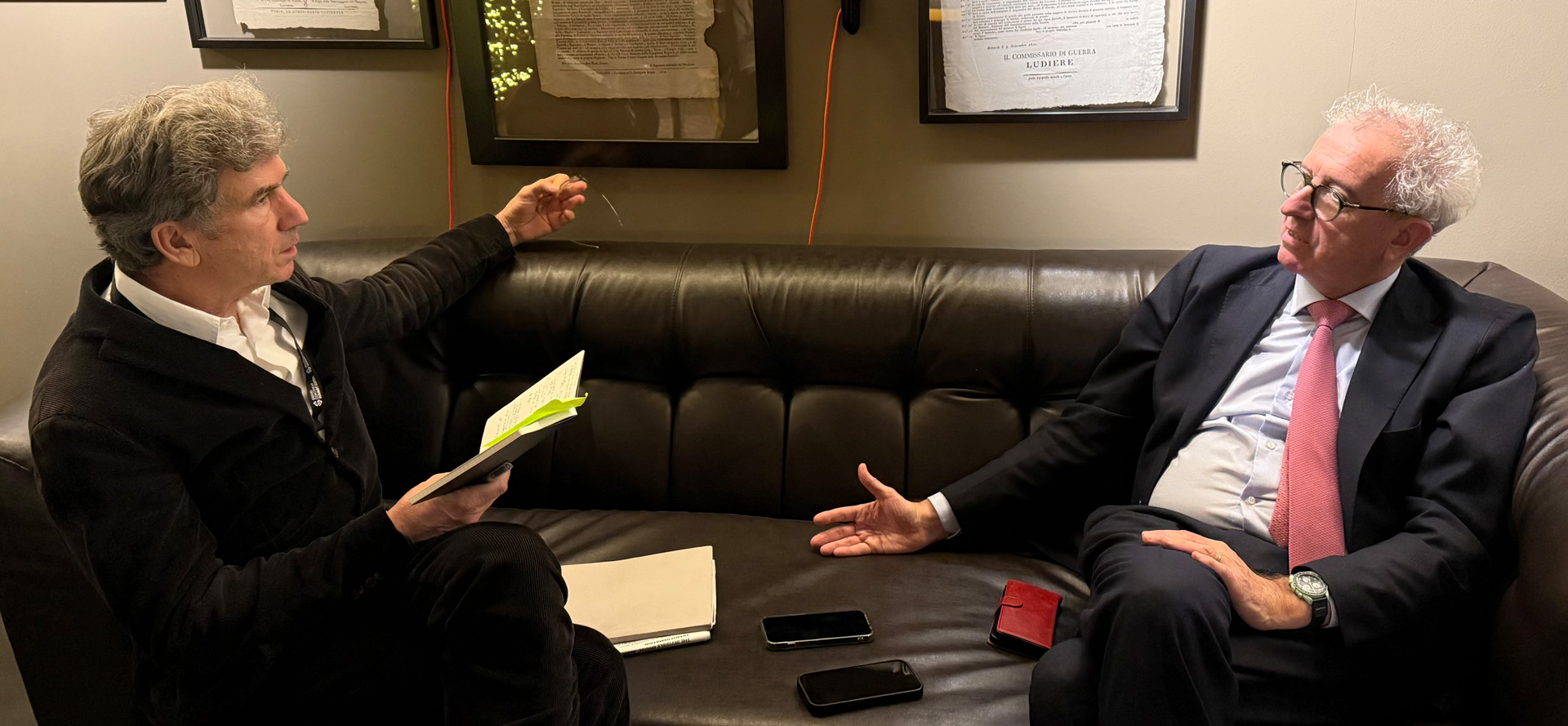
Interview with Pierre Gramegna, ESM Managing Director
Published in Les Echos (France)
10 December 2025
Interviewer: Pierre de Gasquet
Original language: French
Les Echos: How can the ESM contribute to supporting the financing of the European defence architecture, which is becoming an urgent priority?
Pierre Gramegna: In response to the COVID pandemic crisis, which affected all Member States, the Eurogroup decided in April 2020 to use the SURE programme for unemployment insurance and European Investment Bank guarantees focused on SMEs. An €800 billion recovery plan was approved later. But the Eurogroup had also approved a pandemic crisis support tool set up by the ESM, which has not been used.
Under the Treaty, it was considered that the pandemic created risks of economic and budgetary imbalance due to an external factor. This analysis could be used today, by analogy, for defence spending, which is increasing dramatically and risks putting pressure on member countries' budgets.
There is an external cause, which is the requirement to increase NATO contributions, but also the existence of a war in Ukraine, on our doorstep. These are objective and external triggers.
Does this not amount to an extension of the ESM's mandate?
No, there is no need to extend the mandate. It is like the pandemic. The factor that justifies the ESM's intervention and requires unanimity among countries is the risk of financial destabilisation of a country or the eurozone. That is the trigger criterion. It is not the crisis itself.
Defence is an external factor that causes instability. We have a range of seven instruments at our disposal. We are prepared to use them to finance defence efforts. If we have the consensus of the member countries to use one or other of these instruments, we are within our remit.
Do you think that the risk of a systemic crisis has never been higher since 2008, despite the optimism of the stock markets?
There are several risk factors ahead of us. Historically, stock market prices are very high, with some reaching record highs. That is a fact. Whenever we have seen this kind of phenomenon in the past, there have been readjustments.
There is enormous enthusiasm for artificial intelligence, and this sector is contributing significantly to the surge in prices. That is also a fact. We saw similar behaviour around the year 2000 with information technology. I am not saying that there is a risk of a ‘bubble’, and I do not believe that there is.
Today, geopolitics is the biggest risk factor. The clearest example of this was when the US administration announced an across-the-board tariff policy. Geopolitical changes have enormous implications for the economy, even if the tariffs were ultimately lower than expected.
For the time being, this has not had a direct impact on growth, contrary to what was anticipated. Europe is maintaining a projected growth rate of above 1% for 2025. We believe that there could be a delayed effect of higher tariffs on our exports and therefore on growth. It is too early to say that what we predicted six months ago has not happened.
The other major risk is, of course, the war in Ukraine. The ongoing conflict is creating enormous financial needs, combined with the commitment by European countries in NATO to spend up to 5% of their GDP on defence.
Could the fragility of the credit market and the private debt market also be a source of concern?
In Europe, we have learned the lessons of the last crisis. We have largely established the banking union. Our banks are very well capitalised, much more so than fifteen years ago. They have much more liquidity. The banking sector in Europe is solid. This is one of the positive and reassuring points. We have the highest savings rate in the world.
What is lacking in Europe is that there is not enough entrepreneurship, innovation and projects financed in Europe, so that part of these savings finance investments abroad, particularly in the United States.
How do you view the systemic risks associated with the rise of stablecoins? Some see this as an attack by the Trump administration on Europeans. Do you share this view?
We cannot take the rise of stablecoins lightly, 99% of which is happening in the United States. Unlike bitcoin and crypto-assets, stablecoins are not currencies for speculative purposes. Ninety-nine per cent of them are issued in and backed by US dollars, backed by the guarantees behind them.
It is an innovation that makes it easy to pay anywhere in the world. This leads some to say that we will see more dollars circulating around the world, leading to increased dollarisation of the global economy and payments.
At the ESM, we cannot deny their existence. We will have to deal with them. There are even a few tentative initiatives by certain banks in Europe that want to issue stablecoins in euros. Perhaps we could draw inspiration from this in some way.
We need to see whether our European regulations would protect us sufficiently if there were public mistrust that could weaken the financial system. Stablecoins are issued by private companies, not central banks. This also poses problems for the transmission of monetary policy. We must not be obtuse, narrow-minded and closed to innovation, but we must keep the risks in mind.
The European Central Bank (ECB) has chosen a different path. It has decided to create a digital euro that will perform the functions of a stablecoin. But this is a different approach because it is issued and guaranteed by the ECB. It is a very different approach from that of our American partners, who have prohibited the Fed, the US central bank, from creating a digital dollar.
Could the risk of confiscation of Russian assets frozen in Brussels pose a threat to the stability of the European bond market?
If this seizure goes ahead, there is a high risk of Russian retaliation against European assets in Russia. That is obvious. Furthermore, the ECB pointed out a few days ago that if it would be providing liquidity, it would violate the Treaty. These legal arguments are difficult to dismiss.
There are several options on the table. And this is an issue that is still fluctuatingmoving. A loan on the markets taken out by the states themselves would be legally flawless. But the problem is that this would add to each country's debt, which is what we are trying to avoid by using these Russian central bank assets as collateralguarantee.
Should foreign investors be wary of buying bonds given the risk of them being seized?
That is the question: it is what the ECB is highlighting. There are legal and practical consequences that are difficult to measure and anticipate.
Contact