

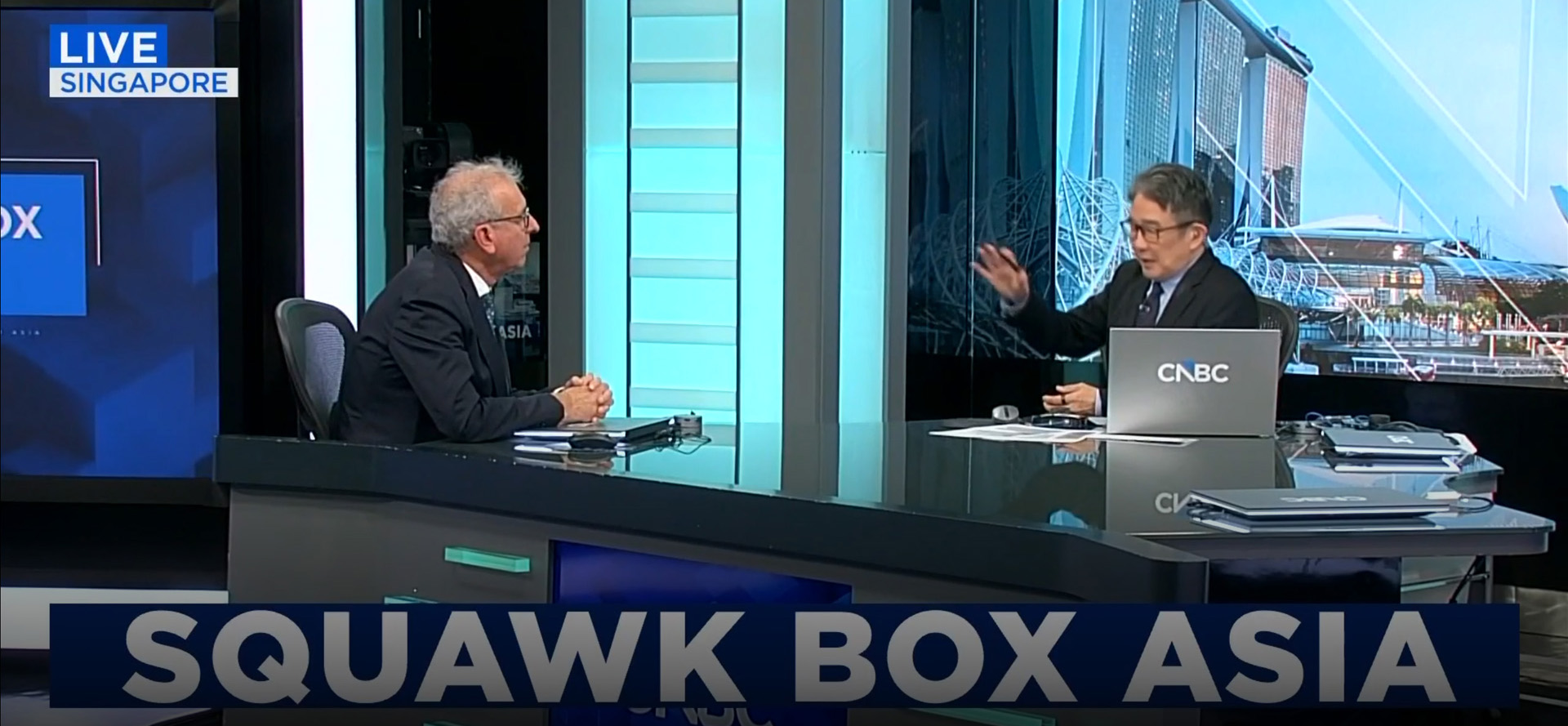
Transcript of interview with Pierre Gramegna, ESM Managing Director
Broadcast by CNBC Squawk Box Asia
16 December 2025
Interviewers: Martin Soong and Chery Kang
CNBC: Pierre, good morning. It's always a pleasure having you on the show. You travel to this part of the world fairly regularly. What brings you to town this time around?
Pierre Gramegna: What brings me to town is first and foremost that we are the lender of last resort of the euro area, and we have our partner here, which is AMRO, the lender of last resort of ASEAN+3, with whom we do meet regularly. On the same occasion, we are going to see potential investors and existing investors here in Singapore. I have to underline that Asian investors represent, depending on the year, close to 25% of buyers of our bonds. It's very important to be here. It shows, in a way, the solidarity that we have around the world in ensuring financial stability.
So, Asia accounts for a quarter of the buyer base for your bonds? What's demand been like? How has it been picking up? Because one of the things we've been following for months now is driven by a lot of concerns, not least, of course, Russia and Ukraine. In Europe, the fiscal spigots are finally being turned on.
I think if you look at the situation in Europe, it's really better than anticipated. When high tariffs were announced in the United States, the expectation was that this would hit Europe particularly hard because we are an export-import powerhouse, as is Singapore. By the way, every time I come here, I'm amazed to see this buzzing airport. You are one of the most open countries for investment and trade in the world. And so are we in Europe. We're very similar in terms of how we see the world pushed by international trade and openness. So that's why it's so important to be here.
On European growth, it has been performing better than expected. It will be probably around 1.4% - 1.5% this year and above 1% next year. When you put this together with the geopolitical turmoil that we're living in all around the world also in Europe itself, I think it's a good result.
So demand for your bonds is growing, is what you're saying?
Demand for bonds is good. We have issued bonds, up to €300 billion, to assist countries in the last decade, and we're refinancing those bonds every year, between €25 to €30 billion.
I have to ask you, just before we came to you, we were talking about a lot of the troubles that car makers in Europe are facing in, obviously, the challenge is from Chinese carmakers. How do you assess the situation? How much trouble are they in?
We’ve just heard in the last days that Europe is going to update or slightly change the goal of terminating cars having to be CO₂-free by 2035 because demand hasn't picked up. It shows that now you can be in favour or against it because you're more climate friendly or not. But what you have to face in the end is that it’s the consumer that decides. I think the bet that was made that by having attractive electric cars with some subsidies, the consumer would switch more quickly. This doesn't seem to be the case. I think economically speaking, there's no other way than having a little bit more flexibility. I think you can see also that European carmakers are having a different look at many things. For example, the company Volkswagen is now building and doing the research for new cars entirely outside Germany. So, the company is becoming even more international.
What you're saying is for European consumers then, as well as for consumers anywhere around the world, affordability and price is the main issue?
I think it's the same for all consumers in the world. Yes, I don't think Europeans are particular in that. It is also fair to say that you need to have charging stations all over the place before consumers are ready to go 100% for electric cars.
Pierre, you've been rooting for a stronger euro, and it might be happening already. It could actually accelerate in that direction in the New Year as well with the Fed likely to cut. That's really one of the biggest market questions of the year. While the ECB is feeling very comfortable with the growth trajectory and so on, do you think that this is somewhat a part of this trend of ‘sell America’, that it's really the debasement trade of the US dollar at the moment?
There are many questions embedded in your intervention. I will not comment on the rate of the euro because this is not appropriate to do so. But factually speaking, you're right, the euro is quite strong for, I think, two reasons. One is because it is the wish of the United States to have a lower currency. If you declare officially that you want a lower currency, then, by definition, other currencies are going to be higher. I think the second reason why the euro is very appreciated is because we have our budget situation in most European countries in order.
What do I mean by that? We have a new Stability and Growth Pact, which is a little bit more flexible, but at the same time, very stringent. If you look at debt-to-GDP as an average for European countries, it's 89%. Now, compare that with the debt-to-GDP of the United States, which is much higher, or the debt-to-GDP of Japan or even China . Basically, I think for investors, Europe is a safe bet. As we have stringent rules because we have a common currency and we, for example, are the lender of last resort of the euro area, well, this pushes towards a lot of confidence.
And you've got the fiscal stimulus element going on, especially led by countries like Germany. Savings, employment is looking pretty decent across the Eurozone. How about one of the last few pieces of the puzzle, which is improving productivity in the euro area. What are some of the conversations that are happening around productivity in the region?
Yes, you're completely right. It would not be balanced to say that everything is perfect in Europe. Our productivity is growing half as fast as that of the United States in the last 10 years, so we have to improve that. One way is obviously by having productive investments like announced by Germany and many other countries, but these investments need to be in productive areas, and we do need to do our homework, and this is the Savings and Investments Union. In Europe, we have a lot of savings, and a large part of these savings are not channelled and do not go towards investment in Europe, but more to the United States or other parts of the world.
We need to make sure that our capital market becomes deeper with less obstacles, and that the internal market of the European Union, which was the flagship project and success of the '90s, is revamped and up to speed with the new economy. We have to do our homework and then productivity will spike up. I attend the Eurogroup meetings every month in Brussels or Luxembourg, and I can tell you that we realize that we are overburdened with regulation. So simplification is also a point, but also in some areas we need to deregulate if we want to be competitive and attract also more investment into Europe.
I would say one of the biggest policy shocks of 2025 really around the world was Trump's tariffs. It laid bare the trade issues and perhaps the imbalance that the European region has got with China. Of course, the two parties are trying to work that out. What are you seeing in terms of financial stability for the areas of the economy that are geared closely towards China? What are some of the re-jiggings that you're seeing on the ground?
What we're seeing and what we know is that China is a very important trading partner for Europe, in fact, in terms of import into Europe, the biggest one, and also for us, a very important market for exports. At a time when the American administration has put into place higher tariffs, I think China and Europe can come closer together. I think this is the challenge of the years to come.
Will the trade relation improve? There are indications in both directions because trade relations are never easy with large partners. On the positive side, I would mention that both China and Europe say they would like to stick to the rules of the World Trade Organization. That means to stay in a legal framework that is agreed. I think that bodes well for the future.
But there are some areas, and cars being one, where there are tensions, obviously because there are also tensions in that part of the economy, and that needs to be sorted out. I think it's a blurred, mixed picture. I know that the European Union, European Commission, who is exclusively in charge of trade relations with all the countries around the world, including China, is monitoring this very closely. I think it's too close to call if we're going into a relationship that will improve or deteriorate. That's how I see it from my station.
I want to get to crypto. You would agree that Europe does not want to be marginalised in the cryptocurrency world. Stablecoins, talk to us about that, because stablecoins are dominated by the US, 99 %. Europe has yet to launch one, yet you have grave concerns about stablecoins. And you've been quoted saying that, ‘Look, it poses risk to financial stability’. What's the way around that?
Stablecoins are a new development, but they're there to be dealt with because the United States has now enacted the GENIUS act, and so they will be around. Europe has chosen another route because the European Central Bank wants to issue a digital euro, which is a different approach with, to some extent, a similar objective. What is the objective? To make payments easier and cheaper and faster. The digital euro can deliver that. The big difference is that stablecoins are issued by private companies and the digital euro will be issued and guaranteed by the ECB. A different approach, but a similar scope. We have a regulation in Europe called MiCA (Markets in Crypto-Assets Regulation). We need to make sure that these stablecoins are as stable as the acronym says, that remains to be seen.
There are also initiatives in Europe by certain banks to issue stablecoins denominated in euro because there's competition upcoming in this area, and we are observing this very closely. Now, what will happen also with dollar-denominated stablecoins in those countries that have weak currencies themselves or currencies that are not seen as very credible in international trade will be tempted to use these stablecoins tomorrow, eventually also in euros.
So, we as Europeans should take that seriously, look at it, and if our regulation is fit for purpose with this newcomer, because stablecoins are a newcomer, then we need to adjust it. But we also need to be open to innovation. There are some who say: ‘We should get rid of that. We should say no to the stablecoins’. No. When something is a reality, you have to deal with it.
Contact