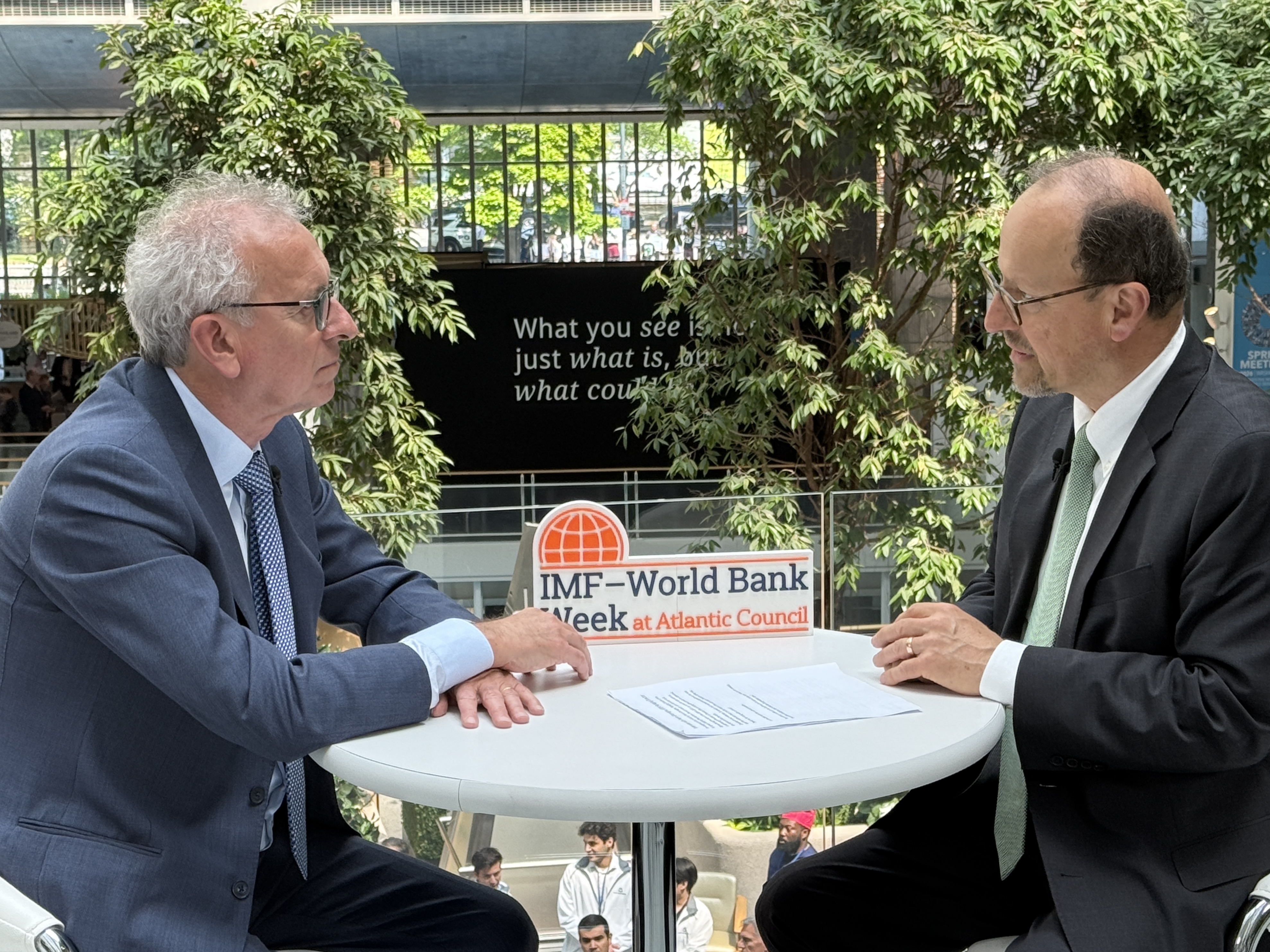
Transcript of interview with Pierre Gramegna, ESM Managing Director
Published on 16 April 2026 (conducted on 15 April)
Interviewer: Martin Mühleisen
Martin Mühleisen: Let us start maybe with the current situation. The military conflict in the Gulf has hit Europe pretty hard, like other parts of the world. How do you assess the current situation and what are the greatest risks?
Pierre Gramegna: It is obvious that since a couple of years geopolitical risks have taken centre stage, and the latest conflict in Iran and in Lebanon is just one more example. And it's not easy to get used to such situations. Now, Europe has been hit, this is correct, but how to assess the impact on Europe and the rest of the world is complicated because we have a big unknown. And that's the duration of this conflict. And as Gabriel [García] Márquez said famously in One Hundred Years of Solitude, he said, “it's easier to start a war than to end it.” And when you think a little bit about it, to start a war is probably a unilateral decision. Now, stopping a war is a bilateral or a multilateral decision. So, I think one has to keep this in mind, and whatever I'm going to say about the consequences has to be seen through that lens.
If I look at the situation of how Europe has been hit, and then I'll come to numbers, I would say the following: obviously, a region like Europe, which is an importer of energy, is hit more if you have a shortage of oil or gas. This being said, we have reduced our dependence on oil and gas significantly. Still, Europe imports close to 60% of its energy. And out of the 60%, oil and gas is 90%. So obviously the impact is much higher than a country that, like the United States, which is exporting oil and gas. But we have done better.
We have also a better organisation of our markets compared to 2022, which was another energy crisis. We also have, I would say, a better resilience, also because our fiscal positions have recovered since the Covid crisis and the war in Ukraine. And we have learned quite a few lessons from that period. So, let's not forget that. On the other hand, if you look at the International Monetary Fund (IMF)projections and the ones of the European Central Bank (ECB) and the calculations that we do, it is obvious that you can have three situations. One is the scenario of reference that the IMF has just presented, which already reduces growth for Europe by 0.2% because of this conflict. But I would like to focus more on inflation. So, inflation will be for sure 0.5% higher than anticipated. So, we will not have reached the goal that we've had now for 1 or 2 years of having target inflation of 2%. That is the target of the ECB. So, we'll be 0.5% above.
This is obviously not dramatic, but that's the reference scenario. Now, if we go to a kind of medium scenario, adverse scenario, then the inflation increase would be, in 2026, 1.5%. That is already very important. And if we go in an even more dramatic scenario with the Strait of Hormuz being closed for a long time, and you will have to deal with uncertainties for a long time, inflation would go up 2% to 2.5%. Obviously, that would trigger decisions of the ECB in terms of interest rates. And that will have a huge impact on growth. That's why I think it's more important to focus now on inflation than anything else.
Europe is in a better position than a couple of years ago. Also, if you look at growth last year in Europe was 1.5% despite the tariff disputes and all these uncertainties. Our stock exchange did better than the American one last year. We were getting in a very- in a good spot, in a sweet spot, if you speak tennis language. I'm a tennis player. We had this situation.
Rounding off what I just said, it's obvious that the duration of the war needs to be looked at. if I look at what's happening on the battlefield, there's contradictory messages. Discussions are going on and you have a ceasefire that's more or less complied with on the one hand, but then the closing of the Strait of Hormuz by the United States themselves is adding a huge amount of uncertainty, and contradicting international law, which the other side had already done. So, it's kind of a retaliation. But this resembles more an escalation than anything else. One needs to be really cautious how to read all this. And I wouldn't sign on any scenario because uncertainty is too high.
Right. No, I agree with that. And I think that was the gist of the IMF forecast as well yesterday. Right.
But staying with the tennis analogy, let me kind of put the ball back in your field on the fiscal issues. You mentioned that things have improved, but, even if the crisis recedes, Europe is facing large public spending needs, whether from an aging population or from higher military spending, transition to renewables... And we have some countries that have seen quite a big increase in debt over the past decade. So, are you in any way concerned about fiscal trends or even debt sustainability within the euro area?
So let me start, and that might surprise you, by telling you that the average of debt in the euro area is 90%, while the goal should be 60%. But it's rather stable despite all the crisis that we've had. I've mentioned Covid, war in Ukraine, and now Iran, and all these energy shocks. It's not a bad stabilisation, although it's not where we should be. But compare with the deficit. The debt accumulation of the United States, and the same in China. I mean, the budget deficit of the United States is twice our limit of 3%. The deficit of China is also twice, 2.5 times higher. So, the major counterparts of Europe, the two largest blocks of economies, United States, China, and Europe, we are the ones who are paying most attention to our budget. For one important reason is because we have a Stability and Growth Pact and we have rules. Now, the other countries, the only limits they have are when the markets punish them. For the rest, a government wants to spend 10% more, wants to have a deficit of 8 or 10%, they just do it. And so, in that sense, the discipline we have is our first protection.
Now, you were saying some countries haven't stabilised their debt. That is true. I'll come back to it. But others have done immense progress. In fact, Greece, Spain, Portugal, Ireland, Cyprus, all the countries-
As a former IMF staff, I'm very happy to hear that.
Yes. Well, this is a success story for the IMF and it's a success story for the European Stability Mechanism (ESM), because these five countries had to do reforms to get the support of the IMF and from the ESM, in particular - the IMF helped us to devise the restructuring programmes. So, what does it tell us? It shows us that when you do reforms, you will reap the benefits. It takes time, but it is worthwhile.
These economies I just mentioned are growing faster than the average of the EU, it is the large countries that are more now facing problems. Germany has had no growth in the last three, four years. France has had little growth. Italy was more up and down. And those three countries are obviously the strong engine of the European economy. Now, Germany has no financial issues or structural budget issues. That's obvious. They're the best in class. In fact, the Bund is the reference for all bonds in the world. But France has not been able to really reduce consistently its annual deficit and is not really complying with the expenditure part on the one hand. Italy has done well on the deficit. Italy is close to the 3%. That's good news. But it's not able to reduce its global debt, which continues to grow. It's a mixed bag, but still I wouldn't call it dramatic at this juncture. It's obvious that because of this geopolitical situation, one has a different view on all of this.
And then you are asking me all the expenditures that are coming our way, and you are completely right. I would highlight two. One is obviously defence. And the other one is everything that is linked, I would say, with energy shocks and all other risks around. Now, let's stay a moment with defence. Defence expenditures and investments are also going to be an element of growth. That's not only a cost. As long as we nurture, buying European goods and European equipment, in as far as we have it. And obviously that's also a limit because we are too much dependent on the United States. And that's because of our own fault, because we haven't developed that and also because we lack unity in procurement and so on. There's a big uptake there if Europe would do more things together. And I really call for it also at the ESM to avoid that we have inefficient spending in terms of procurement and use of public money.
On energy and the measures that eventually have to be taken and will be taken by countries for this additional new energy shock, I think we need to learn from the past. We have to learn from the '70s where the wrong answers, political answers, triggered what you could call stagflation for a long period on the one hand. And in the recent energy crisis at the times of the start of the aggression of Russia on Ukraine, we took lots of measures that were extremely costly, costly on the one hand, and that were not limited in time. They were just announced and then to roll them off is politically always difficult. The recommendation that the EU Commission makes and that we support is that we need to have targeted and temporary measures. And you should announce the timeframe from the outset. It's more of the type of decision, to have decisions with the sunset clause than the other way round. We need to learn from that.
We try in the Eurogroup. As the Managing Director of the ESM, I attend all these Eurogroup [meetings] as an observer and I intervene there. And one of the lessons that we should learn from the last crises is we should coordinate more and help each other. But if, in fact, one member said that last month, he said “wait a minute, I've been resisting for calls to reduce VAT, for example, on excise taxes on energy. And I explain why this would not be smart, why this is a bad decision. But then if my neighbouring country or someone else does it, then how can I go back to my citizens and say I'm not doing it?.” This is very difficult because we are in the national realm. It's normal that it is national decisions. It is not a common policy. And nevertheless, the absence of this common policy makes it that it is very difficult to coordinate and encourage.
In the recent days, you have seen in many countries some decisions announced that are reducing the price of oil, mostly oil or gas. And obviously this is in contradiction with our policy that we should concentrate on renewable energies.
And we've been doing that. We have improved our situation. We have more renewable energy now in Europe. But if you disincentivise the fact to invest more in renewable energy as soon as there's a hike of price in oil, well, you're just delaying the process on the one hand, and you're using up money for the wrong energy policy. These incoherences that we see in many countries is obviously something which is difficult to tackle, but we're getting there.
I mean, overall, what you're saying is that Europe is in a relatively acceptable fiscal position. And we talked about individual countries but now let's maybe go to one of those more adverse scenarios, maybe even a longer-lasting shock. The ESM was created at the height of a crisis and, you know, you have considerable financial firepower. If Europe were being hit by really a long-lasting shock, what do you think, what could the ESM do and provide in order to help kind of some especially affected countries? What kind of tools do you envisage?
First, I have to say that the ESM, which was created in the midst of a crisis and was immediately used while the crisis was developing, we look back now on these years and say “well, it's good that we have the ESM and it's the lender of last resort”. What we've seen in the last crises very often is that Europe finds solutions. I think of the Next Generation EU programme, for example, or the SURE programme for unemployment. So, that was all in the Covid time where also the ESM (ESM) had suggested a pandemic crisis support mechanism, which was never used because it was less favourable than other measures. So, this is a very political decision. How long do you delay, coming to the time when you have only the ESM available as a solution. So, point number one. Point number two, with all the crises that we've been facing, I think we have made the Stability and Growth Pact smarter by allowing more investment, allowing more attention to productivity, competitiveness, and so on. So, that's the first buffer that you have, and we've seen with the escape clauses being used and so on and so on that Europe has some flexibility which is built in, which is good.
Now, what can the ESM do?
We come after that. When you ask me how the ESM can help, I would say first and foremost because we have not used these tools in the past crises because there the crises had already hit the countries. We anticipate that we could play a bigger role in anticipating the crisis and using our prevention tools. It's a kind of credit lines, we call it precautionary loans, which we have available. We have a lending capacity or firepower €430 billion, and, sometimes, just the announcement that you could benefit from it would calm the markets. Now, to benefit from the precautionary loans, you need to have a sound fiscal policy, which is the case of most countries, but not all of them. This precautionary aspect, I think, is the one where we see the likelihood that it could be used if the crisis gets worse.
The ESM, as you mentioned, has almost €500 billion in lending capacity. And maybe the crisis doesn't hit that bad, but we already talked about a lot of common spending needs. You mentioned defence, for example. Is there any way that the ESM could be also used or be helpful in kind of financing some of these expenditures? Especially if you think of a euro-wide effort? I think you mentioned some of that in a recent speech, that there might be such a possibility.
I need to explain this a little bit better. First of all, we are not a multilateral development bank. We cannot do what, for example, European Investment Bank now does by financing dual products, dual equipment, which is for civil use and military use. So, we are there, we intervene when there's risks of financial instability. In the white paper on defence, the European Commission mentions that if the SAFE programme of €150 billion would not be sufficient, eventually one could turn towards the ESM, but it would not be to do procurement, it would not be to finance projects. That's the difference.
Eventually we could strengthen the financial situation of a country with a precautionary loan, which would allow the country to finance more defence. It's kind of an indirect way. And more generally, I think that we, many of us, including people who have lived the crises of last decade, the financial crisis, tend to see the ESM as an institution that intervenes in case of financial crisis. But one should look at all the things that can trigger a financial crisis. So, defence expenditures could eventually, if they are very high, trigger budget strains that could require the ESM to intervene.
That's how I describe it. And we have a list of tools, precautionary or just support measures, as we did with the five countries that we supported in last decade. But I think we lack an emergency tool. I'm recommending to the member states to have an emergency tool ready-made. For any type of crisis, so when it is needed, you can use it fast. The IMF has such emergency lending.
Rapid financing
Rapid financing tool, and we are working on it. And, well, I must say we've not been able to convince all the countries that we should have it. I suppose and I hope that in the months to come with this additional crisis, there will be readiness. In fact, there's no disadvantage of having a tool like that. It's not because you have a tool that you have to use. That's one of my tasks, and my teams, to convince countries to have it.
I can also see the connection with a specific purpose where you have an ESM credit line, as you say, as a backstop kind of, because it takes away a bit from the stigma of having to go to the ESM, right?
You are so right. And we're working in parallel with something which we are doing with the member states to allow collective requests. Because in the treaty it's foreseen that it's country by country. But we have learned from the experience that the Commission had with the SAFE programme that they bundled the requests, so the stigma goes away. So, this is something where I think we will make progress, that it will be possible in the future, which might also then encourage countries to revert to us.
Right. Now, speaking of backstop. The ESM is a treaty-driven organisation, right? It's not like one of the statutory European agencies, so to speak. It's between members of the euro area. And that treaty has been revised a couple of years ago, and it includes, I believe, a backstop for bank resolution. And my question is: what concrete changes do you expect for the role of the ESM if and once the treaty is finally ratified?
This treaty has been ratified by all countries but one, Italy. And this has been long pending. The main feature of this amended treaty is one. I would just stick to that one. And that's the backstop to the Single Resolution Fund of banks. We have earmarked €68 billion of our lending capacity to be the backstop, the additional safety net to the Single Resolution Fund that has roughly €80 billion, which are paid in by the banks.
Not having this backstop obviously is not good for the banks. It's not good for financial stability. Fortunately, the situation of banks is much better than it was in the financial crisis. Huge profits, huge liquidity. It's not really on the radar. There's so many other things that we need to have on the radar. The focus has been a little bit forgotten. Point number one. Point number two, I think it is important to say that, this amended treaty has not been ratified, all the rest of the treaty is functioning.
Sometimes I hear people telling me, especially in Italy “it's such a pity that Italy is blocking the ESM to be used.” And I say, “wait a minute, what do you mean?”,” Well, because we did not ratify.” People think it is the whole treaty. Italy has ratified, is a member, it is the third largest country. There's one specific important measure that cannot be implemented. And that's a pity.
Despite that little hiccup, I think the European safety net as a whole looks pretty robust with the ECB tools, with the ESM. Maybe if you want to leave our US viewers especially, who are not so familiar with the ESM, with a final thought. How much trust, how reassured are you about the quality and the quantity of the European safety net if we experience another shock like the one we're currently having?
I like your question because it allows me to explain that we have different layers of protection. The first one is that we have a smarter Stability and Growth Pact. We have a budgetary discipline that no other part of the world has. That's an inbuilt thing.
Right. So the United States states have the kind of balanced budget rules. It's not quite the same in Europe, but you do have a rule like the SGP that limits deficits for member countries.
Yes, for all the member countries. Normally, they cannot have a deficit per year above 3%. Many countries are converging to it now, and hopefully soon all will comply with it. So, we have like an in-built disciplinary budget policy for all countries. It's not negligible. The second layer, I would say is monetary policy. That's the ECB. The monetary policy is obviously in the hand of the central bank. And then the central bank has some specific instruments that are foreseen, which is the Outright Monetary Tool and the [Transmission Protection Instrument] TPI, which are two instruments, which have a link to the debt sustainability.
To use these tools you need to do a debt sustainability analysis, and we are the ones who would do it because, obviously, it already means that if these monetary instruments need to be implemented, there should be also a follow-up because there's such problems in countries to do.
We have that cascade, if you want, our own discipline, the [European] Central Bank for Monetary Policy, some instruments of the ECB which are connected to debt sustainability. You have the firepower of the ESM. And I would like to add, we have a good checks and balances here, because what is important here is that if you want to benefit from the ESM support, you need to do - this is based on conditionality - restructure your economy. If you want to have the ECB to use these monetary instruments, again, it refers to having serious budget policies to improve the situation.
And last but not least, our central bank is totally independent. Now, this is something that is not the case worldwide, and we know that there's a debate in the United States on that, which is extremely worrisome. Now, we, in Europe, believe that the independence of the central bank is like a sacred cow, let's put it this way, and it has worked extremely well. And the result is there. The euro is a success story. We have now an approval rate of the euro of close to 80% all over Europe. Point number 1. We have now 21 countries in the euro, Bulgaria just joined. The elections in Hungary were also saying, "Oh, we are considering the euro." So, it is a slowly building effort that is becoming very pragmatic, credible, and strong.
The success story of the euro was not something that was so evident. In German, you would say, Selbstverständlichkeit, as a matter of fact. No, it was very complicated. Some were even doubting it would survive. The ESM was created to avoid that, like a domino effect, one or two or three countries could fall out of the euro area.
Now we take all that for granted that this is all put in place, it took years. Today, the euro represents more than 20% of reserves of central banks, [with a] tendency to climb. And we see more and more countries that are not euro-based, now issuing bonds, bonds in euro more than in the past, much more than in the past. So, I think the credibility of our currency is increasing, and I think this is a tribute to the whole institutional setup that we have just discussed.
Thank you, Pierre. It was great talking to you.
Thanks.
I appreciate it.
I really enjoyed our discussion. All the best, and it's a pleasure to be with the Atlantic Council. Thank you.
Contact