Frequently Asked Questions on ESM issuance using Pontes

1. Why did the ESM issue a digitally native bond?
The ESM issued its first-ever digitally native bond in a live test transaction to gain practical experience and to better understand the specific features of digital bond issuance and settlement.
As an issuer of European safe assets, the ESM has an interest in understanding how market infrastructure is evolving and in contributing practical experience to that evolution. Through this transaction, it also seeks to contribute practical experience to the development of future standards for primary-market settlement. An important objective is to preserve the role of central bank money as the safest, credit-risk-free means of settlement when using distributed ledger technology.
At the same time, the transaction requires meaningful investor engagement, and it is therefore important that innovation is pursued while preserving the legal certainty, ease of access, and the core characteristics capital market investors expect from ESM bonds.
As one of Europe's largest issuers, and through this first step on the Eurosystem’s Pontes, the ESM sees value in learning how financial market infrastructure is evolving and in exploring how new technologies could complement well-functioning European capital markets. While the future direction and pace of this evolution remain uncertain, gaining practical experience today will help us prepare for changes that may become increasingly relevant to market infrastructure over time.
2. What is new about this transaction?
The ESM is combining digital and traditional (“legacy”) infrastructures.
The novelty of the transaction lies in using a distributed ledger technology (DLT) through Clearstream’s D7 platform and the Eurosystem’s Pontes platform for primary settlement, while preserving the characteristics investors expect from a standard ESM bond.
It is the first transaction by a European supranational issuer (on the primary market) to be settled through the Eurosystem’s Pontes platform. Further, the use of D7 DLT required certain legal regulatory and operational adaptations. It also required a connection to the traditional market infrastructure, as the digital infrastructure and the traditional market infrastructure needed to operate together to support this transaction.
While there is a lot new about this transaction, certain elements stay the same: the bond retains the size, liquidity features and market access associated with ESM benchmark bonds and, following settlement, integrates into the traditional market infrastructure.
3. How does this affect investors?
For investors, this remains first and foremost an ESM benchmark bond, a debt instrument issued under the ESM’s existing Debt Issuance Programme, with the same ESM credit quality, same legal protections and economic terms.
The new element is the infrastructure used for issuance and initial settlement, including the use of the Eurosystem's Pontes initiative. The ESM has sought to make investor participation as straightforward as possible, allowing investors to gain experience with digital settlement without requiring significant changes to their usual investment and operational processes.
Following settlement, the bond integrates into the traditional market infrastructure, supporting the liquidity, accessibility and collateral usability expected from an ESM benchmark bond.
The bond is listed on the Luxembourg Stock Exchange. It is eligible as as collateral for Eurosystem’s operations.
4. Why do you settle at t+5 instead of settlement at t+0?
A fully interoperable digital market infrastructure may support faster and more efficient settlement, including potentially T+0 (on the day of pricing). Our choice to settle five days later (on a T+5 basis) was not driven by the technology, but by the objective of keeping the transaction as familiar as possible for investors.
The objective was to combine a traditional issuance process with innovative digital settlement, allowing investors to participate with minimal changes while still demonstrating the benefits of a digitally native security settled in central bank money.
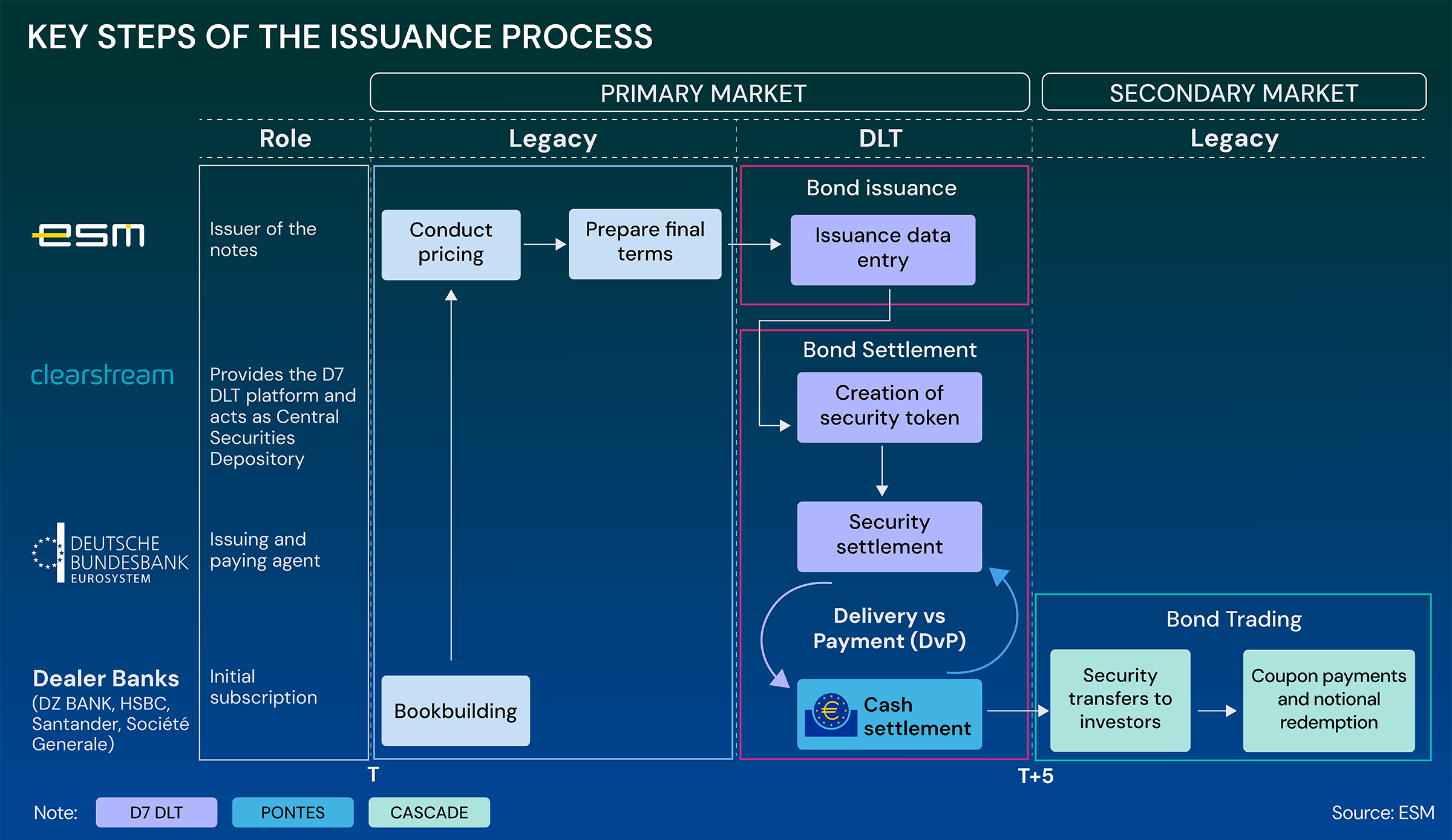
Download : ESM Issuance Process (PDF)
Learn more:
ESM is first European supranational issuer to settle DLT-based bond issuance on Eurosystem’s Pontes platform with Bundesbank and Clearstream | European Stability Mechanism
Digital Finance | European Stability Mechanism
ESM statement on the launch of ECB’s Pontes initiative | European Stability Mechanism
Contact