

Annual report 2025
The annual report includes descriptions of the ESM's activities, policies, and financial details for the year, along with a selection of topics relevant for the reporting year and a personal message from the Managing Director.
With a lending capacity of up to €500 billion, the ESM stands ready to support its Members. The ESM also works closely with its Members to ensure its toolkit remains fit for purpose.



Building public trust through transparency and integrity
“As a longtime lawyer at the ESM, the work done in 2025 on ethics, compliance, staff rights, governance, and organisational values resonates deeply with me. These matters are close to my heart, and I remain committed to advancing them as our institution evolves.”
Karolina Matuszewska-Pautsch
Corporate Governance and Internal Policies

Ten years of cooperation in the RFA-IMF network
“As the world order shifts and old certainties fade, cooperation among global and regional crisis fighters has become increasingly important. It is truly rewarding to help the ESM build trust and foster shared purpose across borders through open exchanges that offer perspectives beyond our own.”
Graciela Schiliuk and Dominika Miernik
Policy Strategy and Institutional Relations

ESM marks strategic leap in financial management
“Becoming a direct member of Eurex Clearing marks an important step for the ESM, made possible by colleagues across various teams working towards a common goal: reinforcing our operations and contributing to a stronger, more resilient Europe.”
Sara Alonso Martinez
Middle and Back Office
Macroeconomic and financial environment

Macroeconomic and financial environment
Global growth proved more resilient than expected in 2025, with real GDP growth at 3.4%, holding steady despite the impact of US tariffs and policy uncertainty. In the euro area, early export front-loading lifted momentum before tariffs slowed trade, allowing for modest domestic demand-led growth buoyed by a robust labour market. Euro area GDP growth accelerated to 1.4% from 0.9% the previous year. The first year of implementation of the revised EU fiscal framework delivered a marginally lower euro area deficit, even as public debt edged slightly higher on an aggregate level. The financial sector remained on steady footing, with banks well capitalised and profitable, even as vulnerabilities in the non‑bank financial sector warrant continued vigilance. The conflict in the Middle East and subsequent oil and gas supply disruptions have driven up energy prices and tightened financial conditions, igniting inflation pressures and introducing clear downside risks to growth.
2025 year in review
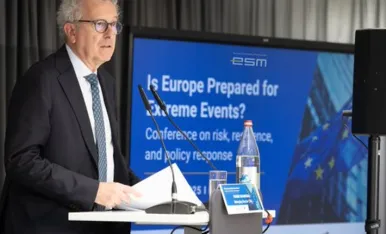

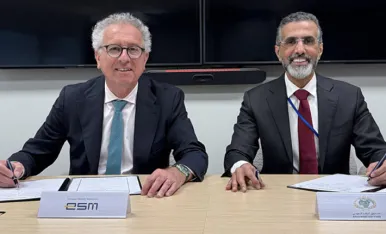
PHOTO: ESM Managing Director Pierre Gramegna (left) and H.E. Dr. Fahad M. Alturki, Director General Chairman of the Board of the Arab Monetary Fund (right) prepare to formally renew cooperation of their institutions.
24/04/2025
ESM and the Arab Monetary Fund renew their Memorandum of Understanding to strengthen existing cooperation.
Read more

PHOTO: ESM Managing Director Pierre Gramegna (left) and ESM Chief Financial Officer Kalin Anev Janse (right) give then-Crown Prince Guillaume of Luxembourg a tour of the ESM trading floor.
14/05/2025
Luxembourg's Crown Prince Guillaume visits ESM as he prepares to take on duties of Head of State.
Read more
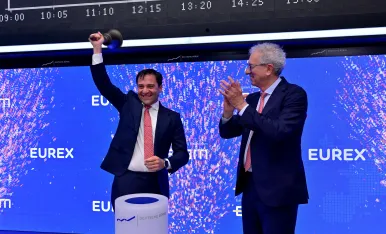
PHOTO: ESM Chief Financial Officer Kalin Anev Janse (left) and ESM Managing Director Pierre Gramegna (right) celebrate at the Deutsche Börse’s bell-ringing ceremony.
15/05/2025
ESM becomes first international financial institution to join Eurex Clearing for its interest rate swap transactions.
Read more


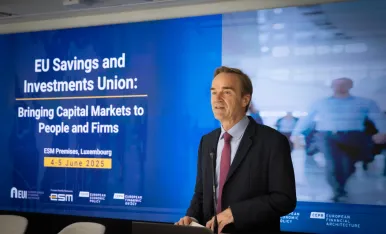
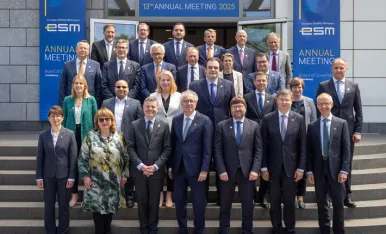
19/06/2025
At 13th Annual Meeting, ESM Board of Governors approves the 2024 Annual Report and follows up on previous year’s comprehensive review of adequacy of ESM’s lending capacity, capital stock, and financial assistance instruments. The Board of Governors also appoints Colette Drinan, Tine Debusschere, and Jorg Kristijan Petrovič as members of the ESM Board of Auditors.
Read more

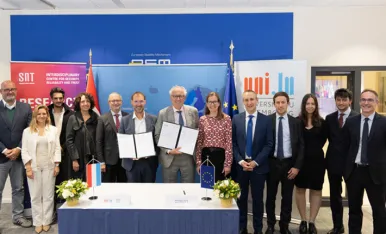

PHOTO: CNBC interviews ESM Managing Director Pierre Gramegna live from the annual Capital Markets Seminar.
01/10/2026
ESM co-hosts 7th annual Capital Markets Seminar with the European Commission and the EIB, focusing on the role of capital markets in financing European policies amid geoeconomic disruptions.
Read more
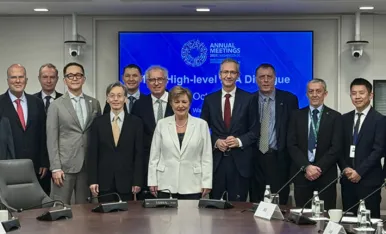
14/10/2025
ESM co-organises 10th High-level RFA Dialogue in Washington, DC to bolster cooperation among RFAs and with the IMF, recognising their roles as key pillars of the global financial safety net. The three organisers (ESM, AMRO, FLAR) sign extensions of respective bilateral Memorandums of Understanding, marking a decade of collaboration and reflecting continued dedication to global financial cooperation.
Read more

02/12/2025
ESM and EFSF Boards of Directors waive Greece’s proportional repayment obligations, paving the way for a €5.29 billion early repayment to Greek Loan Facility; ESM Board of Directors also approves the use of funds from a dedicated cash buffer account created at the end of the adjustment programme to carry out this prepayment.
Read more
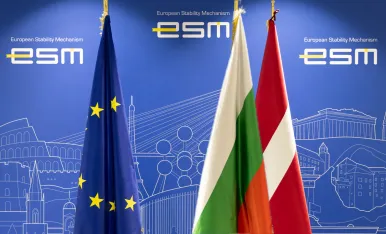
11/12/2025
ESM Board of Governors approves Bulgaria’s ESM membership application and ESM Treaty adaptations following the end of Latvia’s temporary correction.
ESM Board of Governors appoints Kyriakos Pierrakakis as its Chairperson for the duration of his term as President of the Eurogroup, starting on 12 December.
Read more on Bulgaria

31/12/2025
After completing the design phase earlier in the year, work on the ESM’s new building moves to the preparation of construction tenders and related permits.
Ireland (EFSF)

Irish GDP expanded at an exceptional rate in 2025, partly driven by multinational pharmaceutical firms front-loading exports ahead of tariff changes and by robust domestic demand. The general government recorded a budget surplus, thanks to windfall revenues from corporation income tax. Irish banks maintained their sound financial position throughout the year, supported by stable profitability and robust capitalisation. It remains pivotal to implement the reforms necessary to face long-term challenges, such as climate change, ageing, and threats from geoeconomic fragmentation.
08/12/2013
Programme exit date
20.8 years
Final weighted average maturity
€17.7 billion
Total amount disbursed
€17.7 billion
Outstanding loan amount
Greece (EFSF and ESM)

In 2025, the Greek economy remained robust amid global uncertainties. Growth exceeded the euro area average, public debt fell further, and unemployment dropped to the lowest level since the global financial crisis. Greece’s sovereign spreads declined further. However, inflation hovered around 3%, and external deficits remained large despite a significant improvement. Advancing reforms to boost productivity, innovation, and climate resilience is essential to Greece’s future prosperity in the face of structural challenges such as climate change and demographic pressures.
30/06/2015 (EFSF) 20/08/2018 (ESM)
Programme exit date
42.3 years (EFSF) 32.4 years (ESM)
Final weighted average maturity
€203.8 billion (EFSF and ESM)
Total amount disbursed
€185.1 billion
Outstanding loan amount
Spain (ESM)

The Spanish economy enjoyed solid momentum in 2025, propelled by brisk domestic demand and a strong labour market. Healthy nominal growth and fiscal consolidation efforts bolstered public finances. Sovereign market conditions remained favourable, with spreads steadily tightening. Bank profitability exceeded the EU average, and capital and liquidity buffers stayed at comfortable levels. Structural challenges, including productivity growth, climate change, and demographic pressures, pose risks to medium-term debt sustainability. Ongoing reform efforts are essential to stimulate long-term growth and fiscal resilience.
31/12/2013
Programme exit date
12.5 years
Final weighted average maturity
€41.3 billion
Total amount disbursed
€7.3 billion
Outstanding loan amount
Cyprus (ESM)

Cyprus stayed on a robust growth path in 2025. While higher public spending reduced the primary surplus, public debt continued its substantial downward trajectory. The banking sector extended its strong performance into 2025, maintaining high profitability. Still, reducing legacy non-performing loans remains a challenge. The economy would benefit from fresh reform momentum including in the green and digital transition to sustain growth. Medium-term challenges include navigating geopolitical developments, ageing, addressing climate change, and strengthening the energy mix, as well as enhancing water supply resilience.
31/03/2016
Programme exit date
14.9 years
Final weighted average maturity
€6.3 billion
Total amount disbursed
€6 billion
Outstanding loan amount
Portugal (EFSF)

The Portuguese economy grew steadily in 2025, underpinned by strong private consumption. Public debt fell below 90% of GDP, supported by sustained fiscal surpluses. Sovereign market conditions remained favourable. Portuguese banks registered record profitability and kept good quality loan books. Steady productivity improvements and the pursuit of further reforms are essential in view of ageing-related demographic pressures. Accelerating the digital and green transition through the effective use of financial support from Next Generation EU and targeted housing policies remain critical. Medium-term challenges include confronting the costs of an ageing population, mobilising investment, and progressing with structural reforms.
18/05/2014
Programme exit date
20.8 years
Final weighted average maturity
€26 billion
Total amount disbursed
€22.6 billion
Outstanding loan amount